Dud battery or ‘leak’?

paradave

Well-Known Member
Joined
12 Dec 2019
Messages
468
Visit site
This is probably a difficult question to answer categorically but I’d appreciate any thoughts.
Our small boat’s battery has been too flat to start the engine a few times lately (after 2-3 weeks inactivity, no shore power) and I’m wondering if the battery is just knackered or whether there’s some kind of drain going on.
The boat’s kept in a dry stack and the battery is isolated when not in use. Voltage across the battery is 12.2v today with no use over the last couple of weeks.

I’m inclined to just buy a new battery but before I do, is there anything else I can realistically check? I did have a look today to see if I could get a multimeter across the isolator but the way it’s installed meant this wasn’t possible easily.
 
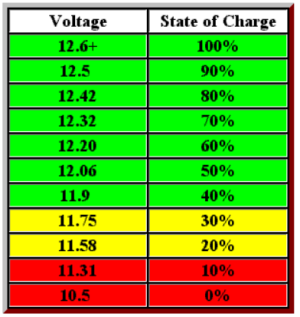
If the battery was fully charged 12.7+ volts and after 2-3 weeks it drops to 12.2 then prob the battery is knackered and not holding charge, it should not have dropped more than 0.1 volt if good. 12.2 shows a state of charge of ~60% far too much drop for 2-3 weeks. You said "The boat’s kept in a dry stack and the battery is isolated when not in use." so there sould not be any drain. Final check would be to fully charge, disconnect battery terminal then check voltage after 2-3 weeks.
 
Thanks Croftie. Certainly sounds like the battery. A few of the marina guys were concerned there could be some voltage drain going on, how it could happen with the isolator I’m not sure.
 
Thanks Croftie. Certainly sounds like the battery. A few of the marina guys were concerned there could be some voltage drain going on, how it could happen with the isolator I’m not sure.
The bilge pump(s) supply wiring usually bypasses the isolator. Better to have a flat battery than a boat sunk due to water ingress.
 
Usually anything (without parasitic draw) less than 12.5 is needing revived or replaced. Usually as a result of long term sat idle and exposed to cold or varying temps perhaps.
My thrown in advice, should it be of use…
You could do one of, or all of the following;

Take it home and charge it with a hood modern smart charger
Put a good meter across the battery with the isolation off…then take a reading across the other side of the isolator. Better still…take a continuity ohms reading from one side of the isolator to the other. Make sure it’s showing open circuit.
Or…take the battery into Halfords. They do a free battery health check.

Just a final thought…the only thing that would be connected directly to the battery, circumvent of any isolation switch…would be a feed to an automatic bilge pump…or perhaps a diesel heating unit.
 
The subject can be a bit complex when factoring battery types, chemistry, ambient temperature etc. in, but as a basic rule:
1692501675327.png

Start batteries will suffer if discharge more than 80% (some dual consumption/start types tolerate 50%, dedicated deep cycle consumption batteries much lower).


Hence the theoretical lifetime of starter and dedicated deep cycle batteries are.


,
 
Last edited:
Thanks all. It’s in an enclosed dry stack so no bilge pump concerns.
I’ve brought it home and have it on charge, from what’s been said, it sounds like a new battery is in order but I’ll
Double check after a full charge. 👍🏻
 
Top