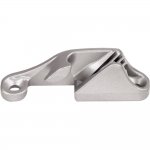
Drilling new holes in the mast

Greenheart

Well-Known Member
Joined
29 Dec 2010
Messages
10,384
Visit site
My main & genoa halyards emerge from the centre of the mast-foot, then turn through a very awkward diagonal to reach their clam cleats, just a few inches above. Everything about hoisting & lowering is made harder by the unnatural corner they take.

It wouldn't be hard to drill four new holes about 15" above the mast-foot sheaves, allowing me to cleat the sheets then yank on the tensioned section to get the sails that bit higher; and slackening/lowering them would be much less effort too.

Given that rivet (or bolt) holes for the clam cleats will only be around 3mm across, is there any good reason not to drill new ones?

I can't work out why the mast's maker (or the dinghy's designer) chose the present cleat locations. It's not as if there's no room for them elsewhere. Am I likely to regret making a change?
 
Dan,

the secret to working in alloy - ie fitting sheaves, which I have done a lot of, is rounded corners at the sheave apertures - my own mast was a Bowman kit - amazing to think such things were available in the mid/late 1970's, transporting the extrusion was the main problem, solved by a little diversion of a Hawkers / BAe lorry ! :)

Originally completed by my aircraft fitter Dad, I have done a lot of work on my and other masts since as I had the training by BAe and more importantly Dad.

Within reason you can chain drill and file any rectangular hole for a sheave, but it is ESSENTIAL you round the corners of all the sheave apertures.

Failure to do this, leaving sharp square corners in alloy, led to crack propogation and catastrophic failure to DeHavilland Comet windows and Venom wings via square cornered wheel bays, we Hawker types tend to look down on DH as flimsy ' wing and a prayer ' jobs !

Obviously there's a sensible limit to how much to cut away but you strike me as having common sense.

Dunno if relevant but one of the upgrades I fitted to my mast was ball bearing double sheaves so the halliards etc exit between two sheaves, allowing pull from any vertical and quite wide azimuth angles.

For lines led aft you may need a deck organiser or cheek blocks; in the name of all that's holy use ball bearing kit wherever possible, throughout if you can - Barton do good kit at relatively sensible prices ; I can reef with one hand with some wind in the main when normally a winch might be involved...
 
Given that rivet (or bolt) holes for the clam cleats will only be around 3mm across, is there any good reason not to drill new ones?

I take it that the mast is deck-stepped, in which case there is no bending force near the deck, just compression. Therefore it seems to me that there will be no stress concentration near new holes.

But hopefully Vyv will be along to give a real engineer's viewpoint...

Mike.
 
I take it that the mast is deck-stepped, in which case there is no bending force near the deck, just compression. Therefore it seems to me that there will be no stress concentration near new holes.

But hopefully Vyv will be along to give a real engineer's viewpoint...

Mike.

The Osprey mast is keel stepped, I've owned one which I raced and cruised; I'd consider a deck stepped mast under slightly more lateral loads at the foot, but any perfomance boat mast will have bending loads to a degree, whether induced by Mother Nature or the crew.

Hopefully my various engineering qualifications will suffice, considering I've done the task on the same and other boats.
 
Dan, is the genoa hanked onto a forestay old style, or is the halyard pulling a luff wire tight in the genoa?

On my dinghy, there is no standing forestay, the luff wire in the sail does all the work.
The halyard exits the mast just below the gooseneck and I hook a 16: tackle to it.

The main an spinnaker exit the sides of the mast below the deck.
The main passes around or through a clamcleat screwed to the side of the mast, and then through a pulley also screwed to the mast.
So you pull most of the halyard up avoiding the clam cleat (to avoid wearing the rope or cleat), then put it in the cleat and pull up the last few inches.
The pulley means you can pull at a range of angles and the rope pulls through the cleat.

The deck level of the mast is quite stressed, but if you keep the slots reasonably away from deck level you should be OK.

I use a 2:1 main halyard of 4mm spectra cored rope with a polyester cover.
 
Gentlemen, I thank you for your comments and comparisons. Andy, I remember the BBC4 documentary on the Comet's square windows & metal fatigue.

But I should clarify the point Mr Kelpie made, that I'm only talking about moving the cleats. As such, this really isn't a big deal...

...but as I hope this photo shows, the present positioning of the cleats relative to the emerging halyards, defies reasoning to my mind...

Screenshot_2016-05-21-12-20-04_zpsngm4fkis.png


(I wonder if that old double-sheave could be replaced by a slick ball-bearing double, the same size? Where might I find one?)

...LW395 mentioned that his main halyard passes by or through the cleat, and this draws my attention to the chief difficulty I have, which is that the clam cleats don't have an 'open' side, as some do; so all the length of the halyard has first to be pulled up out of the sheave, then (and before any tension can be applied) all pulled diagonally through the little hoop on the clam cleat...

...it doesn't pull easily through that diagonal, especially when there's considerable friction in the mast track too...whereas, if I used those one-side-open clam cleats instead, it wouldn't be necessary to then pull the whole length of the halyard through the cleat too...

c218mk1.jpg

So, that would be an answer vastly preferable to my current set-up. But my thinking is that if the location of the cleats wasn't so awkward to pull through, the whole hoisting action could be done in one go, without a fraction the difficulty I currently put up with.

I've looked closely at the monel rivets I'll use and I reckon the holes will be 5mm diameter. So, to the original question, am I weakening the mast by drilling them?

In answer to your question LW395, the genoa's boltrope does indeed constitute the forestay, and its halyard is the control for overall rig-tension. But I have a separate headstay whose foot is six inches forward of the furling drum, so I can drop the rolled-up genoa when the boat's ashore.
 
Last edited:
Easy answer: stick a tapped plate, or even a square nut, in the mast track and bolt your cleat to that. You will need to get it tight to stop it sliding down though.
 
Easy answer: stick a tapped plate, or even a square nut, in the mast track and bolt your cleat to that. You will need to get it tight to stop it sliding down though.

Good call.
Possibly with a pulley after the cleat so you can pull from a comfortable angle?

On my dinghy it's very important to get the main up hard, with the halyard pre-loaded, otherwise the cunningham pulls it down. May not apply to all!
 
I'm relieved that you concur on the solution, and that it can be summed up so easily; but I'm not sure exactly what you mean.

I can see that a block or cleat or both, wedged in the mast track some distance exactly above the bottom sheaves, will solve the awkwardness that my present rotten cleat-layout causes.

But what exactly is a tapped plate? Is it simply a matter of tightening a bolt within the track, that clamps a piece of something solid onto the track, as a mounting for block/cleat etc? Is that firm enough for serious loads?

Isn't there the danger of bending the track?

Sounds like a smart solution...is it something I can best improvise myself from materials lying around, or are such things sold for purpose?

Apart from not having the lines leading through that impossible diagonal, the best thing about this plan will be the fact that the halyards are at last accessible...the present arrangement involves hunching over the floor at the very front of the cockpit.
 
By a 'tapped plate' I mean a small piece of stainless steel with holes drilled and tapped to take the two bolts for the cleat. Slide this up (or down, depending on access) inside the mast track to the desired position, then the cleat goes on top and you bolt them together. Has to be nice and tight of course, otherwise it will slip. I had this arrangement on my Wayfarer.

Alternatively, you might want to mount a cleat either side of the mast track. With a bit of ingenuity (and a slim spanner) you can use bolts rather than self tappers, as you can reach through the mast track to put the nuts on. I have used this method also and it was fiddly but I was happier not relying on self tappers. Of course you could use rivets as currently shown in your photo.

The main thing is to get the cleats higher and closer together, for a better lead. I can't see it damaging your mast whichever way you do it.

By the way, re the comment about halyard tension, this is probably common knowledge but I always get the halyard tensioned before putting the boom on the gooseneck. Then you can just lean down onto the boom and get plenty of tension that way.
 
Thanks very much Kelpie, that's very clear.

I get the feeling (and I realise that I should have, before starting this thread) that anything which works, is the answer...so as long as I don't pepper the mast with holes, or rig up lines in the way of each other, I can rig up anything which seems to answer.
 
I did something similar when I fitted a winch to the aft side of my mast.

I took a piece of stainless steel ,y[u count also use aluminium, and bend it into a flat bottom V shape with the flat bottom the width of the two clam cleats. The 2 sides would then wrap around the mast side so the the existing holes that the clam cleats use can be used to bolt the plate onto the mast at the same height.

The 2 clam cleats cam then be bolted onto the flat now vertical piece of the plate inline with the exit pulleys.
 
Dan,

I'd be very tempted to forget the built in sheaves at the mast foot - leave the thing in for strength - and fit new sheaves & cleats at sensible angles, virtually wherever you like; anything would be better than those original exits, which are high friction to put it mildly at any angle of pull.

My chum Vern's Osprey - very similar to yours originally - has the same sheaves, but as we're only planning light local trips for the moment ( first trip soon ) it's just about sufficient, I'll probably go to town on it with new sheaves in different positions etc in the winter.
 
Hi Andy, how right you are. Once again, I'm surprised to find that there isn't necessarily only one answer to a problem on the boat, even to a problem concerning parts which were presumably selected and assembled by chaps who knew much more than me.

I had imagined there must be distinctly right and wrong ways of setting up cleats and sheaves on the mast and boom, but now I can see that several difficulties and inconveniences I've encountered with the Osprey, could be sorted out by a little logic, and modification of components and their positions.

So I welcome the radical idea of just ditching the present hateful arrangement, and rigging up a better one. :encouragement:

Here's my awful bottom sheave, only about 12 inches above the mast foot, where it (and the cleats) are badly inaccessible:

Screenshot_2016-05-22-16-19-02_zpsrtt5kpbg.png


Surprisingly, the left-hand sheave is simply crumbling, bits breaking off it. I suppose some inferior metal has been used there, and has suffered over the years in the moist atmosphere. So, I'm determined to find an alternative way, because this isn't fit for purpose.

Now that I looked closely at the mast, I realised there's another 'splayed' section in the track, 36" above the foot...

20160522_162757_zpswe5zpsl2.jpg


...so presumably it could easily house a double sheave for my halyards, from which they'd emerge accessibly...and critically, I could easily hoist the sails while standing outside the boat, which has always been very difficult with the mast-foot sheaves/cleats.

The only question is, where can I purchase a double sheave block designed to be partially enclosed inside the mast, and with bearings, and less than 25mm wide and about 60mm long?
 
Hi Dan,

the metal used wasn't inferior, just suitably light and easy to cast zinc alloy, I bet they weren't thinking of us still using their products 50 + years into their future, we're all supposed to be going around in siver one piece suits and jet cars by now !

I'll have to check on where I got my ball bearing double sheaves from, but I suggest your first stop should be the Barton catalogue.

On the Osprey I'd probably prefer tradional staghorn cleats for the halliards as one can hang the halliard ends from those; if one uses clamcleats then hangs the coiled end above them, the gravity pull on the coil will be to slacken the line in the stopper...
 
Thanks, Andy; again, we think the same way. The stainless cleat visible in my second photo above, is for my spinnaker (or, I assume it is, never having used the spinnaker nor having found any use for the cleat), but looking at it yesterday, I recalled all the resistance I've encountered when hoisting sails, caused by halyards running through clam cleats. That was a particular infernal nuisance with the woefully offset mast-foot cleats preventing a smooth hauling motion, but I believe I'll prefer horned cleats anyway.

Googling late last night led me by degrees to the phrase 'exit box' to specify the enclosed type of sheaves I'm looking for. It surprises me how few doubles seem to be for sale.

Plenty of singles, and there are so-called doubles, but they're in line, for some purpose different to mine. I need two parallel sheaves, ideally with bearings. Very few out there.

I suppose in the spirit of using my imagination rather than assuming that purpose-made fittings already exist for sale, I could source an ordinary block with a hollow spindle, and run a sturdy bolt through the section of mast where I want the exit box...then block out the periphery where tangles might occur, and call that a job done.

Good point about the degraded zinc-alloy sheave...although it's surprising that its twin, which also bears a considerable burden, is in pretty good shape.

Some time this summer, I'll get the boat in the water. :rolleyes:

EDIT:

This one by Allen, appears to be the only one available at reasonable cost, but it's significantly too wide (and probably too deep) for my mast track - which will only house something less than 25mm wide...and, I can't find any priced in pounds. Are 'exit-boxes' called something else, outside the States? And does anybody make them with bearings?

500cc1dd0053dcd417002bc3
 
Last edited:
When I switched from a wire to dyneema halyard on my Wayfarer, I added a horn cleat up near the gooseneck, i.e. as high as I could put it. But I left the exit sheave at the mast foot. This gives me a nice long working length to swig up and I have not trouble with it at all. If your sheaves are rotten then I guess you will want to replace them, but just thought I'd mention that it's perfectly possible to make a huge upgrade over your current setup with very little effort.
 
Dan, it looks like the halyards run in the luff groove, not right inside the mast?
So all you need is a fairlead or two, to take them out of the groove below the gooseneck.
straight down to your choice of cleat, then on to a turning block for hauling.
 
Excellent points for which I thank you, gentlemen. The more I bother to think about the question, the less binding the solution seems to be.

It's true that the halyards don't run inside the mast tube, only in the track...so technically I could lead them out of the track below the gooseneck, and straight into cleats...

...but I was thinking that a sheave or turning-block allows a great deal of hauling effort to be applied outward, which may suit hoisting circumstances better than simply pulling a halyard downward from a masthead sheave...but...even as I type, I'm re-reading your words LW395, and I can see sense in having the hauling block after the cleat...

...or, just sticking with my clam cleats, which could receive the line where it emerges from the track, and grip it allowing swigging and rapid securing of the slack, faster than a horned cleat.

In my mind, you have abolished the problem with your logic; I am in your debt. :encouragement: At least, until I get to the boat this evening and realise it's more complicated than that. :rolleyes:

I wonder why whoever set up my mast originally, did such a doubtful job of it? In a way I'm back to square one - if I hadn't discovered my bottom sheave was in such a sad state, I could simply relocate the clam cleats below the gooseneck and use the free height between the sheave and cleat, for swigging. But removing it from the equation is irresistible.
 
Top