Dragonfly shroud curiosity.

Mark-1

Well-Known Member
Joined
22 Sep 2008
Messages
5,690
Visit site
This question is really aimed at one member, but we might as well all share the wisdom.

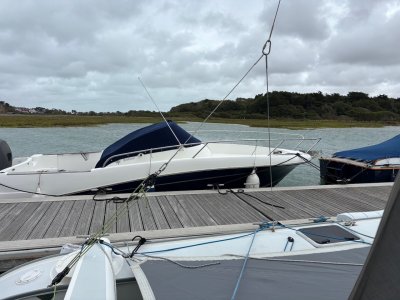
I recently passed a moored Dragonfly tri and noticed the shrouds are secured to chainplates on the outriggers. When the outriggers fold in or out, the entire chainplate (obviously) moves with the outrigger. I assume the arc is such that the tension remains similar throughout the move. Once the outriggers are in their folded or sailing position, block-and-tackle allow for fine tuning.

Have I got all this right?

Does it work well?

Do people typically measure the shroud tension/mast angle before sailing or just pull it a bit and see if it looks ok?
 
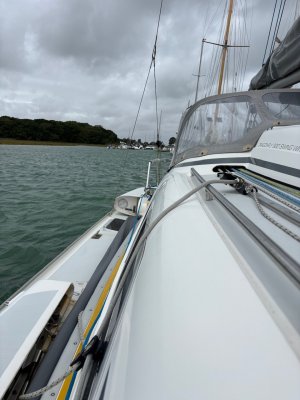
That is not how it works. That geometry was not really possible. You may have noticed the short running backstays. They basically tension the shrouds when you unfold. You release them before folding. Underneath, there chunky dyform stays running from the waterline to the junction of the arm and the ama, so the arm is loaded only in compression. Here’s the designer telling you about it all. In normal conditions you winch the backstay to the max on low power, high speed. Ours are marked, like the sheets on a race boat.
 
Not a Dragonfly but saw a foiling trimaran (grey and orange) having a good work out (singlehander) in Chichester yesterday around 2pm, over HW in a F4-5. Biggish boat needed a lot of space but being a weekday and quite windy harbour was pretty empty. Over Pilsey sands and the Emsworth channel. Lots of speed. Meanwhile we were hitting nearly 8 knots (SOG) in our Konsort:)
 
That is not how it works. That geometry was not really possible. You may have noticed the short running backstays. They basically tension the shrouds when you unfold. You release them before folding. Underneath, there chunky dyform stays running from the waterline to the junction of the arm and the ama, so the arm is loaded only in compression. Here’s the designer telling you about it all. In normal conditions you winch the backstay to the max on low power, high speed. Ours are marked, like the sheets on a race boat.
Thanks. A very interesting video. It looks a great boat.

Do the dyform stays counter the shear load applied through the back stays rather than eliminating it?
 
Thanks. A very interesting video. It looks a great boat.

Do the dyform stays counter the shear load applied through the back stays rather than eliminating it?
They are parallel to the arm, so a part of the backstay/shroud load actually helps prevent inadvertent folding. You certainly couldn’t move the ama without taking the tension off the backstay. But in the vertical plane, yes, you wind the tension on the backstay, the waterstay goes tight. Clearly much more tension, from the geometry, than in the stays. Hence the thumping dyform wire. The sailing loads must be pretty high there, by the time you’ve got 2 tons of my boat, or at least 4 tons of Angus’s nearly flying off that leeward ama.
 
Top