DIY top down furler for 40 footer

2copplane

Well-Known Member
Joined
28 Aug 2009
Messages
223
Location
Fleetwood
Visit site
I had the chance to try a top down furler with gennaker the other day and it immediately went on my must have list. That was until I priced them up. So I'm considering making my own Furler and fitting it to my cruising chute (15.4m luff circa 1,000sqft) but am not sure what kind of breaking load I need to design to. I'm currently working on 2,700kg, which with sensible Light airs use I think should be adequate?

Also the anti torsion rope used in the systems is mega bucks, so instead considering using an old spare halyard. My plan is to double it over slip inside 15metres of anti chafe 'tube' and then run a stitch lengthways to keep the two lengths separated. This way when the halyard is tensioned the two lines roughly 25mm apart should be able to transfer the torsion to the top swivel. Has anyone heard of this being done? Maybe in the days before antitorsion.

Please don't debate the virtues of top down furlers as that has been done on other threads. This is about a project to make one for a 40DS and with a budget of just £220.
 
Interesting thought although I would have expected two ropes sewn together in parallel to act more like a webbing tape and twist like a double helix (as in the pictures of DNA).

I have just tried twisting a few of the ropes I have on board and the best in terms of anti torsion was some ex fire service rope that appeared to have been used and abused until it was like wire.

Karver have an interesting document that details the loading/stress calculations for various size boats and also describes nicely the requirement for the anti torsion cable.

http://www.p2marine.com/sailing-gear/karver/ksf-instructions.pdf

And for others intrigued about the setup of a top down furler, that actually has the drum at the tack (bottom) of the sail there is a nice one page diagram here
Furler_systems_diag3.jpg
 
Last edited:
Also the anti torsion rope used in the systems is mega bucks,.

Have you had a price for Cousin Trestec King rope? A few years back, I got a quote from their distributor in Somerset (IIRC) and it wasn't too bad to have a 18m length made up with appropriate ends. IIRC, the price was sub £200.
 
Guys, great responses thanks. According to the Karver link looks like a 40 footer is circa 600kg (1T tops) loading, so I'm over-engineering, which will be a first.

No obvious Cousin Trestec distributors in uk but assuming I can source rope for under £200 then that will be okay. I'll start making calls and get some real quotes next week. I'll probably try my 'double helix' version first, just to test and discount, but at least i know i can afford the pucker anti-torsion rope. Now I've thought about it reminds me of those little balsa planes I made as a kid using a wind up elastic band to drive the prop.

if anyone is interested i can post links to the bits I'm planning to cobble (elegantly engineer) together. I've now some confidence they will hold together.
 
Another thought... If it comes to needing to gybe - Is the plan to mount the lower furler on a short bowsprit?

Happily I had already made a Removeable bowsprit using 3" stainless tube. I think it is mirror polished 304 but doesn't seem to be rusting. It will be needed to keep a seperation from the rolled genoa to give a clean furl, and jibe.

Previously I had to take the anchor off to fit it, so I'm just in the process of making a more convenient mount where the anchore stays in situ. Nothing fancy just a stainless u bolt into 25mm x 132mm tube and a 11mm x 165mm pin to hold in place on the tip of the bow roller. Whole thing will/has cost about £60.00.
 
[if anyone is interested i can post links to the bits I'm planning to cobble (elegantly engineer) together. I've now some confidence they will hold together.[/QUOTE]

Hi there, I'd be really interested in how you propose to do this .... just the sort of project I love ! Are you starting from scratch or 'modifying' an old furling gear?

Cheers Phil
 
[if anyone is interested i can post links to the bits I'm planning to cobble (elegantly engineer) together. I've now some confidence they will hold together.

Hi there, I'd be really interested in how you propose to do this .... just the sort of project I love ! Are you starting from scratch or 'modifying' an old furling gear?

Cheers Phil[/QUOTE]

I'm typing this on my wife's iPad while in the bath so will keep it brief, in case she confiscates it.

For the lower furler I will use a ronstan rf79 which has a bl of 2700kg. The furling drum will be an aluminium pulley wheel with 25mm bore, with lots of 10mm holes drilled a couple of mm from the outer edge to help grip the rope. The forces on the pulley wheel are low so I will rely on a couple of grub screws to lock it in place.
The tricky bit is the bearing to attach the tack to. For this I found a few websites that sell deep groove Bearings with a 25mm bore. I'll either weld a couple of lugs on, or fit a further bit of tube that fits the external bore tightly and tack weld, or bend over the bottom rim so it cannot be pulled of. I can then bolt whatever I want to this.

I haven't decided how to make up the cage that will retain furling rope. Probably just some 2mm x 10mm ss strips suitably tack welded together and attached to a shft collar on the fixed bottom of the swivel.

My desire is to make it without any professional bought in skills or tools- proper diy. Though i may pay a welder to tack it together, primarily as it may be cheaper than resurrecting my old MIG and then buying gas and wire.

The ronstan rf79 is about £80.00 but so much easier than trying to make a swivel up myself.

I'll either use an rf75 or rf79 for the top swivel. Anyone suggest cheapest supply for ronstan?
 
Hi there, I'd be really interested in how you propose to do this .... just the sort of project I love ! Are you starting from scratch or 'modifying' an old furling gear?

Cheers Phil

I'm typing this on my wife's iPad while in the bath so will keep it brief, in case she confiscates it.

Thanks for that. I'll start having a think about it myself for a project ! Good luck and post some piccies when complete. Cheers Phil
 
When you have scrubbed her back - do not drop the soap & pretend you are looking for it----we have all done it!!!!-

Perhaps this will work- I have wondered how to make the torsion rope myself
I suggest 2 dynema ropes & one none dynema stretchy rope
the centre one is the stretchy one
the next 2 dynemas wound in opposite directions down the central cord & whipped every few inches
Stretch the central part between 2 posts & tensioned lightly, Then wind on the dynema & whip as required or perhaps heatshrink if you can be sure not to melt the ropes
When halliard winch tension is applied to the centre ( really wind it up)it should pull the dynema ones tight & the windings may reduce twist
the outers need not be big & the central could be about 10mm- amply strong enough

If it works let me know as i want to try it as well
 
When you have scrubbed her back - do not drop the soap & pretend you are looking for it----we have all done it!!!!-

Perhaps this will work- I have wondered how to make the torsion rope myself
I suggest 2 dynema ropes & one none dynema stretchy rope
the centre one is the stretchy one
the next 2 dynemas wound in opposite directions down the central cord & whipped every few inches
Stretch the central part between 2 posts & tensioned lightly, Then wind on the dynema & whip as required or perhaps heatshrink if you can be sure not to melt the ropes
When halliard winch tension is applied to the centre ( really wind it up)it should pull the dynema ones tight & the windings may reduce twist
the outers need not be big & the central could be about 10mm- amply strong enough

If it works let me know as i want to try it as well

Sounds great but That's a lot of work, and sounds a bit expensive (unless you have the rope already). My latest thinking, looking at examples of antitorsion rope, they seem to be a composite of a core rope, pu monofilament tube , then outer protective layer.
I've an old 12mm braid on braid sheet, and am thinking as an experiment I'll slide out the inner core slip over heat shrink to act as the monofilament (apply heat) then slip back over the layer of braid. The heat shrink will transfer the torque. Total cost about £20.00. The heat shrink works at about 70C so shrinking should harm the polyester too much(?). I may try the type with glue as that should mix with the polyester braid and form a kind of flexible composite.


Alternatively selden GX torsion line is about £100.00 for 16metres so may opt for that. Out of interest an entire gx10 system would be about a grand so very tempting.
 
If you are going to add 1mm or 2mm diameter to the inner core then be sure you have an extra meter or two of outer braid
 
If you are going to add 1mm or 2mm diameter to the inner core then be sure you have an extra meter or two of outer braid

Thanks tawhiri hadn't thought of that! I've just bought a couple of metre lengths of glue heat shrink and standard stuff. The glue stuff seems pretty tough,so I may just put heat shrink round the entire braid on braid and leave it as the out core.However I'll have to make the same consideration for the heat shrink. I'm also quite pleased how well in transfers the torque, even though the sample is only 8mm finished diameter.

Next question is how to thread 17metres of 12mm braid on braid into the heat shrink, anyone done something like this before?
 
I pulled 9 meters of inner core out of my toping lift to inset a wire, which I use as an antenna. To get the inner core back again I tied 10m of (strong) thread to the other end of the inner core.
 
I'm typing this on my wife's iPad while in the bath so will keep it brief, in case she confiscates it.

Thanks for that. I'll start having a think about it myself for a project ! Good luck and post some piccies when complete. Cheers Phil

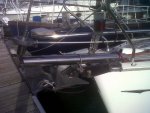
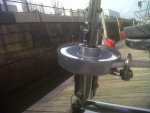
Ta da! Prototype v1 of my top down furler. In the end I made my own from some precut bits of 50mm tube off ebay and a 125mm pulley wheel, and a pair of deep groove 47mm x 25mm bearings. The trickiest bit is using basic hand tools though I'd do it much better on a version 2, and would cheat and get someone to machine and weld a few bits. The cage is some old car repair resin/cloth I had spare moulded over my wife's butty box. I Haven't actually fitted the sail yet but it seems to rotate okay using an old 14mm halyard as the antitorsion rope, though the plan is to put some heat shrink on it.

image.jpg

image.jpg
 
Ta da! Prototype v1 of my top down furler. In the end I made my own from some precut bits of 50mm tube off ebay and a 125mm pulley wheel, and a pair of deep groove 47mm x 25mm bearings. The trickiest bit is using basic hand tools though I'd do it much better on a version 2, and would cheat and get someone to machine and weld a few bits. The cage is some old car repair resin/cloth I had spare moulded over my wife's butty box. I Haven't actually fitted the sail yet but it seems to rotate okay using an old 14mm halyard as the antitorsion rope, though the plan is to put some heat shrink on it.

View attachment 40342

View attachment 40343

Looking forward to the report from trials, I'm afraid that the "old 14mm halyard as the antitorsion rope" will be huge disappointment.
Is the tack rotating free from the drum/antitorsion rope?
 
I made up my own torsion rope , they all seem to be overpriced .
take double the length needed and place the loop around a good strong post .
take the two tails and tie together and place a bar in between . continue to twist this whole length until it starts to buckle .
then place this end over the towball on a van/ car and drive gently away ( this is why it needs a strong post ! )putting it under high tension .

this will create heat , park the van and then squirt superglue over every contact point along the twisted rope .
leave to cook overnight .
takeit all apart in the morning and viola , 1 x anti torsion rope , which when you haul it up the mast will provide prodigious grip to your chute .
once furled it will stay twisted .
 
I made up my own torsion rope , they all seem to be overpriced .
take double the length needed and place the loop around a good strong post .
take the two tails and tie together and place a bar in between . continue to twist this whole length until it starts to buckle .
then place this end over the towball on a van/ car and drive gently away ( this is why it needs a strong post ! )putting it under high tension .

this will create heat , park the van and then squirt superglue over every contact point along the twisted rope .
leave to cook overnight .
takeit all apart in the morning and viola , 1 x anti torsion rope , which when you haul it up the mast will provide prodigious grip to your chute .
once furled it will stay twisted .
Interesting - just wondering
-What size of sail?
-What type of sail?
-How long have you used this homemade anti torsion rope?
-How much superglue?
-How durable is superglue when it's exposed to UV?
 
Knuteritk- The tack does rotate freely, it is the fitting just above the furling drum. I've wound the halyard up tight and everything has stayed in one piece and all still rotates freely.

Grafozz - thanks for the tip, unfortunately I don't have any suitable rope long enough. The 14mm braid seems to work pretty well without a sail attached. Though I've a feeling that when lowered it will kink up. I'm optimistic casing it in heat shrink will be adequate, it seem to work on test pieces I've made up.

I think the next hurdle will be the large headboard fitted to the chute. For the trials I'll try and crush it with cable ties, otherwise it will jam on the genoa/forestay.
 
Top