DIY freezer lid

Kelpie

Well-Known Member
Joined
15 May 2005
Messages
7,766
Location
Afloat
Visit site
A little over a year ago I converted a locker in to a freezer. I used a kit from Penguin Refrigeration and can't fault its performance or power consumption. The insulation was built up using layers of 25mm Kingspan with judicious use of expanding foam where necessary. I lined it using perspex sheeting, with sealant at the joints.

The lid was a bit of a compromise. It's just a slab of 50mm Kingspan which wedges roughly in to place. It's now pretty worn around the edges so there's essentially no seal at all. This is causing a lot of frost buildup inside.

Any ideas or examples of how to build a proper lid? I'm toying with using a rectangular plastic deck hatch, with a plug of insulation on top. Should be reasonably well sealed?
 
A little over a year ago I converted a locker in to a freezer. I used a kit from Penguin Refrigeration and can't fault its performance or power consumption. The insulation was built up using layers of 25mm Kingspan with judicious use of expanding foam where necessary. I lined it using perspex sheeting, with sealant at the joints.

The lid was a bit of a compromise. It's just a slab of 50mm Kingspan which wedges roughly in to place. It's now pretty worn around the edges so there's essentially no seal at all. This is causing a lot of frost buildup inside.

Any ideas or examples of how to build a proper lid? I'm toying with using a rectangular plastic deck hatch, with a plug of insulation on top. Should be reasonably well sealed?
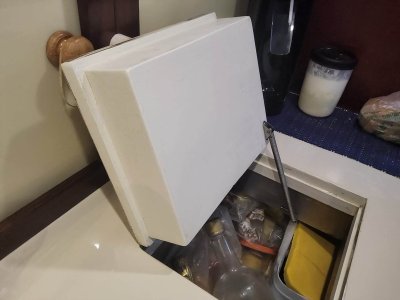
I made a mould with formica. Waxed it, gelcoated it, laid up glass. Worked a treat. Filled it with 3" of Kingspan.
 

Attachments

  • received_526451829683185.jpeg
    received_526451829683185.jpeg
    101.4 KB · Views: 10
I´ve briefly logged the duty cycle of my fridge with the lid on for an hour, then lid off for and hour then ..
Wasn´t possible to tell when it was on or off from the duty cycle though...
Put a warm litre of milk in this morning & ........
1680788062171.png

Big fat lid might not actaully do much....
 
I think it makes a difference when it's a freezer. I've had to increase the insulation because I was getting condensation on the outside of the lid.
 
Our freezer fills part of the space under the floor of the galley and the lid looks almost identical to that of Geems. Its basically wedge shaped to match the top of the freezer, fibreglass and has 100mm of foam. The fit is not perfect and we have 1mm rubber strip round the edge to better the seal. We found that increasing the flow of fresh air round the compressor, which is located in the bilge (and removing the warm air) offered the most advantage to making the unit more effecient. We take air from the anchor/chain locker (its the coolest) and duct it to the compressor using domestic ducting and judicious use of computer fans wired to the fan on the compressor works well.

A hatch sounds overkill and expensive but then building a custom lid takes a lot of time (but can be cheap). Use the existing unit as the 'mould' - methinks its a project for winter or rainy days.

Jonathan
 
Our freezer fills part of the space under the floor of the galley and the lid looks almost identical to that of Geems. Its basically wedge shaped to match the top of the freezer, fibreglass and has 100mm of foam. The fit is not perfect and we have 1mm rubber strip round the edge to better the seal. We found that increasing the flow of fresh air round the compressor, which is located in the bilge (and removing the warm air) offered the most advantage to making the unit more effecient. We take air from the anchor/chain locker (its the coolest) and duct it to the compressor using domestic ducting and judicious use of computer fans wired to the fan on the compressor works well.

A hatch sounds overkill and expensive but then building a custom lid takes a lot of time (but can be cheap). Use the existing unit as the 'mould' - methinks its a project for winter or rainy days.

Jonathan
Our compressor lives in what is effectively a chimney. The cooling process is called 'stack effect'. The chimney induces flow from top to bottom. The heat from the compressor is naturally sucked out without the use of mechanical ventilation. It works very well. I installed a fan on the compressor but it has proved to be unnecessary.
 
Top