Digital volt and amp meters - Where to buy?

Richard10002

Well-Known Member
Joined
17 Mar 2006
Messages
18,979
Location
Manchester
Visit site
Been toying with buying a Smartgauge, or a Sterling Monitor, to monitor my new 330Ah domestic bank state of charge etc..

However, I've been using a multimeter on the battery charger terminals sporadically, and find I'm probably getting as much info as I need.

So....

Where can I buy a reasonably accurate volt meter and amp meter, preferably digital? I'm guessing that, for a small percentage of the cost of the above monitors, I could set myself up with all I need.

Done a bit of googling, and found some on eBay, but not really sure of what I'm looking for.

Many Thanks

Richard
 
Been toying with buying a Smartgauge, or a Sterling Monitor, to monitor my new 330Ah domestic bank state of charge etc..

However, I've been using a multimeter on the battery charger terminals sporadically, and find I'm probably getting as much info as I need.

So....

Where can I buy a reasonably accurate volt meter and amp meter, preferably digital? I'm guessing that, for a small percentage of the cost of the above monitors, I could set myself up with all I need.

Done a bit of googling, and found some on eBay, but not really sure of what I'm looking for.

Many Thanks

Richard

Something like this I should think
http://www.ebay.co.uk/itm/Blue-LCD-...uipment_ET&hash=item337208c4b9#ht_2478wt_1185

20 volt max reading fine for a 12 volt system

Make sure they don'd need a separate paower supply ( or a battery).

You may be able to find themwithout the permanent back light

maybe find them fully encased

I searched for "digital panel voltmeter"
 
Last edited:
Amp meter

The voltmeter in Vic's link would be ideal. It is powered of the voltage you are measuring hence won't work below 7volts ..no prob...
An amp meter is a bit more complex. To drive a digital panel meter you need 200millivolts for max indication. So for a 20 amp meter with 20 amps (19.99 amps) you lose 200mv or 1/5 amp in the shunt. Of course if you only have 10amps flowing you only lose 100mv. This may be acceptable or maybe not. For less volt drop you need a clamp on type meter or some sort of amplifier to get the 200mv needed from a lower resistance shunt. Or have the meter read 200 amps max so 10 amps will then only drop 10mv but with less accuracy and less precision.
Some time back a forum member gave a link to I think a US digital panel amp meter with amp hour totaliser. This I reckon would be ideal. You reset it say before an engine run and it will totalise the number of amp hours put in. Or reset it at the start of a day or evening and totalise the amp hours used. It was relatively cheap. Further it probably has an amplifier such that it runs on a lower resistance shunt.
http://www.ebay.com/itm/3-1-2-Blue-...918?pt=LH_DefaultDomain_0&hash=item35ba5cbe66 might suit for amp meter
So there are a few thoughts. good luck olewill
 
Last edited:
I have some E-bay type volt meters measuring voltage and current. My current display volt meter which have a range of 200mV and are driven by hall effect current sensor's I got from Halcyon of this parish
 
I bought one very similar to the one in VicS' link a couple of months ago. I had some reservations because it was coming from Hong Kong, but in the event it arrived promptly and seems to be good. I have yet to install it so cannot comment on its performance. Don't forget it needs a shunt, ordered separately.

I do have a similar V/A meter, bought from a UK Ebay company, now defunct. I find it extremely useful and, as you say, as useful as a battery monitor for a quarter or less of the cost. It has a separate switch for V/A selection but my HK one has it built in.
 
.

A short word of caution about the 31/2 digit ammeters such as those from As*a Eng** on eBay; I bought one, didn't work (DOA), neither did the replacement (DOA) nor the replacement after that. Having had this experience with a number of similar items I began to suspect that these were actually manufacturers fall-out, QA batch test fails. Cheap as chips, because chips are cheap, especially suspect ones. No actual evidence of course, just a sneaky feeling....
 
amp meter

Never bought or fitted an amp meter before - As I understand it, the amp meter essentially counts the amps being put in or taken out ....

therefore presumably when fitting and setting up a new amp meter, one has to 'enter' details of nominal values of the battery bank - such as how many amphours it is supposed to be at the get go. i.e. if one has a nominal 300 ah battery bank , then one sets up the new amp meter to show 300 ah before any loads have been switched on or charging has taken place ??

Can anyone comment ?
 
No, an ammeter is essentially a flow meter for electricity. Simply shows what is being drawn by a user.

Or charge to the battery, but it should be wired to give net charge or discharge to/from the battery.

By using a voltmeter to monitor max charge voltage, the ammeter to monitor when charge drops to a low level, you can optimise your battery charge.

Allowing you to run the engine for the minimum time, while recharging to the maximum effective level.

Or put it the other way, running the engine any longer will give little extra charge, but will burn a lot of expensive diesel.

Brian
 
Never bought or fitted an amp meter before - As I understand it, the amp meter essentially counts the amps being put in or taken out ....

therefore presumably when fitting and setting up a new amp meter, one has to 'enter' details of nominal values of the battery bank - such as how many amphours it is supposed to be at the get go. i.e. if one has a nominal 300 ah battery bank , then one sets up the new amp meter to show 300 ah before any loads have been switched on or charging has taken place ??

Can anyone comment ?

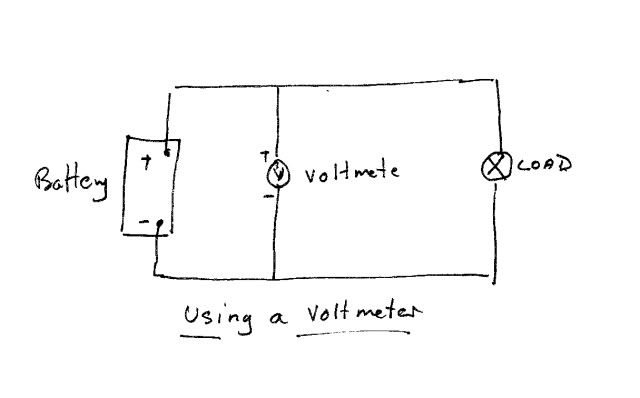
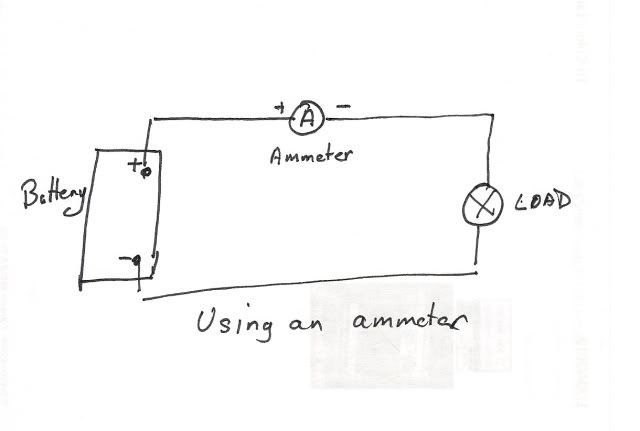
A couple of sketches I did a while back to show how voltmeters and ammeters are connected might help.

But see also the relevant sections on http://www.tb-training.co.uk/cover.html to see how a shunt can be used with an ammeter.


(I must do another diag to explain shunts)
 
No, an ammeter is essentially a flow meter for electricity. Simply shows what is being drawn by a user.

this is true of an ammeter in its simplest form

But surely a BM1 could be described as an ammeter - after all it meters amps and then as pitcairn says counts them up in amp hours

An integrating ammeter but still an ammeter?
 
Integrating amp meter

I am sure I saw one referred to in a link on the forum some time back. I have tried "cumulative amp meter"
"Ampmeter AH counter" and now "integrating ampmeter" no joy.
As said the ampmeter is equivalent to your water flow meter while the BM-1 or amp meter integrator is more equivalent to your water consumption meter. The BM-1 goes further to try to give a percentage of battery charge based on battery capacity and amp in and out since full charge. In my opinion this production of a percentage charge is so fraught with errors as to be more a menace than value. (As shown by questions on this forum).
I would be very happy with AH in or out (and instantaneous amps) for any chosen small period. I could relate this in my head to actual and claimed AH rating of battery.
So the question again does any one recall this cumulative amp meter. Perhaps they have gone out of business. olewill
 
AMP METER

Ok whether the ameter is measuring flow of electricity 'into' or 'out of ' the battery , my question is realy about fitting a new battery monitoring system. One wants to know the extent of discharge of one's battery bank. Is the battery bank 100% charged or 70% charged or 50% charged.

So when fitting a new battery monitor one presumably needs to calibrate it to show what is the Amphours of the battery bank when 100% charged. The monitor (via the ameter) now starts 'counting' usage, by measuring the flow of electricity.

Having not fitted such a system before I just wondered if I was right in assuming the battery monitor needs to be calibrated on first install (and I guess needs to be periodically recalibrated since it is the case that batteries loose their ability to hold amphours as they age i.e. if a battery starts its life as a nominal 100amp/hr battery by year 2/3/4 etc that 100amp/hrs is more likely to be 90/85/80 amphours when fully charge ??)

Any comments please
 
Having not fitted such a system before I just wondered if I was right in assuming the battery monitor needs to be calibrated on first install (and I guess needs to be periodically recalibrated since it is the case that batteries loose their ability to hold amphours as they age i.e. if a battery starts its life as a nominal 100amp/hr battery by year 2/3/4 etc that 100amp/hrs is more likely to be 90/85/80 amphours when fully charge ?

Life is more complicated as a battery gains capacity above nominal from new, reaches a peak, and then falls with age. All depending a lot on how you recharge the battery, and the discharge level.

Brian
 
Top