Deadwood Bolts - any tips?

Roach1948

Well-Known Member
Joined
27 Apr 2006
Messages
1,268
www.dallimoredesigns.nl
OK next weekend I am going to attack my deadwood bolts that have been weeping.

They are quite small at 1/2" dia with badly corroded 13/16th nuts on the top. I might hack saw the nuts off as I think they may disintigrate with the old wrench.

Other than that I plan to get a drift and lump hammer and bang them out hoping that they don't split in half and ride up over each other. Other than checking underneath after each strike, are there any other tips I should know about? I want to get this right, and they are quite thin bolts so I am worried can really get in a pickle.
 
If you can move the nuts at all I would take them to the end of the bolt so that when you start swinging the hammer you are striking the nut and not the bolt. I'd probably try heating the bolt first to try to crack any corrosion and soak in penetrating oil for a few days prior to attacking..
 
Have you thought about a think walled piece of tube, with some teeth sawn onto its end to work a cut down around the outside the end of the bolt, then you could turn up a drift that sits over the end, chances of mullering the bolt into a mashed up mess would be less!
 
Thanks to both of you for those tips

I do have a some copper pipe that the drift can run in - i'ii look into making teeth.

I have done the keel bolts, but those are far thicker at 1 inch. The fear with the deadwood ones is if they split. Just incase they do - what is the proceedure then? I am pretty sure I am dealing with the original bolts, and the fact that they weep, means they are sure to be wasted a fair degree...
 
If there is a risk of shearing & jamming as you knock them out, it may be possible to deliberately shear them before knocking through, then wind the top section out by installing washers under the nut (if you can get it to move) and pulling the sheared bolt out from the top by adding extra washers each time instead of driving through. A slide hammer might help if the bolts are only small dia.
The bottom section can be drifted out by using a drift with a drill hole in the end for the "spike" of the sheared bolt to bottom in.

Might be an idea.

John Lilley
 
Soak the bolts in coke a cola for a day or so, the phosphoric acid is the best penetrating/ freeing fluid you will ever get - i have always wondered why i don't drink the stuff!
 
The drift must be almost the same size as the bolt for max effect.
Find the biggest sledge hammer you can.
Clear the head from underneath first, measure up to the bolt head.
When you hit the bolt (as hard as you can, plus some) as soon as it goes down, check the outside measurement for movement.
If no movement, and the bolt has sheared, you may still have enough thread to weld a stud on and bridge it to a block and bottle jack.

When you refit the new ones, don't forget a nice grommet of cotton or oakum under the washers, plus a little modern squidge.
 
If you go down the method of forming a hollow drill bit.
Use a length of good "Steel" pipe cut your teeth in the end and then Case Harden it.
A bit of copper might cut out one if turned with care and the wood is soft around the bolt but if it is good wood it will fail to cut very quickly.
You may be ably to fashion a hollow drill bit from a hole cuter and mig weld an extension to.
Of course this method would entail fitting larger bolts but would that be a bad thing especially if the new ones where silicon bronze.
Cheers and the best of luck let us know how it goes David.
 
After all the business of getting them out what are you planning for their replacement? I recommend that you seriously consider replacing with something special from Anglia Stainless. Very helpful team, reasonable prices and very swift dispatch.
There is a lifeboat at Burgh Castle being rebuilt and he swears by the company and the products. Steve is using silicon bronze throughout. Although he is wearing a frown he is getting on with a super project and taking advice and help from all over. But silicone bronze is his favoured kit at the moment.
 
There are two very good engineering firms in Woodbridge, so not worried on that front. I can either go trad and get mild steel ones or as you suggest get stainless ones. My deadwood is Oak; I presume stainless is OK in Oak? I certainly dont have the budget for SiBronze at present....
 
Anglia Stainless. Is the company that took over Combwich marine, an excellent Co.
A length of Silicon Bronze Rod and nuts is the way to go.
Not too expensive bought this way.
You will need to cut it to length and thread it at both ends this will need to be done in a lathe thread cutting and finish with a die set to give a good fit for the nut.
Chamfer the thread out one side of a nut and run it on one end with just enough thread for the nut with one thread protruding of the rod, cut to length to suite the dead wood with enough threads to put on a washer and nut, then rivet it up.
A nifty tip to hold the rod in your vice when working on it by hand,
Drill a suitable hole though a scrap piece of say 1 1/2" sq X 2" ( this should suite a 1/2" bolt and grip it without it bending out of shape) steel cut it in half along one side of the drilled hole and you have a holder to use to rivet up or run a dia down the threads, it should not mark or damage the new bolts.
I am suggesting all this as you say you have a workshop you can get things done at.
Cheers David.

You then have a purpose made bolt of the correct length that will not only do the job but will look right as well.
At half the price of a ready made one bought off the shelf that more than lightly will need to be modifying in some way even if it is only shortening the end of it.
 
Ditto, no to stainless. Un-predicatble performance long term. They need checking as often as un-painted mild steel, so what is the point?
Go for Silicon Bronze rod, get a die and thread them yourself, or get a real boatbuilder to make them for you.
Galvanised mild steel good too. I removed 20 yr old Galv mild steel keel bolts last week. They were like new.
 
Rusty steel in a wet hole in old oak..good luck. I think that deciding on what replacement material to use is the nice easy part of the job, sorry.
I favour the coke, nut off and 'give it a huge clout' method of removal, preferably smacking both ends if you can get at em..to get it started a mm or 2.
Stage 2 Ditto but with a hollow steel toothed sleeve wound down into the wood from both ends..
And Stage 3. If the bolt breaks and overirdes itself in the wood , weld or clamp something onto each end and extract what you can in 2 pieces, from both ends and then send the hollow steel toothed sleeve back down the hole from both ends to cut past the rotten centre piece of old bolt, and Bob's your very tired uncle with consumate skill and strong biceps and a shiny enlarged hole ready for the new oversized bolt.
 
I had this problem with rusted iron keelbolts through oak, original 1880s. It was impossible to drift them out - the movement I thought I was getting was simply the top half concertinering into the crumbling remains of the bottom part.

In the end I had to jack up the hull, hacksaw through all the bolts at the join between iron ballast keel and false keel, and then pull the ballast keel out on a contrived trolley. The stumps refused to drift out of the iron keel, so I had to laboriously drill through 12" of cast iron, X 6, to restore the holes.
The remaining bolts in the keel and deadwoods and floors still would not budge, so I had to remove all the floors (hacksawing off all the iron nails) and again cut through the bolts at the interface. Some of the remaining lengths of iron would then drift out, one spit the floor, and one came out leaving a hole twice the size.

Good luck!

I got marine grade wrought iron bolts specially made to fasten the iron keel, and bought silicon bronze threaded bolts from Anglia Stainless for the deadwoods and non-iron bits.
 
[ QUOTE ]
I think that deciding on what replacement material to use is the nice easy part of the job, sorry.

[/ QUOTE ]

Indeed. I will see how I get on but not really thinking about the replacements yet. I need to get the old ones out first. the last couple of posts re-affirmed my apprehensions. Will let you all know how I get on - I just pray Roch is kind to me and they budge first whack....
 
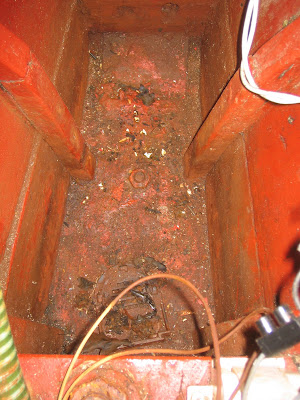
Well spend last weekend doing all the prep work. Tube made, drift made. I poured 4 litres of cheap Tesco cola in the bilge - hope non-proprietory brand is OK? The only thing I did not do is heat the bolt up. The reason for this is that on the top it seems to be surrounded by black tar varnish and underneath, it is embedded in the deadwood; and I dont really want to set the whole boat alight. How does one heat the thing then?

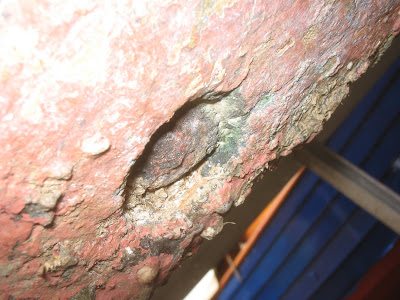
PS. Chipped away underneath to get the pug looking clearish; shall I chisel in around the plug?
 
IMG_3179.JPG
IMG_2603.JPG


Here are a couple of pictures of the bolts top and bottom. (yeh - I know I need to replace frames there too, but I was going to wait after my attempts with the sledge hammer). The top bolt has hardly anything showing as it is swimming in tar around it. Was wandering wehther I shoudl chisel down and eventually grave a new bit of wood afterwards - that would allow me more to bash it down.

The bottom bolt shows that it is well encrusted - and I am unsure whether I should chisel away around it or not.
 
Top