Damaged threads in mast?

Tim Good

Well-Known Member
Joined
26 Feb 2010
Messages
2,888
Location
Bristol
Visit site
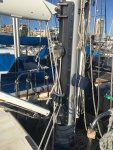
On my mast i have a large alloy facing plate. The gooseneck, sheaves and rod kicker attach to it. Behind is the in Mast furling gear.

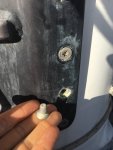
At some point the stainless bolts were inserted without using Duralac resulting in the threads corroding in the aluminium mast.

What is the recommended course of action? A stainless threaded insert or some kind so that I don’t have to use a large bolt and therefore don’t have to drill the facing plate with larger holes?

Here are some photos:


2A9A5474-04E1-486D-BB18-836C5FF65C86.jpeg
E48E3FA2-0630-4BC7-B359-DA6E21C46074.jpeg
 
It looks like Duralac was used.

What diameter are the screws?

If a suitable size could be obtained I would probably use countersunk pop-rivets.
 
You have two simple choices plus many more complex ones. Either a Helicoil or a threaded insert. I have used helicoils in aluminium cylinder heads, both for spark plugs and manifold studs. Both have worked well and are easy to fit. Helicoils come as a kit including the correct drill, tap and insert tool.

I have not used thread inserts but one of my cylinder heads has one to repair a spark plug thread. It was fitted before I bought the car so has been good for over 5000 miles.
 
Thread inserts, definitely. Some folk call these 'helicoils', but that's merely one brand. I generally use 'Recoil' brand which has simpler, cheaper application tools. The inserts themselves aren't particularly expensive. The resulting thread will be stronger than the original. (Porsche, and many racing vehicles, routinely use inserts on threads into aluminium for this reason.)

Many of the larger fasteners on some spars (including our Kemp/Selden) have stainless thread inserts as standard. They're the ones you never struggle to remove, but nor do they seem particularly prone to corrosion between the insert and the aluminium.

Tip: the inserts come in an assortment of lengths, usually expressed as 'x' times diameter. If you want to keep a selection in stock, buy the longer ones: they can easily be shortened, if necessary, by snipping off a coil at a time with side-cutters. (Obviously at the end opposite the knock-off insertion tang.)
 
Last edited:
In terms of the insert. Am I looking for an aluminium insert to match the mast or a stainless one? If stainless then am I using expoxy to fix them in place and act as a barrier between the two materials?
 
I expect the mast wall will be too thin for helicoil/recoil type inserts to work reliably.
If the mast was thick enough, I doubt that plate would have been added.
It looks like a bodge to use the kicker and gooseneck brackets from a n old mast on a standard section.
I think riveting is a good option. Rivnuts a second choice.
It should have been welded on and the mast re-anodised.
 
I expect the mast wall will be too thin for helicoil/recoil type inserts to work reliably.
If the mast was thick enough, I doubt that plate would have been added.
It looks like a bodge to use the kicker and gooseneck brackets from a n old mast on a standard section.
I think riveting is a good option. Rivnuts a second choice.
It should have been welded on and the mast re-anodised.

It was a design used by Proctor who at the time I believe were regarded to build the highest quality masts so I doubt it was poorly thought through.

Also the plate is designed to be easily removable to service the in Mast furling system.
 
It was a design used by Proctor who at the time I believe were regarded to build the highest quality masts so I doubt it was poorly thought through.

Also the plate is designed to be easily removable to service the in Mast furling system.


I always hate to shy away from the original question but in this case ;-)

.....I guess the threads are stripped? If not I would bung it back in and forget about it. A better thing would be to remove the lot, service the lower system and check for corrosion behind the plate at the same time.
Running a tap through the holes might save the day, if not opening them up to the next size would be easier than anything, provided you can source the new screws and suitable tap.
 
Am I looking for an aluminium insert to match the mast or a stainless one?
If stainless then am I using expoxy to fix them in place and act as a barrier between the two materials?

Also the plate is designed to be easily removable to service the in Mast furling system.

You're looking for a stainless insert. They need no fixing in place other than themselves.
As said, I haven't found corrosion between insert and aluminium to be pronounced (on a 30 year-old mast). If I were trying to keep corrosion at bay, I'd be inclined to put a small cone of butyl tape behind the countersink to keep water out. The same is very effective on deck fittings.

We have a similar plate, albeit not Proctor, behind which there's plenty depth of metal for thread inserts. As lw395 suggested, you'd need to be sure that's the case with yours. I suspect you know better than to weld it on ;)

(Wish we'd had torx fasteners on ours: the slotted screws were a bu**er to get out.)
 
Last edited:
If the plate comes off to give good access to inside, you could press threaded inserts from behind each screwhole.
Or even use some form of captive nut.
 
I've used Rivnuts on my mast years ago, various styles available and they've worked well. I've also used the self tapping stainless screw inserts, again ok. Or you could use Pop Rivets as mentioned - Monel metal of course(but they are hard to 'pop') I've used a pair of scissor tongs.
 
Any reason not to use aluminium bolts also? I can see the bolts taking much load to be honest.


You would need a sophisticated alloy to get near the shear strength of a Chinese stainless bolt. I always reckon there is generally a good reason why the folk who put masts together do what they do.
Helicoil type inserts are problematic for thin materials a 1/4 in dia job really needs a 1/4 in depth of material + a bit. Rivinuts would (as someone mentioned above) mean your fitting not sitting flush, forming a water trap and possible alignment problems for your furling gear. You could counterbore the rear of the strap to get around this but it's a lot of fussing.
 
Rivnuts come as countersunk versions and I’m going to have to drill out a wider bore in the mast whichever solution I go with. It’s a all going to be a fuss either way I look at it I think.
 
Any reason not to use aluminium bolts also? I can see the bolts taking much load to be honest.
One of my outboard motors had aluminum transom clamping screws into the aluminium casting. The aluminium screws seized in to the aluminium casting and I had to drill out both and fit a stainless insert and a stainless steel clamping screw.

Based on the above I would not use aluminium screws in aluminium tapped holes.
 
The obvious answer is to use another larger size .Perhaps also a different thread pattern. It just depends on what bolts are available. Have you checked that the old bolts are not imperial so the next size up is not that much bigger. ie as in 3/8 - 10mm.
Alternatively, leave the worse holes as redundant. Plug them with the old bolts in mastic. & drill & tap new holes with new bolts in between the existing holes. they have, presumably, lasted a fair while so should last the same again.
Next option is to find out if it is possible to have the mast dropped & have a welder visit the yard & weld the fitting to the mast, thus making the bolts redundant
 
Last edited:
Top