
D2-40 overheat alarm but not overheating

Playtime

Well-Known Member
Joined
29 Jan 2007
Messages
1,194
Location
Chichester
Visit site
This is a curious one that currently has me scratching my head.

My Volvo D2-40 overheating alarm is triggering when the temperature at the sensor is only 85C (checked with a cheap IR thermometer but feels about right). Water flow (seawater and coolant) are all OK.


My first thought was a faulty sensor but this appears to match the resistance curve given in the MDI testing manual (snippit attached below; you don't need a breakout box to do the check - just remove the wire and measure resistance to earth against the temperature). I now suspect the voltage that is used in the sensing circuit (nominal 5V open circuit but reduces as the sensor resistance falls), or the alarm trigger circuit.


When the alarm triggers I get the following readings at the sensor


Sensor resistance 65 ohms
Sensor temperature 83C (as measured with the IR thermometer and correlates with the resistance)
Sensor voltage 0.62V.


My questions -

  • Does anyone know at what voltage the alarm should trigger?


  • Assuming the sensor is functioning correctly (which I'm convinced it is) is it the voltage that is too low or the alarm trigger is too high?

Any other thoughts gratefully received. Although I'm sure the engine is not overheating I don't like motoring with the alarm disabled (I can't stand the noise) so need to fix this soonest.


Note: The engine control panel is the simple one - alarms are indicated in the tacho window; no gauges.
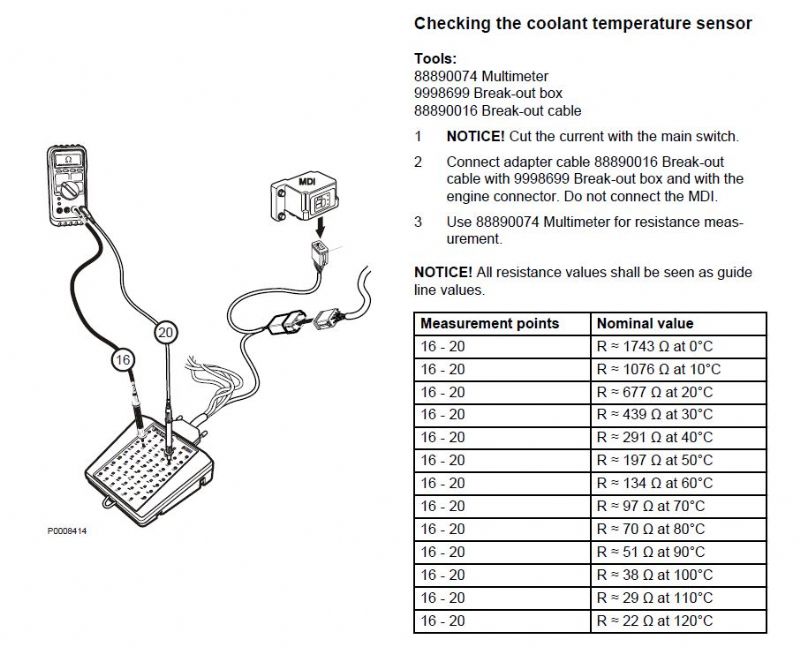

Temp_Sensor_values.JPG


I had a few occurrences of the alarm going off on my D1-20. I always took it at face value and believed the engine to be too hot, though it was never so hot as to be boiling or burning paint off. It generally occurred when motoring in rough conditions, so when we had to cover the entire south coast of Guernsey against a 2 knot tide and with 30 knots on the nose I felt obliged to limit revs to 1800 which made for a very slow and unpleasant passage.

I searched high and low for a problem but the only fault I could find was a small leak from the driveshaft seal of the raw water pump. It was rebuilt with Speedsleeve and a new seal, and have had no problems since.
 
Thanks but my alarm is going off consistently at around 80C. It shouldn't trigger until 110C. The sensor is working correctly (i.e. resistance follows the published values) so I believe the problem is in the EVC control box. Since these are over £400 to replace I am keen to explore other possibilities! It is strange because it is almost working correctly - just slightly oversensitive on temperature. The other alarms and the tacho all seem OK.

The only difference from all previous outings is that the calorifier is empty, but I don't believe that is the answer either.

I can reproduce the fault tied to the pontoon after motoring in astern at 2000 rpm for about 5 minutes.
 
As feared another load of spherical things therefore deleted
 
Last edited:
Thanks but my alarm is going off consistently at around 80C. It shouldn't trigger until 110C. The sensor is working correctly (i.e. resistance follows the published values) so I believe the problem is in the EVC control box. Since these are over £400 to replace I am keen to explore other possibilities!

Had you considered adding a resistor in series with the sensor, to artificially fool the control box?
 
Vic
You're looking at the cct for earlier models with old type control panel. OP has the later EVC type which uses one sensor see cct on P44. Thanks for posting that manual, it covers my engine too, I only had the manual for the non EVC one before!
 
Playtime
You're saying that the voltage drops as sensor resistance decreases, and alarm is voltage triggered. Do you know that for a fact? My assumption would have been that the 5V supply should hold up and the alarm would be current triggered, in which case the answer might be a defective regulator in the EVC module.
I have no evidence for this view, it's just my guess.
 
How about if the 5 volts is a pull-up on the gate/base of a device?
It'll be pulled down by the sensor until the device switches off and triggers the circuit.
I'm not sure where you are actually measuring - I assume there is no possibility of a short in the cable loom as the engine warms and vibrates?
 
How about if the 5 volts is a pull-up on the gate/base of a device?
It'll be pulled down by the sensor until the device switches off and triggers the circuit.
I'm not sure where you are actually measuring - I assume there is no possibility of a short in the cable loom as the engine warms and vibrates?

Certainly possible, also thinking about it, I guess the OP is measuring voltage just across the sensor, so it could be that the overall excitation voltage is constant but there is a potential divider within the control unit. I don't think it's soluble without some idea of what's inside the EVC control unit, and there's not much chance of getting that!
 
Does anyone know what these forum cronies are talking about? Links in deleted posts, PMs with links. Very "community"!

No I posted my idea of what might be the trouble at #2 but then thought better of it , fearing correctly as it turns out, that it was a load a rubbish.

I subsequently found a link to the electrical section of the workshop manual, thought perhaps that I had been right in the first place so posted again what I had previously deleted. It turned out that I was wrong because I failed to realise that I was talking about an earlier version of the engine than the OPs So deleted my ramblings for a second time.

Plevier had seen the link to the manual but not copied it ( I expect its in his history file though) and asked me to re post it or PM it to him. So its now re-posted


Understand now ? .... No ... tough!
 
Last edited:
Gents

Thanks for all the replies. For some reason I'm not receiving the usual email notification of replies so have not been keeping up with the flow.

My problem is that I don't know how the control box works. I only know what I have measured using a digital multimeter and a (cheap) IR thermometer. However, at the moment I don't suspect my readings and I don't suspect a mechanical (water flow etc.) problem.

I still suspect the control box but am reluctant to remove it for internal examination for fear of making things worse - all other functions it performs appear to be OK.

I have thought of inserting a resistance in series which might well fix it - but would leave me with an uncomfortable feeling that it was a bodge and might actually render the alarm useless at some point in the future.

My favoured solution, if I can't find someone with 'inside' knowledge of the control box, is to use an old fashioned normally open switch type sensor and wire it in parallel with the oil pressure switch. This would sound the alarm but give the oil pressure warning icon - still sufficient to prompt some quick action I think.

Any other (constructive) suggestions gratefully received
 
Don't know if this helps - I had a Volvo on which the overheat alarm went off when the engine was running at normal temperature. It was traced to an impeller blade which had sheared off and become stuck in the exhaust causing a very localised rise in temperature, which the sensor detected. Once removed, never a trouble again.
 
Yes - that's certainly a possibility. I haven't checked the impeller yet (it's only done 100 hours) and the raw water flow out the exhaust looks good. However, I'm ruling nothing out yet.
 
Aaaarghh I was trying to edit not delete!

OK condensed repeat.

Manual says sensor feed voltage with sensor disconnected should be 5V. Checked?
Then says V across sensor with it connected at 20 deg should be 2-3V. Checked?
If we assume it's 2.5V, then as sensor is specified as 677 ohms at 20 deg (checked?) this implies a source resistance of 677 ohms also.
At 83 deg you're measuring 65 ohms. If it's a simple cct that should give you 0.44V across sensor but you're getting 0.62V.
At 110 deg sensor resistance should be 29 ohms, giving a voltage across the sensor of 0.2V leaving 4.8V internally as the correct tripping voltage.
Just possibly the voltage has drifted - if you check it with sensor disconnected and get 5.5V rather than 5V that could explain it (4.8V trip level + 0.62V seen on sensor = 5.42V)
There are a number of assumptions in the above and it could also be sphericals but it's one to think about.
 
Last edited:
Plevier

Thanks for that. I have checked all the above at some point and I agree with your suggestion that the voltage (or trigger point) may have drifted.

What I need now is someone who has 'inside' knowledge of the internals of the box before I remove from the engine and open it up. At £450 to replace I am not keen to wreck it as all other functions work correctly. For it to 'drift' as you suggest, has something actually failed?
 
Top