Cylinder head salt weep?

Seasick Ian

Active Member
Joined
13 Jan 2015
Messages
62
Visit site
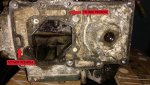
Hi all, doing a service on my Tohatsu 8hp 2-stroke, and I noticed a build up of what looks like salt around the cylinder head gasket (decided against confirming with a taste-test). The engine is in salt water on a mud mooring year round. I have the tools and the service manual, so I will probably take the head off and inspect the water channels, but I don't have much experience, and was hoping to find some here, in terms of what i'm looking at. Does this look like salt weep? Is this normal?

I did a compression test, cold, and got 100 psi on both cylinders. The manual specifies 50 psi. I will get some bits and bobs to get the engine started and then take a warm reading. I'm not sure if the high compression could be connected to the suspect head gasket (would have expected low compression...).

Any thoughts on this would be appreciated,

Cheers
 

Attachments

  • image.jpg
    image.jpg
    103.6 KB · Views: 0
Hi all, doing a service on my Tohatsu 8hp 2-stroke,

Any thoughts on this would be appreciated,

Cheers

50 psi will be the minimum at which the engine is likely to run ( I'd have suggested 60)

It'll run better at 80 to 100. 120 would be exceptionally good ... higher probably means a dodgy gauge.

I agree that looks like a weepy gasket but not not affecting the compression at the moment.

taking the head off to renew the gasket looks straight forward. You really ought to find out the correct torque for the bolts before reassembling.
 
50 psi will be the minimum at which the engine is likely to run ( I'd have suggested 60)

It'll run better at 80 to 100. 120 would be exceptionally good ... higher probably means a dodgy gauge.

I agree that looks like a weepy gasket but not not affecting the compression at the moment.

taking the head off to renew the gasket looks straight forward. You really ought to find out the correct torque for the bolts before reassembling.

+1

It looks as if the outer part of the gasket has started to weep between a water channel and the outer block. The inner section of the gasket which is sealing the bore might well be sound. However, two stroke head gaskets are usually fairly straighforward providing you can get the parts.

Richard
 
I am in the process of rebuilding a Yamaha 9.9 that had been left on my boat for about 4 years. The gaskets didn't look half as salty as yours, yet when I got the head off the water passages were solid with salt and Calcium Carbonate residues. Plus, the water jacket had corroded through into one of the exhaust ports. I would suspect that your engine will be compromised in the cooling department that you are probably on borrowed time before something gives out. So, a choice between keep using it as is until it dies or, take the head off (prepare for snapped bolts etc.) clean out and inspect with the possibility that you wont get it back together without spending a few quid. I like to know the condition of the engine I am relying on, so if it looks ropey I will strip it until it isn't ropey, but that's me :)
 
Thanks for the input.

I have decided to go ahead and take off the cylinder head, mostly because it turns out I need a new lower unit, as I don't think I can repair the holes in the current one. If I am going to spend money on the engine I want to be certain that everything else is functional. So, off with the head.

Any tips for removing the bolts without snapping them? I had a go but started rounding off the edges so left it for now. Normally I would apply heat, WD40, and also some extra leverage, but not sure if that is a good idea for this. The service manual says to disassemble it by undoing the bolts furthest from the centre first.
 
Heat is your friend, we are talking a big torch not a kettle or a pencil torch. But on an old Tohatsu You are going to be doing well to get the bolts out.

Use an impact wrench [ air or lecky ] with a black impact socket rather than a spanner. As you have already found the bolts are not high quality.
 
Heat is your friend, we are talking a big torch not a kettle or a pencil torch. But on an old Tohatsu You are going to be doing well to get the bolts out.

Use an impact wrench [ air or lecky ] with a black impact socket rather than a spanner. As you have already found the bolts are not high quality.

Impact sockets are usually hexagon so even if you don't use an impact wrench make sure you use a hexagon socket. A 12-point socket on this type of nut / bolt will normally open the door to a world of pain! :(

Richard
 
Thanks for the tips, I'm going to do all the stuff that has been recommended.

As for sourcing the parts, I've found a few gaskets on eBay UK, but they are kind of pricey. There's some cheaper options from Singapore, but I'm a bit nervous about buying components from Asia. The UK supplied gaskets appear to have copper rings for sealing the bore, but the Asian ones have some sort of silver looking metal. Ive got the proper part numbers, but beyond typing them into google....Any suggestions?
 
Some years ago I brought a brand new 8hp sail drive Tohatsu, within six months it developed deposits like you are describing. The dealer said ignore it, that it was something to do with the gasket material. I ignored it and the engine continued to perform faultlessly. I sold it to a friend of a friend after three years and it continues to perform to this day some ten or so years later.
 
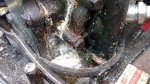
OK, thanks Calico Jack. That makes me think that maybe I don't need to take the head off. But at the same time I would like to know what condition the inside is in. I want to be able to use the engine without worrying and wondering when it will pack in... But then the compression test gave good readings. I'll attach a photo of the base of the engine block. It ain't pretty. I need to clean it up (why is plain white vinegar so hard to find!?). My engine has two peeholes, an idle and a fast. The idle one is small and it was blocked, but the fast one was fine. The water channels that I can see appear to be OK, but I do wonder about the channels around the bores.

The very poor condition of the lower unit makes me think there could be more of the same. I quite like playing mechanic - if I end up with a leftover useless lower unit, I want to cut away a section with an angle grinder so the internal working parts can be see, just for a laugh. But at the same time taking the head off could turn into a right ball ache.
 

Attachments

  • IMG_20160320_2109424822BFX.jpg
    IMG_20160320_2109424822BFX.jpg
    100.4 KB · Views: 0
Top