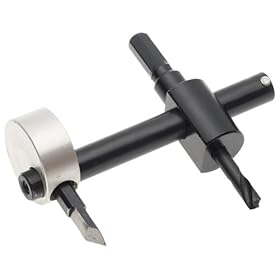
Cutting big circular 'oles in fibreglass

Ubergeekian

Well-Known Member
Joined
23 Jun 2004
Messages
9,904
Location
Me: Castle Douglas, SW Scotland. Boats: Kirkcudbri
www.drmegaphone.com
I need to fit a compass to a bulkhead and an access hatch to a buoyancy tank. Both involve some circular hole cutting - about 8cm and 20cm diameter respectively. That's bigger than any hole saw I have ever seen, and I would welcome tips on good ways of doing it. In the past I have done similar jobs (a) by drilling a lot of holes and sawing between them and (b) with a jigsaw. The former was extremely time consuming and the latter I found difficult to do accurately. Any advice, other than "learn to do it better" - which I ruefully accept may be the only answer ... ?
 
You need an adjustable scribing saw like this

41g5WL0ZZJL._SL500_AA280_.jpg

In fact there is one on Amazon UK Here and loads here on Ebay
 
Last edited:
Rough the hole out slightly undersize using either method a) or b). Finish to marked line with an abrasive flap-wheel held in an electric drill. This is quite accurate and quick, and avoids chipping the gel coat. NB Jigsaw blades don't last long against GRP.
If chain drilling, use a biggish drill to speed the job, then join with the jigsaw.
 
Last edited:
I need to fit a compass to a bulkhead and an access hatch to a buoyancy tank. Both involve some circular hole cutting - about 8cm and 20cm diameter respectively. That's bigger than any hole saw I have ever seen, and I would welcome tips on good ways of doing it. In the past I have done similar jobs (a) by drilling a lot of holes and sawing between them and (b) with a jigsaw. The former was extremely time consuming and the latter I found difficult to do accurately. Any advice, other than "learn to do it better" - which I ruefully accept may be the only answer ... ?

Starrett make hole cutters at 83mm and 210mm. the 83 will make a nice clean hole if you do 1/2 from one side and 1/2 from the other side of the b/head

I'd do the 200 with a jigsaw and a dremel
 
I would mark off with dividers then drill with a small dia. drill as close as poss. then use your jigsaw to link up. (thats if your not very good with a jigsaw)Finish off with a half round file.Never had any success with scribing hole saws, prob. OK on thin ally but would be useless on grp.
 
But have you seen the price of a 200mm bimetal hole saw cutter?

fair point, i just largend my exhaust outlet and borrowed one. surely an onsite engineer or even the marina workshop will have one you can borrow for 5 mins?

it mite be be expensive but it does a very good proffesional job, the right tools useually are expensive!
 
These devices are basically out of balance and must be rotated extremely slowly. They are difficult to control the rate of cutting anf tend to dig in and then your wrist rotates instead of the cutter. They cannot be used in confined places.They are not suitable for large holes.

I advise their use only as a last resort.
 
[QUOTE
I advise their use only as a last resort.[/QUOTE]

I would agree. A large hole-saw requires a lot of torque and should be used in a pillar drill or similar. Hand held, it could cause damage or even personal injury.
 
You need an adjustable scribing saw ...
In fact there is one on Amazon UK Here and loads here on Ebay

Ah-ha. Thanks. I have met and used fly cutters on metal, but didn't know they existed in this form

Rough the hole out slightly undersize using either method a) or b). Finish to marked line with an abrasive flap-wheel held in an electric drill. This is quite accurate and quick, and avoids chipping the gel coat. NB Jigsaw blades don't last long against GRP.
If chain drilling, use a biggish drill to speed the job, then join with the jigsaw.

Flap wheel = good idea. Many thanks.

what u want is one of these.

Starrett make hole cutters at 83mm and 210mm. the 83 will make a nice clean hole if you do 1/2 from one side and 1/2 from the other side of the b/head

I'd do the 200 with a jigsaw and a dremel

The trouble with a fixed size hole cutter is that are blinking expensive in those sizes, and I only have two holes to do.

I would mark off with dividers then drill with a small dia. drill as close as poss. then use your jigsaw to link up. (thats if your not very good with a jigsaw)Finish off with a half round file.Never had any success with scribing hole saws, prob. OK on thin ally but would be useless on grp.

Warning heeded. It may have to be the hole and jigsaw route ... it just takes ages ...

fair point, i just largend my exhaust outlet and borrowed one. surely an onsite engineer or even the marina workshop will have one you can borrow for 5 mins?

it mite be be expensive but it does a very good proffesional job, the right tools useually are expensive!

Unfortunately she's in a farmyard, and the nearest marina workshop is 35 miles away ... as the crow flies ... on the other side of the Solway. However, it's possible that my local gliding inspector has an 80mm hole saw for instrument panels, so I shall ask him ...

PS Dont forget to tape the Gel coat or you might scratch it.

Good point. Thanks.
 
Provided there was room, I would use a router (+ goggles + dust mask + disposable boiler suit + vacuum cleaner!). The Trend Ltd catalogue lists TCT cutters suitable for GRP.
 
Provided there was room, I would use a router (+ goggles + dust mask + disposable boiler suit + vacuum cleaner!). The Trend Ltd catalogue lists TCT cutters suitable for GRP.

This may be the excuse I need to buy a die grinder ... it used to be possible to buy a Bosch router kit for less than the die grinder which was the works of the grouter ...
 
These devices are basically out of balance and must be rotated extremely slowly. They are difficult to control the rate of cutting anf tend to dig in and then your wrist rotates instead of the cutter.....I advise their use only as a last resort.

If your talking about the adjustable scribing saw then I concur. I used one to mount a VHF extension speaker and it scared the **** out of me. I would not use one again.
 
Two problems I have found with a jigsaw are: the blade wears out quickly and will not cut, You need "turning room" as you go round so if there is anything like a bulkhead or cabin sole nearby you get half way round and find you are stuffed. What type of saw blade should be used for a jigsaw?

I am interested in this as I have acquired a better sink for the heads and will need to enlarge the existing hole I am currently thinking of drilling big holes where the corners will be then attacking the rest with an angle grinder and cutting disc.
 
Top