Curious paint / anti-foul erosion

doraymefa

Well-Known Member
Joined
14 Nov 2011
Messages
109
Visit site
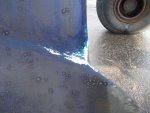
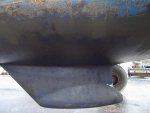
Can anyone explain the wear pattern that I have experienced over both of the last sailing seasons? The boat has either been on a swinging mooring or an anchor and has been sailed for about 45 days each season. I can confirm that we have not been sailing in reverse with a bit of rope over the keel bulb for longer than anyone else!
 

Attachments
  • keel wear 1.jpg
    keel wear 1.jpg
    94.3 KB · Views: 0
  • keel wear 2.jpg
    keel wear 2.jpg
    94.1 KB · Views: 0
Last edited:
It's the perfect location for cavitation erosion, although I am surprised to see it at such a relatively low flow rate. In restricted flow, such as between the top of the bulb and the hull, the flow velocity increases and the pressure decreases. Cavities can then form at the lowest pressure point. As the bulb profile drops away the velocity decreases again, the pressure increases and the cavities collapse. It's the collapse of the cavities that impact on any surfaces in the area, in your case at the trailing edge of the bulb. It's a big problem on ships' rudders due to the flow from the prop, where the same mechanism applies.

Does it occur on both sides of the keel?
 
vyv_cox thanks for the explanation. Yes it occurs equally on both sides of the keel.

When re doing the anti fouling should I put a primer on the bare metal or just slap on the anti foul direct?

It seems as though what ever I do the result will be the same and at least no weed is growing there.
 
Last edited:
Hull cavitation - at six knots??? I doubt that's possible.

It's the swinging mooring that's the clue. How about the where the mooring riser (it's rope, not chain isn't it?) gets hooked over the keel-bulb when the boat overruns it when swinging? The bulb is designed to shed ropes like this but until the boat turns it will remain in place and perhaps pull some slack through, hence the erosion up the fillet.
 
This only began when we moved to a new mooring two years ago. The riser is 20mm chain and does not get hooked over the bulb. The junk is short and could not get tangled either. There is a constant tidal current through the mooring area - Dunstaffnage.
 
This only began when we moved to a new mooring two years ago. The riser is 20mm chain and does not get hooked over the bulb. The junk is short and could not get tangled either. There is a constant tidal current through the mooring area - Dunstaffnage.
It is surprising what gyrations a boat does when wind over tide
It only needs to snag once to get the result shown
I would say chain rubbed at some time
 
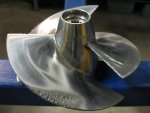
Cavitation looks like this - pitted erosion, whatever's got at that keel looks more like abrasion to me - the smooth shiny metal and the shape of the missing paint suggest that. Cavitation on hulls seems so rare it doesn't rate a mention on the net except for high speed tunnel hulls. It is found in very high speed environments like prop blades, turbines, rotary valves etc. It can occur on concrete spillways at flow speeds of around 15m/s - 30Kts and though not a very scientific comparison suggests that with an added 2m head of water column it would be most unlikely (imo impossible) at sailing speeds.

Something is occasionally getting hooked over that bulb and pulling through a bit to rub off the paint, and I'd wager that coinciding with a change in mooring is the key. Anyway, the boat sailed at the same speed before changing moorings so if it were cavitation it would always have been there - tidal flow speed most certainly isn't doing this. Penny to a pinch of whatsit the mooring's involved.


Cavitation_Propeller_Damage.jpg
 
Last edited:
I did say that I thought the flow rate was too low. However, it is only eroding antifouling that is being lost, no question of anything more severe. In pump impeller research they use a similar paint to monitor the onset of cavitation, it shows up in seconds.
 
Thanks for all these responses. I have had a long time to think about the matter and remain uncertain as to the cause. On the one hand flow rate due to tide alone seems unlikely to cause cavitation but the pattern is consistent with a flow related issue. On the other hand the suggestion of a hook up with the swinging mooring is reasonable but why do the scrape marks not go more vertically down?
 
I don't think it would have to be cavitation as such, a turbulent flow might well accelerate the wear of antifoul.
I don't think a rope or chain would wear the paint right in the corner between the bulb and the fin and leave the rest unscathed quite like that?

It could also be that the area affected was wet or contaminated when the paint went on?
 
Good suggestion, however I don't think the area was wet or contaminated two seasons in a row having never been an issue in the six seasons preceding.
 
Top