
Cunningham

Yes, the cringle will need some reinforcement probably. A couple of layers of sailcloth perhaps?
Then add a decent purchase.

Googling, I saw a nice arrangement of an external ring attached with webbing going off in 3 directions - it looks like the right idea. That guy has a 2:1 mechanical advantage with a line going up and through the ring then down and aft to the cockpit where it terminates on a camcleat. But would that give enough tension? I'd probably rig a 6:1 tackle similar to a vang.

http://www.triton381.com/projects/smallprojects/sailinghardware.htm
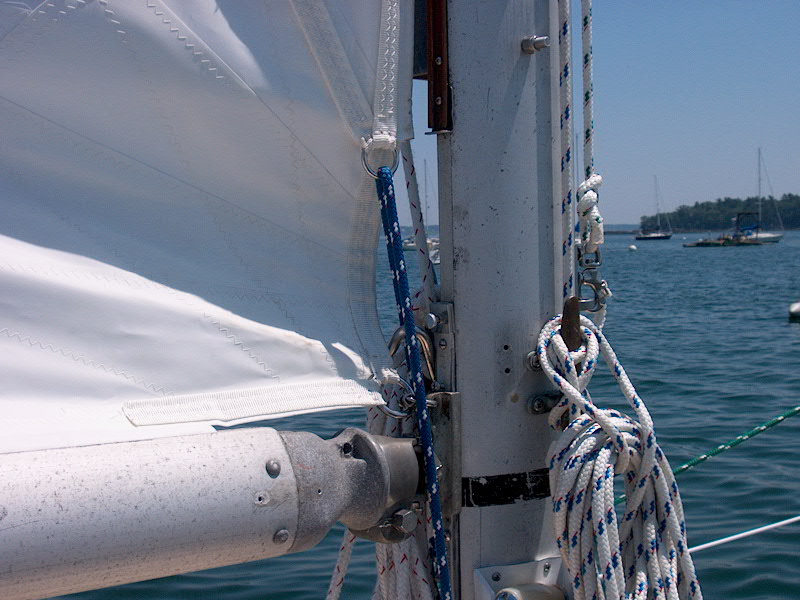
cunningham.JPG
 
Cunningham tackle

I fitted a saddle (pop rivetted) to the side of the mast forward and lower than gooseneck on each side of the mast. A pioece of rope is tied to one saddle goes through the eyelet then down through the other saddle to a turning block attached to the deck then from there back to a winch and cleat. This gives a 2 purchase cunningham but with huge power advantage from the winch.As I said before I don't often bother using it. Depending on crew demands!
Many other boats just use a tackle 4 purchase or more to a hook which goes through the eyelet.
However to Zen Zero I would go for a reef rather than cunningham. That will tame the weather helm.
olewill
 
When I got my current main it came with holes for both a luff and a leach Cunningham. This was my first acquaintance with the latter. So far I've just pulled both in fairly tight to flatten the sail when the wind gets up, but having read some of the erudite stuff here about moving the draft forward or back using the luff Cunningham, and how one should "play" it, I'm wondering if I should be a bit more interactive. So, anyone care to comment on how best to use a leach Cunningham?
 
When I got my current main it came with holes for both a luff and a leach Cunningham. This was my first acquaintance with the latter. So far I've just pulled both in fairly tight to flatten the sail when the wind gets up, but having read some of the erudite stuff here about moving the draft forward or back using the luff Cunningham, and how one should "play" it, I'm wondering if I should be a bit more interactive. So, anyone care to comment on how best to use a leach Cunningham?

1. It lifts the boom further from hitting the water.
2. Using a reefing line which pulls out as well as down, it flattens the lower half of the sail more than the outhaul will. Without pulling the clew beyond the black band, which would take the boat out of certificate in racing.
 
Flattening reef

Not a leach cunningham but a flattening reef. Used to remove the bottom of the sail where the excess cloth for a large camber lives. Flattens the sail without loosing much area. Or you can just put one reef in does same thing. olewill
 
Not a leach cunningham but a flattening reef. Used to remove the bottom of the sail where the excess cloth for a large camber lives. Flattens the sail without loosing much area. Or you can just put one reef in does same thing. olewill

the "droopy boom" is a rule cheat
flattening rhe sail by raising the boom actually is the "measured" size of the sail, so ie the booms normal position
 
For those who use a (luff) cunningham, do you use it only for the full main or would you have attachment points above reefing points to use on reefed main or is halyard sufficient once reefed?
Thanks
 
For those who use a (luff) cunningham, do you use it only for the full main or would you have attachment points above reefing points to use on reefed main or is halyard sufficient once reefed?
Thanks

the mast on a racing boat has black bands
one at the goose neck
one at the measured sail full hoist
one on the end of the boom at the foot max lenght
when the bsail is full hoist and the sail is still to full ( camber) the cunninghan is deployed to stretch the luff downwards.
when reefed the sail isnt full hoist so the cunningham isnt needed
 
Top