Contessa 26 Bow damage fix suggestions??

Sea badger

Member
Joined
24 Aug 2009
Messages
39
Visit site
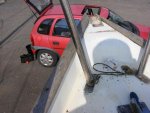
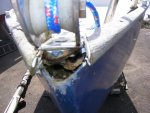
Hello. Wondering if anyone has experience of working on a Contessa 26 bow? I have recently acquired a Contessa 26, but she has suffered some damage to the bow in the past that I would like to put right. The forestay doesn't terminate at the area in question, but there is a small bow roller.
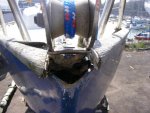
DSCF6822.jpg

I have removed the bow roller, and the small triangle of fibreglass on which the bow roller sat.
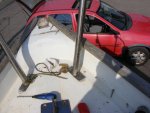
DSCF6831.jpg

And discovered there is a block of timber underneath which does move a bit when levered with a screwdriver. It feels a little soft when probed with a small sharp screwdriver, but seems to be harder deeper down.
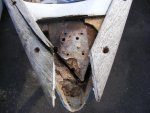
DSCF6849.jpg

Question is how to proceed? I think I could remove the wood with a bit of effort (basically break it up), but don't think I will be able to get a new piece in. Could I remove it and fill the cavity with some sort of resin that will give the required strength? Or should I just glass it in position and cap off with a stainless plate / bow protector combo?

Any advice would be greatly received.:ambivalence: Thanks
 

Attachments

  • DSCF6825.jpg
    DSCF6825.jpg
    93.5 KB · Views: 1
  • DSCF6830.jpg
    DSCF6830.jpg
    93.9 KB · Views: 1
Personally I think I'd shape a piece of hardwood then glass it in strongly, paint it like mad for preservation then put on top a custom stainless roller & deck triangle - if you see what I mean - with a strip down the stem through bolted.

I don't know where you are based but Chris at C&B Marine near Chichester Marina ( reasonable prices despite the location ! ) could do it easiliy with a sketch & dimensions.
 
I'm tending to agree with you. I think I can remove the wood. Then depending what I find, I should be able to glass a slightly smaller piece of timber back in. I think it will have to be smaller, as I assume the original was put in place when the boast was moulded. thanks
 
If you are going to replace the rotten wood with a slightly smaller piece, embed it with West Epoxy and microspheres to take up the gaps. Just make sure the mating surfaces are clean and clear. BTW the capping looks as if it could do with being replaced by the bow. If you're going to scarf in a bit of new wood here, removing the old stuff before you try to patch in the new pad might give you a bit more room to work.
 
If you are going to replace the rotten wood with a slightly smaller piece, embed it with West Epoxy and microspheres.

I can think of nothing wrong with West for this application, but why recommend it specifically? Plenty of other epoxy resins would do the job just as well, and cheaper.
For strength, I'd prefer microfibres to ballons.
 
I can think of nothing wrong with West for this application, but why recommend it specifically? Plenty of other epoxy resins would do the job just as well, and cheaper.
For strength, I'd prefer microfibres to ballons.

If you want strength, glass fibres, not the microfibres.
Polyester resin is generally as good as anything for repairing a glass/polyester layup.
Epoxy comes into its own when you want to stick wood to it or use carbon or Kevlar.
 
Polyester resin is generally as good as anything for repairing a glass/polyester layup.

Polyester does not bond particularly well to well-cured (ie old) polyester; epoxy works better. On the other hand, polyester bonds well to epoxy, so a layer of epoxy and then polyester works fine, if you want the hassle of two resins for a fairly small cost saving.
 
If you want strength, glass fibres, not the microfibres.
Polyester resin is generally as good as anything for repairing a glass/polyester layup.
Epoxy comes into its own when you want to stick wood to it or use carbon or Kevlar.

Perhaps you should have directed that at Topcat, who recommended epoxy.
For what it's worth polyester does not "bond as well as anything" (which is not to say that it cannot bond well).
And isn't sticking wood to it exactly what the OP requires?
 
Polyester does not bond particularly well to well-cured (ie old) polyester; epoxy works better. On the other hand, polyester bonds well to epoxy, so a layer of epoxy and then polyester works fine, if you want the hassle of two resins for a fairly small cost saving.
Polyester should bond to old polyester if you take the surface off, which you need to do to use epoxy on it reliably anyway.
I've never used polyester on top of recently cured epoxy in anything structural where the bond between the new polyester and epoxy mattered. Not heard it recommended before either, although I've never had a problem using polyester gelcoat to finish an epoxy repair. Obviously the stress on the gelcoat bond is low.

I used to think epoxy was the best resin for all repairs, but sometimes it pays to repair like with like, because that way you get the same expansion and shrinkage which can show up a repair where discontinuous materials are used.
Not many of my repairs fall into the class where that matters though, TBH!
 
Polyester should bond to old polyester if you take the surface off, which you need to do to use epoxy on it reliably anyway.
I've never used polyester on top of recently cured epoxy in anything structural where the bond between the new polyester and epoxy mattered. Not heard it recommended before either, although I've never had a problem using polyester gelcoat to finish an epoxy repair. Obviously the stress on the gelcoat bond is low.

I used to think epoxy was the best resin for all repairs, but sometimes it pays to repair like with like, because that way you get the same expansion and shrinkage which can show up a repair where discontinuous materials are used.
Not many of my repairs fall into the class where that matters though, TBH!

Polyester bonding to wood, will mean painting the wood with catalyst to prevent the wood sucking the catalyst out of the resin. When I worked on the yard, we would only use epoxy for this application, with microfibres, not spheres, not balloons and not glass fibres....

Jon
 
I've repaired the bow on my Fulmar with polyester resin when it was ripped off in a collision.It is a stressed area as it takes the forestay fitting so I extended the strap at the stem a few cms further down.Anyway it's still there and the repair is very strong.I would have used epoxy resin though but couldn't find any where I was at the time.
As long as you grind the edges of the repair to a shallow V through the whole thickness of the laminate a polyester resin repar will be perfectly adequate.
 
Polyester bonding to wood, will mean painting the wood with catalyst to prevent the wood sucking the catalyst out of the resin. When I worked on the yard, we would only use epoxy for this application, with microfibres, not spheres, not balloons and not glass fibres....

Jon

+1 also as said previously it would be easier to build up a lamination with the aid of cardboard templates and preferably hardwood if using screws to fix bowroller although some form of through bolting would be better. Another consideration if using thickened epoxy is the heat whilst curing large amounts in a cavity a slow hardener will be safer and building a lamination will mean the heat can be dissipated more gradually .
 
Polyester bonding to wood, will mean painting the wood with catalyst to prevent the wood sucking the catalyst out of the resin. When I worked on the yard, we would only use epoxy for this application, with microfibres, not spheres, not balloons and not glass fibres....

Jon

The wood inside appears to be soggy.
Best regard it as non-structural.
It wants as much of the decaying stuff as possible removing, then dry the rest as best you can.
It then wants sealing and then the structural bit starts. You can seal it with many things, epoxy, polyester with a bit of extra catalyst, whatever.
The sealing layer stops the wood interacting with the main act of the resin, or water from the wood getting into the resin before it sets.

For the structural bit, you want resin with glass in it.

Then repairing the wood trim on top is a separate exercise?
Epoxy and microfibers to glue wood to wood, or even wood to GRP, although screwing it to GRP on a bed of polyurethane sealant might be preferred.
 
Polyester should bond to old polyester if you take the surface off, which you need to do to use epoxy on it reliably anyway.!

It forms a mechanical bond, like any other glue, but not a continuous chemical bond, so you don't get the strength you might. I had to do a hull reinforcement on my last boat and took advice from colleagues at the composites research centre to which I was seconded at the time. Their recommendation, which I followed, was to use an epoxy layer on top of the old polyester and then new polyester on top of that.
 
It forms a mechanical bond, like any other glue, but not a continuous chemical bond, so you don't get the strength you might. I had to do a hull reinforcement on my last boat and took advice from colleagues at the composites research centre to which I was seconded at the time. Their recommendation, which I followed, was to use an epoxy layer on top of the old polyester and then new polyester on top of that.

This 'only a mechanical bond' is oft-repeated folklore.
If the surface is abraded within a few hours of putting new resin on, there will be plenty of cross bonding between the new resin and bonds opened on the new surface of the old substrate.
If you can't get an adequate peel strength or bond, you're not doing it right!

Your layer of epoxy may be an alternative to abrading, but a lot of people will tell you that the bonding of polyester on epoxy is not great.
Many people are convinced that using polyester to stick to epoxy is hopeless, many will tell you horror stories of repairing dinghies which were built with a polyester gelcoat and an epoxy layup.
A lot of people say that poly should not be used on top of epoxy for anything remotely structural.

Of course the caveat is that there are many flavours of epoxy.
 
Is the wood supposed to be there or is it a previous bodged repair?

I tackled something similar on my boat by stripping multiple previous bodges done by other owners, cleaning the whole area back with a sanding disk on an angle grinder then laying up a good few layers of matting plus some tape for the whole area back a good couple of feet from the damage using west system epoxy.

You will need the right kind of matting for epoxy as the stuff for polyester resin has a binder soluble in styrene and wont wet out very well with epoxy.
 
Top