

ProDave
Well-Known Member
I know this has been discussed before but I wanted to add a bit more detail and another twist to make it truly "stand alone"
We have a Navman VHF 7100 and now we have swapped the old chart plotter for a tablet, no longer have a source of GPS data. So I wanted a simple cheap GPS receiver to fill that role.
I bought one of these QUESCAN 5V NMEA 0183 RS232 GPS-Antennenempfänger für industrielle Steuerung GPS RS-232 NMEA0183 QZSS SBAS WAAS, 1-10Hz - AliExpress 34
Delivered in 1 week from China. Make sure you tick the 4800 baud option, and I confirmed that with a message to the seller "please deliver set for 4800 baud output"
This VHF radio has a 8 pin din plug / socket for the data connection supplied with a plug with a bare end cable to connect the GPS data input. The GPS receiver module has a 4 core cable for ground, power and GPS in and out.
For this particular radio (it may or may not be the same colours etc for different radios) connect as follows:
RADIO DATA CABLE GPS CABLE
GPS- (green), Ground (black) Cable screen (bare copper) all connect to Ground (black)
GPS+ (yellow) connects to TXD (grey)
All other cable cores not connected.
This still leaves you to supply power to the GPS receiver to it's Red wire, anything between 3.5V and 5V. Most people suggest a junction box and a small 12V to 5V power supply.
Connected like this it all works. And the GPS receiver acquires a position in about 2 seconds from power on, way way faster than the old Lowrance receiver ever used to.
That is where most people would leave the project and consider it finished. But to me it was a clumsy solution requiring a junction box and a separate power supply requiring it's own 12V feed. Wouldn't it be good of only we could derive the 5V to power the GPS receiver direct from the VHF radio. It has after all got a 5 core cable so time to investigate. Time to take the cover off the radio.
The data cable upon entering the radio passes through a small PCB which looks to be just signal conditioning / protection of the data input cable. It was easy to identify the cable cores that were in use, and also one core that seemed to have no function and measured 0V on that core. So this appeared to be the only spare core in the cable that was terminated and available to connect to, so could be re purposed as the power feed to the GPS receiver. The only nuisance being this was a second yellow core in the data cable, so don't get this confused with the other yellow, the GPS+ core.
So inside the radio, I disconnected and insulated the cable that fed this second yellow core and used a 78L05 voltage regulator to feed 5V power to this second yellow core via the little signal conditioning board. That then just left the requirement to find and easy power feed into the voltage regulator, and that was found in the form of the VDD supply to the DSC receiver board close by which is on the blue wire feeding that.
So here is the result of the alterations inside the radio.
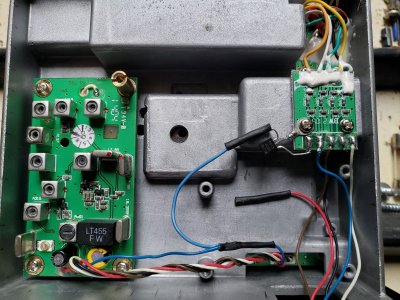
In that picture the little board to the right is the data cable input board. The left hand connection is the one re purposed for the power feed to the GPS receiver. The now insulated and disconnected red wire was removed from the bottom left pad on that board. The 78L05 regulator provides the 5V power for the GPS receiver. And the blue wire that now taps into the blue VDD feed to the DSC board to feed power to the voltage regulator.
Then at the cable connections, just add a connection from the second yellow core from the radio (now the 5V feed) to the red core of the GPS receiver.
Now I have the nice neat solution of a GPS receiver module that plugs directly into the data connector on the VHF radio and it works. No junction boxes, no external power supply, and no need for a second 12V feed. All connections neatly done with solder and heat shrink sleeving.
We have a Navman VHF 7100 and now we have swapped the old chart plotter for a tablet, no longer have a source of GPS data. So I wanted a simple cheap GPS receiver to fill that role.
I bought one of these QUESCAN 5V NMEA 0183 RS232 GPS-Antennenempfänger für industrielle Steuerung GPS RS-232 NMEA0183 QZSS SBAS WAAS, 1-10Hz - AliExpress 34
Delivered in 1 week from China. Make sure you tick the 4800 baud option, and I confirmed that with a message to the seller "please deliver set for 4800 baud output"
This VHF radio has a 8 pin din plug / socket for the data connection supplied with a plug with a bare end cable to connect the GPS data input. The GPS receiver module has a 4 core cable for ground, power and GPS in and out.
For this particular radio (it may or may not be the same colours etc for different radios) connect as follows:
RADIO DATA CABLE GPS CABLE
GPS- (green), Ground (black) Cable screen (bare copper) all connect to Ground (black)
GPS+ (yellow) connects to TXD (grey)
All other cable cores not connected.
This still leaves you to supply power to the GPS receiver to it's Red wire, anything between 3.5V and 5V. Most people suggest a junction box and a small 12V to 5V power supply.
Connected like this it all works. And the GPS receiver acquires a position in about 2 seconds from power on, way way faster than the old Lowrance receiver ever used to.
That is where most people would leave the project and consider it finished. But to me it was a clumsy solution requiring a junction box and a separate power supply requiring it's own 12V feed. Wouldn't it be good of only we could derive the 5V to power the GPS receiver direct from the VHF radio. It has after all got a 5 core cable so time to investigate. Time to take the cover off the radio.
The data cable upon entering the radio passes through a small PCB which looks to be just signal conditioning / protection of the data input cable. It was easy to identify the cable cores that were in use, and also one core that seemed to have no function and measured 0V on that core. So this appeared to be the only spare core in the cable that was terminated and available to connect to, so could be re purposed as the power feed to the GPS receiver. The only nuisance being this was a second yellow core in the data cable, so don't get this confused with the other yellow, the GPS+ core.
So inside the radio, I disconnected and insulated the cable that fed this second yellow core and used a 78L05 voltage regulator to feed 5V power to this second yellow core via the little signal conditioning board. That then just left the requirement to find and easy power feed into the voltage regulator, and that was found in the form of the VDD supply to the DSC receiver board close by which is on the blue wire feeding that.
So here is the result of the alterations inside the radio.
In that picture the little board to the right is the data cable input board. The left hand connection is the one re purposed for the power feed to the GPS receiver. The now insulated and disconnected red wire was removed from the bottom left pad on that board. The 78L05 regulator provides the 5V power for the GPS receiver. And the blue wire that now taps into the blue VDD feed to the DSC board to feed power to the voltage regulator.
Then at the cable connections, just add a connection from the second yellow core from the radio (now the 5V feed) to the red core of the GPS receiver.
Now I have the nice neat solution of a GPS receiver module that plugs directly into the data connector on the VHF radio and it works. No junction boxes, no external power supply, and no need for a second 12V feed. All connections neatly done with solder and heat shrink sleeving.
