Clinker Pram Dinghy

Gryphon2

Well-Known Member
Joined
12 Oct 2009
Messages
247
Visit site
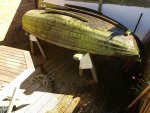
I have been given this nice pram dinghy , made I believe here in Lowestoft about 25 years ago by the boat building training centre. It is very sound with only a couple of small splits.

I have 2 questions

1 I believe the outside has just been oiled in the past with boiled linseed. Is this the sesnible thing to do again or should I prime and paint it ?

2 I believe one can buy some sort of flexible epoxy. Would this be good to do minor repairs and seal minor leaks or should I use something more traditional and/or better?

Any advice welcome by this plastic sailor!
 

Attachments

  • m_IMG_20160823_154557.jpg
    m_IMG_20160823_154557.jpg
    47.9 KB · Views: 1
I presume you are talking about small splits in the planks? On the basis that you would like it to be 'traditional', then replace the 'couple' of planks. Epoxy has no place anyway near that - unless of course it is already destroyed by the use of epoxy. The planks should have no mastic or glue if it is traditionally constructed. Clenching the overlapping planks ensures it is watertight. As far as I know there is no such thing as 'flexible' epoxy.

Boiled linseed. Now that is a difficult decision. But if it is 25 years old and original, then the linseed approach has been pretty successful I would think.
 
I'll read it up, thanks. The point is that the traditional construction of clinker has no glue or mastic to 'stop' up the joints. When first made, the overlap of the planks ensure water tightness by 'clenching' - copper nails and roves. The skill is easy to acquire but does need the right kit - ball pein hammer, a drift for roving and pinchers to cut excess copper nails - Are you aware of the technique? I can add more.

But some more modern 'clinker' construction has used wiring and epoxy. She looks 'traditonal' rather than 'modern' given what I can see from that distance.

A traditional clinker construction does experience the years. If she is, for example, over wintered, the planking will dry and then in the Spring, she will need to take up. My 26ft centre-boarder clinker sloop needed some pumping on launching - in some years extensive pumping. The amount of 'taking-up' can be really substantial and quite worse leaks after several hours can suddenly stop. With a traditional construction there is a temptation to put mastic along the plank edges to encourage the absence of leaks. That is a disaster; it may work this year but in ensuring years the mastic between the planks will distort what should usually be nice uniform joints. Splits? Well how bad. I am guessing there are a couple of splits in line with a rivet? Ultimately replacing the plank is best; releasing the plank shouldn't be too difficult, then provides as a template and re-roving. The right copper nails and roves are easy to get - albeit at the cost of copper.
 
Thank you for all that. I have a better understanding of the nature of the beast. There have been some minor attempts to seal leaks in the past with something white and quite hard.... possibly a fibreglass paste but there is very little of it. I have used a small amount of a brown oil based mastic which looks as if it would stem the flow where I can see potential problems. I shall go and put it in the water sometime soon for a few days and see if it does "take up". I am not sure I have the skills to replace planks ....
 
Some closer pictures might be useful. The 'something white' could be a couple of things - white lead putty can harden and look like fibreglass, or it might be anything. Diagnosis is very important. If different attempts have been made then epoxy might be the way forward. If it is a couple of spots, I would suggest avoid epoxy. It's a judgment call dependent upon her current condition. I think that's a very good idea to put her in the water and take a look.

More photos would, as I said, be a good idea. How long are the splits?
 
For a few small splits I'd be launching the dinghy, filling it with water and letting the planks take up. Only if that doesn't stop it would I start considering remedial work, starting with putty. Epoxy's and fibreglass and such like are the reserve of punts well on the way to being decrepit.
 
m_IMG_20160826_082026.jpgm_IMG_20160826_082438.jpgm_IMG_20160826_082208.jpg
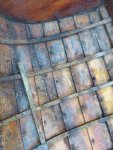
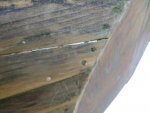
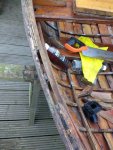
Here are some photos , showing the worst split,a smal bit of white filler that I am fairly sure is grp paste and a pic of the gapbetween the inwhale and rubbing strake. The latter has been filled with short pieces of softwoodbetween the ribsmany of which are soft. Is there any need to replace these except for the sake of looks?

Thanks again for comments and advice.
 
Good photos.

On the basis that she is a lovely classic pram dinghy, that split plank needs replacement. To release the plank, gently grind off the peining of each copper nail. That will release the rove. Genrly drift out the copper nail. Release each hood end (front and rear); they look screwed so carefully clean the head so any stopping is removed before trying to unscrew. It is possible that the screws might have aged and separate head from remainder. Not a disaster but better to be lucky. The plank should gently tap free and then is a perfect template for the new plank. If you don't want to achieve a concorde standard, a epoxy repair is feasible. Externally prepare the split plank and use glass tape and epoxy. The wood needs to be clean for epoxy to stick well. The repair will always be obvious (but under the water). If the wood has been soaked with linseed, the issue of epoxy sticking to the timber is difficult. Perhaps the Flex G is better. But you will have understood that I had always favoured trying to repair back to originality.

I think that might be grp paste but it could be old white lead putty. I note that she was made at the Trainee place so I wonder if that one plank was cut less than perfect and so the 'stopping' from whatever made was to fill the gap. Umm. I would think gently tap out the filler will reveal a gap and so a epoxy fillet is probably necessary. West have a brown colour filler which would be more 'pleasing' but a large amount for a very small bit of work. I would recommend as small a fillet as possible on the basis that clinker construction lives from its flexible structure. But that flexibility is even. So when hard filler is brought in, that part is in ill-company. One small fillet won't harm I would suggest; lots of little repairs with hard filler here and there and the clinker will stronger to take up each year. So, apart from the comment about this one point, if it needs lots of little repairs like the image, do all the filleting along every plank land. I think on what you have shown I don't think wholesale filleting is necessary.

The 'infills'. Umm interesting. On my boat I have infills and I asked exactly the same question 26 years ago. And didn't really get a definite answer. It isn't an important part of the structure or strength except perhaps where there for rowlocks. I suspect the softwood was added. Infills tying in the outer rubbing strake and inner 'beam' shelf adds strength but then needs a capping rail or fresh water will get round the gaps - hence the softwood getting soft. Best remove them I think and check that there are no signs of weakness. If you think it needs to be added then a capping rail would be better. Has there signs that a capping rail has been removed? (When I replaced my infills they were covered by the deck)
 
Thank you for your very full answer... very helpful. I shall not replace a plank for now. If this G flex is as good as it is supposed to be it should do the trick of repairing the splits without using any tape. It would also mean that the plank should still be able to move across most of its width.I think it comes clear but you can add wood fibres etc to colour it. My layman's suspicion is that the most important place not to use something hard is on the joins themselves. I may use a bit of oil based filler if there are leaks once I have given it a good soak.

I shall replace the infills on the gunwale but not cap it as I do not want to add more weight.

One final question. Once I have a perfect boat again(!) how is best to store it. Inside or outside... under a cover or in the open? It has been stored in recent times on saw horses outside and upside down which seems to have been OK

I will let you know how it turns out in a week or 2!
 
From your photos it looks as if you have one split plank in the stern of the boat and another fairly high on the top sides at the bow. Is that correct? If so, the bow split is more a cosmetic job than anything since it will be well above the waterline. On that basis, you could start off with replacing the bow plank, where a few minor imperfections will be less critical, before moving on to the stern, where the integrity of the repair is more critical. That way you can have a ' practice go'. You've probably thought of all that already!
 
Top