Choosing outboard propeller pitch

Sandro

Well-Known Member
Joined
20 May 2004
Messages
281
Location
Northern Italy
Visit site
Good morning,

for my Drascombe Dabber I bought a Yamaha Malta 3hp outboard. As the motor, by eyeball (or earball), did not turn fast enough, I made a few tests with an RPM meter.

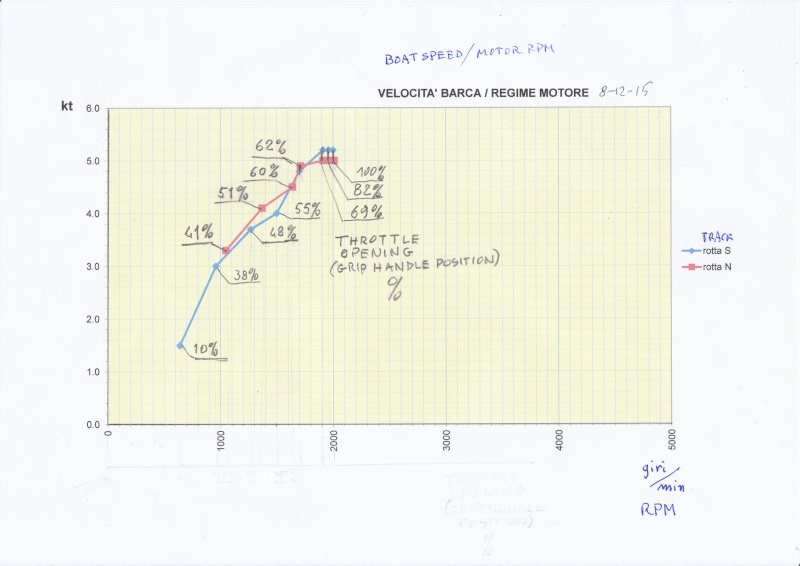
At throttle 3/4 open engine turns at about 1800 RPM and boat makes 5 kt. Further opening throttle until WOT, engine does not exceed 2000 RPM and boat speed increases only to 5.2 kt.
As motor can not reach its maximum speed, rated 5000 RPM, It seems to me that it is overloaded.

In neutral at 2/3 throttle it easily reached 4000 RPM; I did not open further.
In a bollard pull test at WOT it turned at 1600 RPM.

The hull speed of the boat is about 5 kt but, even if not increasing the boat speed, the motor should reach more RPM, with much water mess.

IMHO a propeller with a shorter pitch should allow the motor, with this boat, to reach its maximum speed and to output its maximum power.

I don't seek more speed - the hull is already at its maximum possible - but more thrust would be very useful and also safer in case of strong wind and waves from ahead, or for towing another boat in need.
I also wonder if the motor with this propeller is not overloaded and could be damaged.

The actual propeller is 7 1/4" diameter x 6" pitch. The other only suitable propeller available from Yamaha is 7 1/4" x 5".

Which is the advisable cruising RPM that shall be reached? 85% of maximum rated RPM?
Shall I change the propeller?

Since no prop can be borrowed for a test on water, and Yamaha parts are priced very high, I would be grateful to know the opinion of the experts of the panel before making an expenditure that could prove useless.

Thanks and fair winds

Sandro

P.S. I can give all the details of the tests. I didn't yet because the post is long enough as it is.
 
Sounds like it's way over-propped. Yamaha specify an operating range of 4500 to 5500rpm.
I can't find a power graph on-line, but imagine that at the revs you're achieving your engine is developing maybe half of its rated power...so it's actually pushing your boat along rather well.
 
Yes a prop with a smaller pitch should improve matters but I doubt if the 5" prop will make a huge difference, at least not the increase in rpm you are looking for.

Perhaps worth giving the engine the once over, but its getting the boat up to the expect max hull speed so cannot be much wrong with it

Check its firing properly .. a new plug never hurts a small outboard.

Check the compression.

Carb adjustment, but if it starts easily and runs well I'd not start pulling the carb apart to clean it just yet.


As an aside I assume you are running 100:1 fuel mix. I'd use an oiler mix, esp as you are working it hard. I'd try 50:1 ..... 75:1 at least.
 
Yes a prop with a smaller pitch should improve matters but I doubt if the 5" prop will make a huge difference, at least not the increase in rpm you are looking for.

Perhaps worth giving the engine the once over, but its getting the boat up to the expect max hull speed so cannot be much wrong with it

........
I don't know the gear ratio of the outboard, but it might be worth doing the math as they say.
I've used Maltas a lot on dinghies/tenders, your 5knots at 1800 rpm would imply that full revs on a very light boat would give about 15 knots.
I don't think that's right, the fastest I've had surfing down the wash of a pilot boat is about 10knots, with the motor struggling to keep up with the boat?

First I would borrow a long, light tender and see how the motor goes on that.
Are you absolutely convinced your rpm meter is right?
 
At throttle 3/4 open engine turns at about 1800 RPM and boat makes 5 kt. Further opening throttle until WOT, engine does not exceed 2000 RPM and boat speed increases only to 5.2 kt.
As motor can not reach its maximum speed, rated 5000 RPM, It seems to me that it is overloaded.

Please feel free to correct any of the below as it is not a specialist area for me, but something doesn't sound quite right with the data provided.

From your post I assume you are using a tiny tach, if so are you sure you have it on the right setting as your figures don't look quite right to me.

Even without any prop slip for a Yamaha Malta with a gear ratio of 2.08, the maximum your stated combination could give would be:

1800/2.08*6=5192in/m = 4.2kts assuming moderate slip and the fact that you are more or less at hull speed, it wouldn;t seem unreasonable for your rpm measurements to be a factor of 2 out, which whilst still overpropped would start to make a bit more sense in terms of the likely effeciency of the system
 
post deleted .... more less the same as nrcoyle. but Id not think the rpm figure is out by as much as afactor of 2
 
Last edited:
Before you invest in a new prop, ultra sonic clean carb, along with using BP premium petrol , which has no alcohol at the moment. We down pitched a 8 hp 4 stroke that couldnt achieve max rpm, even with the BP & clean. Petrol quality even when fresh, is nothing like as good as in 1999, and that was poorer than the 80s.

Premium is 97 ron now, super was 98 0r 101 in the not distant past, and will only get worse when B10 & B15 is forced upon us.
 
Assuming the engine is running OK then your quest for more power for possible towing, strong headwinds or waves should be considered against the fact that at present in calm conditions the engine will push the boat along at hull speed at lower revs so less noise and vibration. I would stick with what you have for that fact alone. But then bashing into strong winds and seas is not a priority for me. You decide good luck olewill
 
Take the prop off.

Gently file away along the length of the blade trailing edge.

Make sure it is equal on both blades, ideally by putting the thing on a spinner spindle in a vice or similar.

Try small changes with the prop refitted, and repeat if necessary until the engine builds up to full revs.

You're dealing with a small outboard engine, not a Saturn V.
 
Take the prop off.

Gently file away along the length of the blade trailing edge.

Make sure it is equal on both blades, ideally by putting the thing on a spinner spindle in a vice or similar.

Try small changes with the prop refitted, and repeat if necessary until the engine builds up to full revs.

You're dealing with a small outboard engine, not a Saturn V.
But surely that's only going to increase the rpm at expense of prop efficiency and will not give the increase in thrust that the Op requires in adverse conditions etc.
 
A two-stroke motor fires once per revolution. A four stroke fires once per two revolutions unless it is a system with a so-called wasted spark. This, or rather having your tachometer set to two-stroke, could explain your readings. A further simple test might be to attach the motor to an easily driven hull to see what you can achieve; my 4hp Yamaha will get my 3.5m semi-rib up to about 12 kt, but the motor still sounds as if it is running slow, that's just the noise they make.

Do not add more oil to the mixture without first changing all of the carburettor jets. Adding oil effectively weakens the fuel air mixture and can seriously damage your motor. Also these small four strokes are highly sensitive to contamination of the jets, refusing to start at the slightest issue; The motor could easily suffer from the formation of varnish or gumming in the jets. 'Carb cleaner' only works if it is squirted into the fuel intake, not the air intake as the manufacturers often suggest.

I would not tamper with the existing propellor, but if you were to want to change the pitch there are companies offering this service, usually for larger propellors, but it may be that they can do something with yours. I'd suggest however that the finer prop offered by Yamaha is likely to be quite enough, but get your tachometer readings checked first. A finer pitch prop is also likely to have a greater surface area.
 
A two-stroke motor fires once per revolution. A four stroke fires once per two revolutions unless it is a system with a so-called wasted spark. This, or rather having your tachometer set to two-stroke, could explain your readings.
Do not add more oil to the mixture without first changing all of the carburettor jets. Adding oil effectively weakens the fuel air mixture and can seriously damage your motor. Also these small four strokes are highly sensitive to contamination of the jets, .............

Isn't the Yamaha Malta a 2 stroke? Hence reference to adding oil.

Mike
 
.....
Do not add more oil to the mixture without first changing all of the carburettor jets. Adding oil effectively weakens the fuel air mixture and can seriously damage your motor. Also these small four strokes are highly sensitive to contamination of the jets, refusing to start at the slightest issue; ......

Adding a small amount more oil is very unlikely to make the motor run lean. The oil itself burns to some extent, using oxygen.
The carburation is not likely to be that close to the edge that 1% less petrol makes a difference.
It's not like the old days of Seagull ratios!

Personally I tend to run 100:1 motors at 66:1, it works well with the measures I have.
Excessive oil will cause problems with plugs. But I find very few plug problems on motors that see a reasonable amount of fast running.
 
Adding a small amount more oil is very unlikely to make the motor run lean. The oil itself burns to some extent, using oxygen.
The carburation is not likely to be that close to the edge that 1% less petrol makes a difference.
It's not like the old days of Seagull ratios!

Personally I tend to run 100:1 motors at 66:1, it works well with the measures I have.
Excessive oil will cause problems with plugs. But I find very few plug problems on motors that see a reasonable amount of fast running.

Most if not all 2stroke outboards are run on double the oil in the mix during the break-in period anyway.

Those models that run on 100:1 usually have 50:1 specified for heavy or commercial use
 
A two-stroke motor fires once per revolution. A four stroke fires once per two revolutions unless it is a system with a so-called wasted spark. This, or rather having your tachometer set to two-stroke, could explain your readings.

+1, and exactly the point I was making in post #5, if in less detail.
Having watched a Moto Guzzi go through noise scrutineering at Imola at 12,000rpm with a clip-on tacho set for 2-strokes, it's something I'm very conscious of. In fact my ears are still ringing, 40 years on ;)
 
A two-stroke motor fires once per revolution. A four stroke fires once per two revolutions unless it is a system with a so-called wasted spark. This, or rather having your tachometer set to two-stroke, could explain your readings

+1, and exactly the point I was making in post #5, if in less detail.
Having watched a Moto Guzzi go through noise scrutineering at Imola at 12,000rpm with a clip-on tacho set for 2-strokes, it's something I'm very conscious of. In fact my ears are still ringing, 40 years on ;)

Isn't the Yamaha Malta a 2 stroke? Hence reference to adding oil.

Mike

Yespretty sure a Malta is a 2 stroke. AFAIK Yamaha dont make a 3 hp four stroke anyway.
 
Isn't the Yamaha Malta a 2 stroke? Hence reference to adding oil.

Mike
Doh! Though in my defence the small two strokes are equally sensitive to clogged jets.

The 1999 3hp Yamaha manual says 25:1 during the running in period, so this motor is indeed not bothered by excess oil.

Nonetheless, if the Drascombe is doing 5kt I would be surprised to find that the motor was only reaching half revs, unless perhaps it hits a glass ceiling on approaching displacement speed. I suspect a measurement issue. Trying the motor with a small light launch should resolve that question. Or how about checking idle speed, which should be 1100-1200 ish rpm?
 
Last edited:
Good morning,
Thanks for all the answers.

About oil mix, I am running with 50:1 mix for the same reasons given by VicS, lw395, macd and SAPurdie .

David_backshow, I don't know how if and how much alcohol is in the petrol sold here in Italy. Nowadays petrol is indeed a problem. It soils carbs if left for some time. Even old clear color plastic jerrycans can no more be used. Petrol dissolves some substance from them that then solidifies in the carb. And, as you say, things will get worst.
Nevertheless in my case the motor looks like working properly.

William_H, I usually am a fan of low revving, I hate hearing motors scream (I own and use a Guzzi 500 cc motorbike of 1951 that sounds rather like a 1cilinder tractor) but this one is a small two stroke engine and some little down-pitching would do no harm.
Neither I go sailing in order to struggle against elements but one can be caught out, you never know. Anyway I am here just to get advise.

Back to the main propeller issue of the thread:

Macd, neither I could find a power/rpm graph of this engine.
VicS, why do you think that a 17% difference in pitch would not affect things very much? I was afraid instead that the change would be too big.

Nrcoyl, I made the same reckon without slip, and arrived at the same result, different from the real thing.

Seajet, I am not brave enough to put a file on the prop. I did that long ago by removing only 2 or 3 millimeters of the diameter of a similar prop on a lathe and the effect was way too much.
And, as VicS says, it would not increase the thrust.

I still doubt about the rpm meter.
Being a cheap Chinese one, I checked it against a friend's motor bike's rpm meter: A reading difference of 5% - 15% was found, but the bike meter display is a coarse bar row of variable length, not figures, thus difficult to read exactly.
The bike is a 4 stroke, the Yamaha a 2 stroke. I think to have set the meter correctly but it's so easy to do silly mistakes.
I'll look for some other way to check the meter. Anyway a 2:1 error is not likely: in neutral I read 4000 rpm. My ear should have noticed an 8000 rpm scream, and the motor could have spat piston pieces all over the place.

I suspect some mistake of mine in the whole matter.

I give all the data of the test I made.

Boat:
Drascombe Dabber, open yawl, LOA 15' 6" (4.72 m), LWL 13' 6" (4.14 m)
Displacing hull, not planing.
No masts rigged, one person on board, by necessity rather in the stern.
Displacement in average using conditions: about 600 kg.
Displacement during the test: about 350 kg.
Centreplate down in order to achieve maximum resistence.

Motor:
Outboard Yamaha 3A Malta
Features from the owner manual:

WOT rpm: 4500 - 5500 rpm
Maximum power 3 HP @ 5000 rpm
Average maximum power (?) 3 HP @ 5000 rpm
Gear ratio: 2.08 : 1

Propeller
3 blades
Diameter 7 1/4"
Pitch 6"
DAR (measured on a photo) 0.6

Test conditions:

Lake, smooth as a mirror. No wind. Made two speed tests, one heading South, one North.
Boat speed measured by GPS.
Motor rpm measured by digital meter picking the signal from around the HT lead.
Throttle opened in steps, at each step waiting for the speed to steady (it takes longer than one would expect).
Here is the result.

speed-11.jpg


Singlehanded, having to look after everything, I can't swear on the accuracy of measurements.
I can't explain the slight average difference in SOG between the two headings.There should not be any water stream. Motor warmed up? Reading errors?

I also made a bollard pull test: at WOT the motor ran at 1600 rpm. Unfortunately I had no mean for measuring force.

Inputting my boat's and motor data, Propcalc suggests a propeller 7.38 x 5.85, very close to the actual one (7.25 x 6), but it foresees 5000 rpm, that really are not reached.

I am definitely missing something.

Now, from a very practical point of view, forgetting the Chinese meter, only considering that gradually opening the throttle the motor rpm follow the throttle opening till 2/3 - 3/4 of the travel and then don't increase anymore till WOT, considering that what I am aiming to is not more speed, (I already reach critical hull speed with little throttle), but is more thrust, what can go wrong (apart from possible money wasting) if I fit the 7 1/4" x 5" Yamaha propeller?

Thanks to everybody

Sandro
 
Last edited:
Top