Checking battery

What's the cheapest way of checking the charge level of my battery away from any mains?

A digital voltmeter will give a fairly decent indication provided the battery has not been on charge or on load for at least 12 hours.

The battery condition meter linked to above is a simple voltmeter with very poor precision and accuracy compared with a digital meter. Better than nothing perhaps, but not much. More useful for checking the charging voltage.

The only way to accurately determine the state of charge is by measuring the electrolyte density with a hydrometer.
 
Does a battery need to rest before using a hydrometer? Will it give an accurate reading even during charge / discharge?
 
The battery condition meter linked to above is a simple voltmeter with very poor precision and accuracy compared with a digital meter. Better than nothing perhaps, but not much. More useful for checking the charging voltage.

I guess it depends what you are looking for.
The needle drops as the batteries discharge, about the time it drops into the red things stop working.
 
Does a battery need to rest before using a hydrometer? Will it give an accurate reading even during charge / discharge?

No it does not need to rest, it can be used at any point in the charge / discharged cycle except that it might be necessary to correct the reading for temperature
You cannot use a hydrometer immediately after topping up the electrolyte because it take a long while for any added water to fully mix.
I guess it depends what you are looking for.
The needle drops as the batteries discharge, about the time it drops into the red things stop working.

the one in the link does not appear to be marked in volts merely % state of charge but typically the scale will cover the range 8 to 16 volts. The difference between fully charged and discharged for a rested battery is only about 1 volt so on the scale of these instruments any estimate of % charge is very approximate.

0-525-22-durite-12v-marine-led-illuminated-battery-condition-meter-or-bdi-7306-p.jpg
If its in the red too often or for too long the battery will suffer.
 
Last edited:
Ok all, thanks for the input, I might need to expand on the particular situation to determine the best option.

Boat is fitted with basic equipment and battery rarely used apart from a NASA bidata and a small amount of manoeuvring on electric outboard off and possibly on moorings once, perhaps twice a week. There's a 10a solar panel fitted whenever she's sitting on the trailer or mooring. What I'm after is a way to tell, at a glance, the health of the battery whenever I arrive at the boat. Is that doable? Perhaps, even with a hand-held instrument?
 
Ok all, thanks for the input, I might need to expand on the particular situation to determine the best option.

Boat is fitted with basic equipment and battery rarely used apart from a NASA bidata and a small amount of manoeuvring on electric outboard off and possibly on moorings once, perhaps twice a week. There's a 10a solar panel fitted whenever she's sitting on the trailer or mooring. What I'm after is a way to tell, at a glance, the health of the battery whenever I arrive at the boat. Is that doable? Perhaps, even with a hand-held instrument?

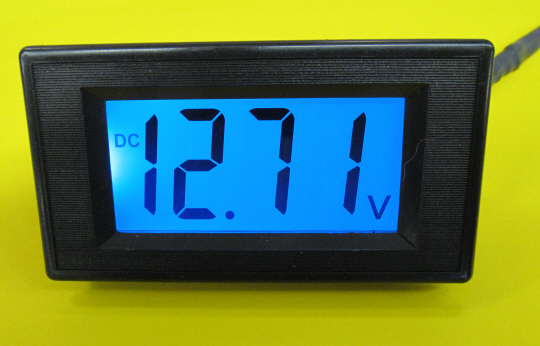
You'd not be the first to semi-permanently rig up a digital multimeter .

But there are plenty of digital voltmeters on ebay ..... just be sure to get one that does not need a separate power supply.

meterlit.jpg
 
There are 2 things ypou might want to know when operating a lead acid battery. One is have I put as much charge in as it will take? and secondly how long will it supply the services I want to run on the battery.
The first question is usually answered by charging be it solar engine generator or battery charger for as long as possible.
The second question is much harder to answer. Assuming you have fully charged the battery then the serviice life depends on age and condition of the battery and of course it's size. Don't be overly impressed by the maker's Amp Hour claim for the battery. At best (new) you could count on about 50% of claimed AH rating. The battery can only deteriate from there.
As said the best way to determine if a battery is getting near practical discharge limit. (remember that deep discharge will shorten the life) is using a volt meter. This especially so as you discharge it. Most people will say do not let the voltage drop below 12v or maybe a little less. (make sure you are measuring at the battery as subsequent wiring can drop the voltage) Of course if you really need to do so you can discharge further but at the risk of shortening life. Deep cycle batteries are more able to cope with heavy discharge than typical car battery. good luck olewill
 
SmartGauge battery monitor. Super simple installation, highly accurate state of charge meter. Cannot run out of synchronisation with the batteries. Volts display, Charge Status (percentage), user programmable alarm functions, about £150 i have one its great.
 
I'd prefer the analogue meter. It doesn't really matter if it is calibrated as long as it is consistent (ie. it points to the same place for the same voltage!) Then you can mark its normal position with tippex or something. Saves trying to remember what a digital meter usually reads.
 
No it does not need to rest, it can be used at any point in the charge / discharged cycle....
This is a myth which can be confirmed from many learned references on Google.....

The battery must been allowed to rest for several hours. This is because SG samples are obtained in the dead space at the top of the plates but the changes in SG density during charge or discharge are occurring between the plates, so there is a time delay between the actual change in the SG in the cell and the change at the sample location. Leaving the battery to rest is not very practical on a typical cruising boat. The best way to stop all charging/discharging is to disconnect each battery in turn and leave for about 5 hours before testing.

Testing SoC by battery voltage is often easier and more accurate, but it is more important that the batteries are left to rest without ANY charge or discharge.

A SmartGauge is the best answer and even at £150, which is 5 times more expensive than the awful link in #4, is worth every penny. Buy an amp meter to use alongside it.
 
Top