
Neeves
Well-Known Member
Sadly incorrect. Sherardising is a Thermal Diffusion Process. It offers the ability to precisely produce a coating of a specified thickness, greater than anything produced by Hot Dipped Galvanising. The coating is harder than HDG. Abrasion resistance is a function of hardness and thickness. The US Navy and Marines are using TDG because it offers longer life than HDG. The US Navy and Marines are using chain of G120 quality (of which I have no experience). The chains in which I have been involved are G80 or G100, compared to G30 or G40/43 the normal specification for anchor chain. The higher 'G' number defines better strength and allows a smaller lighter chain being used. Removing weight, especially from the bow, improves yacht performance.I have always used bog- standard galvanised chain from a chandlery and my efforts to find a cheaper source were unsuccessful. I have no idea what all this G80 stuff is about.
You say that the grade you want will weigh 1.4kg per metre less but isn't weight in a chain a good thing?
Forget about all fancy treatments like sherardising. Only hot-dip galvanzing is a suitable method of protecting anchor chain from rusting.
Weight of chain is a good thing but a snubber is better, cheaper and lighter - where have you been?
https://www.sailmagazine.com/diy/how-to-dealing-with-snatch-loads-in-an-anchorage
https://www.sailmagazine.com/cruising/anchor-snubber-tips
Jonathan
edit
Both HDG and TDG produce a series of Zn/Fe alloys bonded or alloyed to the underlying steel. HDG produces alloys more quickly because it operates at a higher temperature - but the alloys are similar. Both produce a coating suitable for providing protection for Fe (or steel) from corrosion. TDG is a slower process, operates at a lower temperature and is a batch process. Currently much TDG coated product are high tensile steels because the process does not degrade tensile strength so much and hydrogen embrittlement, HE, is not an issue (possibly because the products are not quenched but cooled slowly, there is an ASTM procedure to obviate HE by reheating HDG components and slow cooling). The studs ( typically 120 of them), set in the concrete foundation holding up wind farm towers are specified to be TDG coated, not HDG coated, as are some nails for nail guns and clips to hold rails on railways to the concrete sleeper

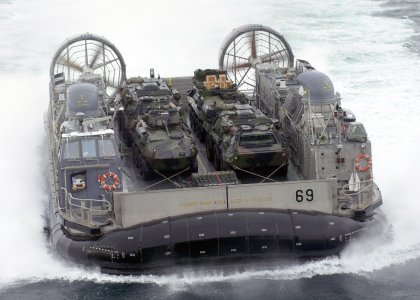
The chains on this hovercraft securing the military vehicles are made from High Tensile steel, including G120 chain, and are TDG coated. Being much stronger, 3 times the strength of a G40 (in America a G43 chain) they are much lighter (and last longer). The savings due to longer life are calculated to save considerable amounts of money. Similar chains are used for anchoring small craft. 'Our' anchor chains would typically be a G30 quality but the market is moving, almost imperceptibly, to a G40 chain.
J
Last edited: