Caterpillar 3208 DITA or C9, 20 years old, performance test

Skipper Felice

Well-Known Member
Joined
24 Sep 2023
Messages
234
Location
Italy - Switzerland
Visit site
Running a marine engine Caterpillar 3208 DITA or C9, 25 years old, around 1000 hours with good, normal service history during a sea trial / WOT performance test:

- What measured values can be expected?
- What deviations from the normal values (power, temperature, airflow, pressure, rpm) are acceptable?
- Is a performance of -5% or -10% or -15% normal or out of tolerance?

Perhaps some of you cruising experts have some real figures with the good old CAT marine engines 3208 or the C9 type.
 
I know it's not particularly polite to answer a question with a series of questions, but I really would like to know:
how are you meant to measure airflow and pressure on a fully analogue engine like the cat 3208?
also how do you access performance? how do you know the 100% on a particular install and how do you establish it's now 85, 90 or 95% of the original.

how about getting a bit serious?

fwiw, a mate has a couple of 3208 which are OK, but v.sensitive to fuel bug.
He was trying to explain that the high pressure pump is fuel cooled and not oil cooled.
Not sure it makes sense, but had to take one of the pumps out twice to clean, replace plungers, o-rings and whatnot and it still doesn't idle as well as the other one...

good luck in your search, but I think you should lower a bit your standards on 25yo diesels that are hardly run in at 1000h, they'll be falling apart from idleness.

V.
 
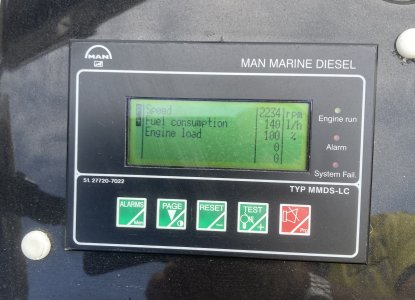
If I can wade in . 2003 engines in August 2023 ( lift out annual antifoul was May ) .Rated Wide Open Throttle- WOT from the manufacturers 2200 rpm .

Not shown is the water jacket temp which stayed at 86 *C

Ideally they should just exceed rated WOT . If they can’t then there’s problems .
This is an important measurement you can do and see in real life .

There’s a lot of ducks to align in no particular order ….to achieve rated WOT
-Stern gear hygiene needs to be good .
- Hull hygiene needs to be good lift out a was few months previously. Not last year!
- All the coolers need to be in good shape to maintain temperatures certainly NOT increase jacket temps .
- Propping needs to be correct . Enough headroom for seasonal variations of above and cruising stores .
- cruising stored ( on boats under a certain size ) = you haven’t overloaded the boat with excess weight in terms of % .
- General injector health to get the manufacturers max fuel burn in this case 140 L = no black smoke or any smoke for that matter .
- Fuel filter generosity, ie not clogged = fresh filters at the annual and fuel bug mitigation due various “ snake oils “ added at every fill up .

Same at the Op on about 1000 hrs + and 20 yr old .

39D2881B-9A97-4AD0-ACFD-9C88F1AE3534.jpeg

If it can’t reach manufacturers rated WOT and maintain a steady temps then one or some of the points I listed needs attention/ adjustment/ cleaning .

So we are looking @ 102 % ….100 % minimum.
Don’t accept anything under 100 % unless there’s a demonstrable reason ….eg props dirty . After clean up it reaches WOT .

Find out the rated WOT ( on the engine plate ? ) of the 3208s are . Enquire if it can reach it ?
See what they come back with .
 
If I can wade in . 2003 engines in August 2023 ( lift out annual antifoul was May ) .Rated Wide Open Throttle- WOT from the manufacturers 2200 rpm .

.... ....


If it can’t reach manufacturers rated WOT and maintain a steady temps then one or some of the points I listed needs attention/ adjustment/ cleaning .

So we are looking @ 102 % ….100 % minimum.
Don’t accept anything under 100 % unless there’s a demonstrable reason ….eg props dirty . After clean up it reaches WOT .

Find out the rated WOT ( on the engine plate ? ) of the 3208s are . Enquire if it can reach it ?
See what they come back with .
Thanks Porto - your ratings / values and measurements came from some (calibrated) ECM / engine computer.
And of course, a 100% rating is perfect with a 20 year old engine.

Look at a CAT 3208: - seems to be only analog controlled engine, no ECM, no computer > you can look at the instruments on board and perhaps they tell you some real truth. You have NO real (calibrated) measurement.
How will a CAT engineer check / measure the actual performance on a 3208?

Look at a CAT C9: - they have an ECM and CAT engineer can do a read out of all running parameters / values. If you have the CAT electronics display (most of the boats don't have / expensive) you have the same with your MAN ECM readout.

And I guess, the seller or the broker will not tell me: "Well, it is a very good engine, but power / performance is just 93% of rated value ... ...."
 
would be extremely interested in explaining how the heck you're going to measure load in a 3208. Only gauges available are a tacho and a series of nice vdo analogue gauges for temps/pressures/etc.
further, what you describe Porto is a decent procedure to follow health of engines you KNOW. Buying a new to you boat there's quite a few unknown parameters that can affect readings.
 
would be extremely interested in explaining how the heck you're going to measure load in a 3208.
Vas, of course the answer to your question is no way, but I suppose Porto's percentages were referred to rpm, not load.
I.e., with the 3208 (which is rated for 2800rpm, as opposed to 2500 of the C9), I think he's suggesting that it should reach anywhere between 2800 and 2856.
But don't ask me where his +2% comes from, also because with the typical analogue tachos mated to 3208 and similar vintage engines, you'd be lucky to measure 100 rpm differences, if that.
Of course, a digital laser tacho and a reflective tape sticked on an engine pulley (together with the obligatory best protection earmuffs money can buy!) would do the trick.
But aside from the fact that the relevance of 2% deviations on 25yo engines is debatable to say the least, I can't understand what the OP could/would do with these numbers.
I mean, any half decent Cat mechanic could survey those engines blindfolded, but with all due respect, this doesn't mean is something everyone can DIY after asking on a forum what is reasonable to expect... :unsure:
 
The initial plan should be to dissasembly both engines to check the clearance of main and rod bearings , piston rings and measuring wear on the cylinder walls . Then reassemble and drill holes in the exhaust to check and verify exhaust gas temperatures and pressures as well soot level and burned oil particles. . Then do the same on the intake side to diagnose the inlet temperatures and pressures . A must have are installed torque meters on the shafts to diagnose the output torque and rpm,s to make sure if you are 102% on or 98% off .

Needless to say are engine oil samples to a laboratory in a spectrum analysis for metal particles .

Since i think you are serious about purchasing a boat do not forget many other things like measuring the output pressure of the toilet in referrence to the solids having put in and also the resistance of the cables when you switch on the microwave .
 
The initial plan should be to dissasembly both engines to check the clearance of main and rod bearings , piston rings and measuring wear on the cylinder walls . Then reassemble and drill holes in the exhaust to check and verify exhaust gas temperatures and pressures as well soot level and burned oil particles. . Then do the same on the intake side to diagnose the inlet temperatures and pressures . A must have are installed torque meters on the shafts to diagnose the output torque and rpm,s to make sure if you are 102% on or 98% off .

Needless to say are engine oil samples to a laboratory in a spectrum analysis for metal particles .

Since i think you are serious about purchasing a boat do not forget many other things like measuring the output pressure of the toilet in referrence to the solids having put in and also the resistance of the cables when you switch on the microwave .
and all that as part of the pre-sale check, right? nice 😁
 
I took it as read there will be an engine survey .

CAT engineer would obviously compare your tach readings with an optical tach gun at the flywheel...

The basic test of reaching WOT maintaining temps still stands .

If the exhausts have 10 mm inspection ports then he might fit a EGT probe (s) .
He will want to inspect them for corrosion ( unless they are new ish ? ) - anyhow and to do this properly necessitates peeling back what ever heat insulation blankets covering them thus exposing said ports .

Yes boats equipped with motors from the top manufacturers with ECM s do have access to a myriad of other data easily available on screen by the helm , but the engineers plug there own laptops in the engines control boxes individualising each cylinder and gather much more+++ that the skipper doesn’t see .

But this does not mean older analogue boats shouldn’t reach rated WOT …..it’s a very simple health check ( laser gun verified )

On the flip side going Fwds older boats with analogue engines means less electrotwackery / sensors / ECM to go wrong and obviously little to zero obsolesce issues and reliance on a guy with lap top to diagnose + fix . Assuming a circuit board fix isn’t impossible .
 
would be extremely interested in explaining how the heck you're going to measure load in a 3208. Only gauges available are a tacho and a series of nice vdo analogue gauges for temps/pressures/etc.
further, what you describe Porto is a decent procedure to follow health of engines you KNOW. Buying a new to you boat there's quite a few unknown parameters that can affect readings.
See the 1 st sentence of post #3 .
 
From experience (both buying and selling) - what seems common is just a visual check - is the status of filters, date stickers on components etc somewhat compatible with "regular mainteinance", then get some CAT / Volvo whatever officials on board, they attach their computer then measure parameters at 800 / 1000 / 1200 / full throttle etc. They give you a report that you are supposed to read and understand and thats it.

Problem is how you are going to know if the previous owner was simple an imbecile (oil change once in a pope death, engine anodes what is this, heat exchanger cleaning not needed just go full throttle 10 mins) and caused a lot of wear / corrosion on the engine. If the oil was changed for the sale and run 1-2 hours I dont think you will find much in the oil sample.

I mean rusted injectors , water seeping from the heat exchanger, block cracked, engine runs hot very quick they are are all clear telltales but if they run the engine without anodes for 4 years ... how do find out whitout taking the engines apart.

Maybe budget for 1 engine replacement ?
 
Thank you guys for your points: I have learned a good lession in nautic engine check :)

- If I have a CAT engine after 2003/2004 (C9, C12 etc.) with ECM, sensors and electronics we can do a full survey and health check with the SW analytic system from the manufacturer (y) This will produce an accurate report of all relevant data from the running engine including each cylinder parameters. This can be done within 4 hours sailing with a CAT mechanic and costs you about 800 Euros - (no oil lab analysis).

- If I have a CAT (VOLVO) engine before 2002/2000 (C 32xx etc.) with NO ECM, sensors and electronics there will be a real physical and mechanical inspection with dismantling some parts - check for internal corrosion and all / most measurements of running parameter done with (analogue) internal (external) tools. Values will be +/- 15% or best guess, if possible ALL availabe service documentation / replacements have to be studied / verified. This will be done within 20 hours (or more) work by a mechanic and costs you about 4000 Euros + oil lab analysis 600 Euros. :confused:

- And I see, that a good engine health and performance check can be done on all engines (older and with ECM) together with a skilled mechanic and sailing a sea trial and reading / do mesurements with the on board instruments (a good GPS gives running speed +/- 3%).

At the end of the day - you make a descission out of your heart ... with some facts, some risk and some money a side for some good engine maintenance! :geek:
 
I just went thru a seatrail with a mechanic.

its very important that this mechanic is proficient with the engine and knows its weak spots and where to look .

tell the seller you want the engines cold when seatrail begins ( to see if there are issues on a coldstart and avoid excuses he didn,t know you wanted the engines cold )

Judge smoke / sound during coldstart , check for obvious leaks . Find a spot of water without speedlimits to bring and keep the boat under load to check if it holds temps and oil pressures , confirm also no leaks at high rpm,s .

Perform a WOT ride to see if the engines perform as expected .

Check for water in oil or coolant loss after the setrail .

My volvo mechanic recommended to not perform a compression test since its a major work on kad44 and the engine started cold well , no smoke , no blowby and also performed well , so there is no reason to believe the compression is seriously wrong .

of course there is always a risk even after a careful seatrail and you will never know if e.g the seller raced it cold , how oil changes were performed , how the breakin period was done and much more . You do not buy a virgin .
 
From experience (both buying and selling) - what seems common is just a visual check - is the status of filters, date stickers on components etc somewhat compatible with "regular mainteinance", then get some CAT / Volvo whatever officials on board, they attach their computer then measure parameters at 800 / 1000 / 1200 / full throttle etc. They give you a report that you are supposed to read and understand and thats it.
Where is he going to connect the computer on a 3208 ?
 
  • Like
Reactions: vas
Thank you guys for your points: I have learned a good lession in nautic engine check :)

- If I have a CAT engine after 2003/2004 (C9, C12 etc.) with ECM, sensors and electronics we can do a full survey and health check with the SW analytic system from the manufacturer (y) This will produce an accurate report of all relevant data from the running engine including each cylinder parameters. This can be done within 4 hours sailing with a CAT mechanic and costs you about 800 Euros - (no oil lab analysis).

- If I have a CAT (VOLVO) engine before 2002/2000 (C 32xx etc.) with NO ECM, sensors and electronics there will be a real physical and mechanical inspection with dismantling some parts - check for internal corrosion and all / most measurements of running parameter done with (analogue) internal (external) tools. Values will be +/- 15% or best guess, if possible ALL availabe service documentation / replacements have to be studied / verified. This will be done within 20 hours (or more) work by a mechanic and costs you about 4000 Euros + oil lab analysis 600 Euros. :confused:

- And I see, that a good engine health and performance check can be done on all engines (older and with ECM) together with a skilled mechanic and sailing a sea trial and reading / do mesurements with the on board instruments (a good GPS gives running speed +/- 3%).

At the end of the day - you make a descission out of your heart ... with some facts, some risk and some money a side for some good engine maintenance! :geek:
Skip I can’t see people letting you strip the engines down.
 
I recently bought a 2004/5 Azi 42 with Cat 3126 Dita 385 hp engines. I’m very familiar with these from my prior Azi, albeit with the detuned 355 hp output. There is a full service history going back 10 years, with detail on oil, filter, fuel filter and coolant changes. Plus impeller history. Interestingly the technicians, well respected, halve used 15w/40 multi grade. I had always used SAE 30 in my 3126’s. I checked with Finnings who confirmed that 30 is the correct oil, so will change this soonest. I’m confident that no harm will have come to the engines, but according to Finnings the Cats can smoke more with the multi grade, and soot the transom. The engines have done 550 hours, so have hardly broken sweat. My first trip was to deliver her from Dartmouth to Portsmouth, 104 Nm. We cruised between 20 and 23 kn. She ran really well. No smoke. Not sure of consumption yet as I haven’t filled, but will do so. I was ably crewed by Sticky Fingers.
I didn’t bother with an oil inspection as the oil was 5 hours old. These are mechanical units, so no diagnostics interrogation. A risk maybe? Buying any boat is a risk. So far so good.
 
Top