
Cast iron keel repair

DAS

New Member
Joined
10 Aug 2021
Messages
6
Visit site
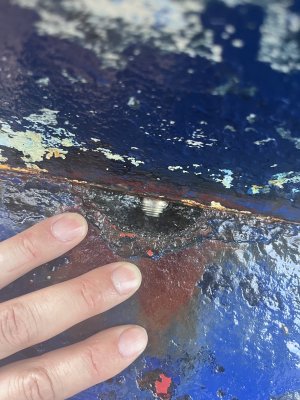
Lifted my newly acquired Westerly Konsort yesterday and see there is a chunk missing at the top of one of the bilge keels about 4cm wide maybe 1cm deep. You can see the edge of the stainless (?) keel bolt.
Keel hull joint seems solid with no movement in the slings no leaks inside no gap along the joint.
Can I just fill this prior to prepping and painting the keels? If so what with?
Thanks David (new poster new boat owner)
 

Attachments

  • IMG_0880.jpeg
    IMG_0880.jpeg
    2 MB · Views: 109
If the other keel bolts are good, I think you will be OK to fill. Epoxy filler as peteK says and give it a good grinding to key the surface. It will also help if you wash it well to get as much salt out of the iron as you can. For future peace of mind, I'd try and find out how long the threads in the iron are - perhaps the Westerly owners could help there.
 
Lifted my newly acquired Westerly Konsort yesterday and see there is a chunk missing at the top of one of the bilge keels about 4cm wide maybe 1cm deep. You can see the edge of the stainless (?) keel bolt.
Keel hull joint seems solid with no movement in the slings no leaks inside no gap along the joint.
Can I just fill this prior to prepping and painting the keels? If so what with?
Thanks David (new poster new boat owner)
Like someone else has said, it looks like someone has attempted to disguise a broken bit of casting.
To do a proper job, check to see if a longer stud/bolt can be fitted. Basically jig up inside so that it can be drilled and tapped to fit a longer stud. Clean spotlessly and fill with JBWeld or similar around where the casting is chipped. Then drill and tap deeper. A jig is essential to prevent wander of the drill or tap.
 
Like someone else has said, it looks like someone has attempted to disguise a broken bit of casting.
To do a proper job, check to see if a longer stud/bolt can be fitted. Basically jig up inside so that it can be drilled and tapped to fit a longer stud. Clean spotlessly and fill with JBWeld or similar around where the casting is chipped. Then drill and tap deeper. A jig is essential to prevent wander of the drill or tap.
That would be the best solution but there doesn't look to be a lot of meat around that stud and the deeper in the keel you drill, the less there will be if the keel tapers away from the keel flange as they normally do. Drilling deeper may result in more of the keel breaking away. Never know until you try it. Nice shiny keel bolt though. It looks as though there's plenty still in the keel after the exposed bit. I think I'd be tempted to fill and forget.
 
Last edited:
Sand castings often have holes and defects, which are filled and faired, that could be an original disguised defect.
Wouldn't it be nice to know for sure. This information may be lost in the history of the boat I guess.

I'm not sure how we could check the corrosion or other potential defects in a cast iron keel. Xrays? Is that even possible to do and at what cost?

Perhaps a more knowledgeable member might advise?
 
Wouldn't it be nice to know for sure. This information may be lost in the history of the boat I guess.

I'm not sure how we could check the corrosion or other potential defects in a cast iron keel. Xrays? Is that even possible to do and at what cost?

Perhaps a more knowledgeable member might advise?
One thing to check is whether there has been graphitisation of the cast iron at that location and if so how wide spread is it.
I have had grphitisation at the
Owervcorner of one of my westerly cast iron keel but nowhere else.
Gtaphitisation causes the metal to go soft and if present in that area it will be obvious if you tap or scrape the surface around the stud using a screwdriver . Also try tapping various places.around the keels There is a noticeable difference in the sound from good metal compared with graphitised metal. It is usual tinuse a wee hammer for this.

Let us know what you find.
 
A snippet from the XOD keel repair fount of wisdom. P38 usually has better adhesion to cast iron than epoxy. Coat it with epoxy after, but fill the ding with P38. We bang our keels on the bottom regularly in the X fleet, no sounders allowed, so are fairly accustomed to patching them up.
 
A snippet from the XOD keel repair fount of wisdom. P38 usually has better adhesion to cast iron than epoxy. Coat it with epoxy after, but fill the ding with P38. We bang our keels on the bottom regularly in the X fleet, no sounders allowed, so are fairly accustomed to patching them up.

When cleaning up our cast iron keel, I cleaned out some defects, used Fertan then Isopon P38 followed by Jotun Vinyguard. All still in place after quite a few years.
 
One thing to check is whether there has been graphitisation of the cast iron at that location and if so how wide spread is it.
I have had grphitisation at the
Owervcorner of one of my westerly cast iron keel but nowhere else.
Gtaphitisation causes the metal to go soft and if present in that area it will be obvious if you tap or scrape the surface around the stud using a screwdriver . Also try tapping various places.around the keels There is a noticeable difference in the sound from good metal compared with graphitised metal. It is usual tinuse a wee hammer for this.

Let us know what you find.
There are a couple of examples of graphitic corrosion on my website. Corrosion
 
Thanks all for the comments and advice. Looking at info on here and elsewhere it looks like this is a not uncommon issue with Westerly cast iron keels possibly poor quality casting 42 years ago. It also seems possible/likely that this is the site of a previous repair which has subsequently fallen out. Given that all the other bolts are intact and only a small section of this one is exposed, the hull/keel joint seems fine and there is no internal water ingress I intend to repair following advice here and keep an eye on it. As it’s a bilge keeler it will be easy to dry out during the season to have a look.
 
In post #6 there's a reference to "keel tapering away from the flange" which doesn't apply to Westerly boats. Firstly there is no flange. Secondly the keel doesn't taper much, if at all.
 
There are a couple of examples of graphitic corrosion on my website. Corrosion
We used to eerience this at sea on equipment like evaporators which were operating at elevated temperatures. I was quite surprised to find d patches on my cast iron keels.Just a couple of localised ares lower forward a d aft on one keel and soft enough to scrape out with a screwdriver.
 
Thanks all for the comments and advice. Looking at info on here and elsewhere it looks like this is a not uncommon issue with Westerly cast iron keels possibly poor quality casting 42 years ago. It also seems possible/likely that this is the site of a previous repair which has subsequently fallen out. Given that all the other bolts are intact and only a small section of this one is exposed, the hull/keel joint seems fine and there is no internal water ingress I intend to repair following advice here and keep an eye on it. As it’s a bilge keeler it will be easy to dry out during the season to have a look.
If you check the link I gave for graphitic corrosion there is another topic that relates to Westerlys. Their keels were cast horizontally, resulting in gas bubbles trapped at the surface. Although hidden when new, after some time immersed the thin surface layer corroded away, leaving quite large cavities that rusted. It may be that this is the cause of the loss of metal in your case.
 
Top