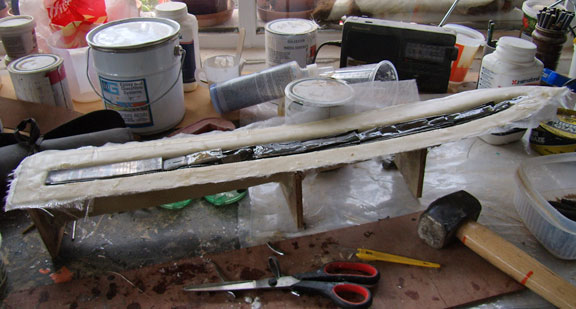
Can you add balast weight to the keel

Richard D

Well-Known Member
Joined
15 Jul 2011
Messages
183
Visit site
I have heard knowledgeable sailors saying about how much wieght there is in thier boats keel as a measure of its worthyness and the figure of 40% seemed to be the goal. Looking at the stats on most GRP 30 to 35 foot cruising boats they seem to be below 30. Would increasing it improve the handling of the boat? Is it possible to increase this weight or area of the keel? Would the keel fixings hold extra weight ? Ok stop laughing, I dont know any better. If you were to fix a winged keel would it do any good?

Richard
 
I have heard knowledgeable sailors saying about how much wieght there is in thier boats keel as a measure of its worthyness and the figure of 40% seemed to be the goal. Looking at the stats on most GRP 30 to 35 foot cruising boats they seem to be below 30. Would increasing it improve the handling of the boat? Is it possible to increase this weight or area of the keel? Would the keel fixings hold extra weight ? Ok stop laughing, I dont know any better. If you were to fix a winged keel would it do any good?

Richard

Increasing keel weight will improve stability, but you can't just go and do it - not very safely anyway. Quite apart from the extra load on the keelbolts, the extra stability will increase loads on mast and rigging, and the chainplates they are attached to.
 
I have heard knowledgeable sailors saying about how much wieght there is in thier boats keel as a measure of its worthyness and the figure of 40% seemed to be the goal. Looking at the stats on most GRP 30 to 35 foot cruising boats they seem to be below 30. Would increasing it improve the handling of the boat? Is it possible to increase this weight or area of the keel? Would the keel fixings hold extra weight ? Ok stop laughing, I dont know any better. If you were to fix a winged keel would it do any good?

Richard

It is not as simple as that. There has been a trend toward lower ballast ratios (although less than 30% is lower than most). This is for two main reasons. Firstly hull shapes now have more form stability so rely less on weight to keep them upright. Secondly keels have become deeper and ballast placed lower down where it is more effective. This means that more of the weight of the boat is devoted to the bits that people use most - particularly the volume of the hull.

You will hear people arguing that heavily ballasted boats are superior - if you hang around here you will find it is one of the most contentious subjects. However, the reality is that lower ballasted boats, which tend to be livelier in rougher conditions are just as capable boats as older styles.

Simply adding extra weight to a boat's keel will not necessarily improve it as you will need more sail area to get it going, which means heavier rig, bigger winches and so on. Winged keels have some advantages, but they have never really caught on. The dominant keel type in recent years has been a foil shaped fin with a ballast bulb at the bottom, although in the higher performance end T shaped keels with narrow foils and a large bulb are becoming popular.

If you are interested in these issues there is plenty of published material around on boat design to clarify or confuse!
 
I think the problem with Hooligan V was the original fabrication of the keel not the extra ballast.

I race on a boat where the hull was strengthened in preparation for an increase in ballast. The original designer was contacted and he came back with a detailed specification.

In any event, not something to do lightly.
 
just read about hooligan very interesting but seems a lot mistakes made, my thoughts were of just putting on a bulb at the base which seems a quite normal mod. Any idea of what benefit to exoect from a heavy keel bulb.

Richard
 
I assume you are trying to increase the righting moment of the keel to carry more sail.

The yacht hull and keel attachment will have been designed assuming the original keel and the forces it would be expected to exert on the hull/keel joint with a built in safety factor.

By 'just adding a bulb' to the keel you are altering the righting moment and also the stresses on the keel/hull joint. Even if the overall keel weight stays the same, the effective 'leverage' of the keel has been increased by moving the COG of the keel further away from the hull.

This must be referred to the original boat designer or a competent marine engineering company to find out what additional modifications are needed to accomodate the new keel.

Hooligan V had two distinct problems - one was the original design of the keel and the other was the additional weight which caused Hooligans keel to fail before other un-modified Max Fun 35s, which were also showing the same stress fractures.
 
I have heard knowledgeable sailors saying about how much wieght there is in thier boats keel as a measure of its worthyness and the figure of 40% seemed to be the goal.

They arent knowledgeable sailors - they are engineering numpties. The ballast ratio is meaningless since it says nothing about where that ballast is. What matters is the maximum righting moment and the angle at which it is developed.Plus the maximum inverted moment and the angle through which the boat is stable inverted. You can easily have a boat with a 30% ratio that is more stable than one with a 50% ratio.

Whats more just adding ballast to the bottom of the keel is unwise since you dont know the strength of the hull and you need to bear in mind the moment of inertia of the boat about its roll centre etc.
 
yes I understand your comments about righting moment but I doubt this sort of info is readily available, as per all the other technical points such as max hull speed etc etc thanks

Richard
 
apart from the keel mounting you must remeber that if you increase the load below you have to up the spec up top
I have experience of putting more lead in the keel and leaving the rig the same only to have the rig go over the side on the first real blow
 
Jake Kavanagh added winged ballast bulbs to a Corribee's keel (along with loads of other mods)... info near the bottom of this page Not sure how it worked out in the end.

ballastbulb_2.jpg
 
yes I understand your comments about righting moment but I doubt this sort of info is readily available, as per all the other technical points such as max hull speed etc etc thanks

Richard
Yes it is. All boats built since 1998 need to comply with the RCD which has minimum stability requirements for different categories. Builders are required to publish a range of data about their boats.

There is a useful summary of stability issues and a lot of data on a range of boats on the RYA site. The subject is also part of the Yachtmaster Offshore syllabus. Some data is available for older boats but not necessarily in the same form.

I know you are new to sailing, but you will find pretty quickly that most of your questions are easily answered if you do a bit of research. There are few secrets about yacht design and plenty of published material at varying levels of detail for those who are interested.
 
Small compensation

apart from the keel mounting you must remeber that if you increase the load below you have to up the spec up top
I have experience of putting more lead in the keel and leaving the rig the same only to have the rig go over the side on the first real blow

How about adding just a little extra to compensate for add stuff aloft such as radar, mast steps etc. Surely that was not taken into the calculation by the builders.
 
Ballast

I would suggest that Saltylegs in asserting that added keel weight caused his rig to fail is possibly wrong. it is more likely the rig failed for it's won reasons. Having said that catamarans do need a much more robust rig than a monohull.

As has been said the stability of a sail boat depends on 2 functions. The pendulum type righting function has little effect until there is some significant heel angle. At 90 degrees of heel the function is most power full and it is this which will right the boat in a knock down.
However the most used function is the form stability. This is where the beam of the boat works with the total weight to keep the boat upright. Think catamaran here being the extreme case of form stability. As the buoyancy of the boat shifts to one hull as it heels the total weight of the boat acting in the centre presses the centre down so rights the boat. A monohull has form stability depending on the shape of the chines. A wide flat bottom giving good form stability while a semicircular shape has none. Think of a log rolling in a river. (no way upwards).

Ok so adding weight on the tip of the keel will improve form stability because it increases total weight of the boat. But you can achieve nearly as much value by putting ballast under the floor internally. This stability is most noticed at small heel angles. It makes the boat stiffer.
However if you do have a knockdown then the ballast on the tip of the keel will improve the righting.
If however the boat is adequately self righting then more ballast on tip of keel will simply accelerate the righting or stop it from going so far.
As said of course a lot of extra ballast on the keel tip may over strain the hull and keel attachment.

We have one style of racing keel boat here called an M27. (27ft narrow) It is not good at self righting and is often layed down under spinacker broach and crew have been known to stand on the keel to get it up.
And before you ask no they are not eligible for for open water racing.
An extra 20kg of lead in the form of shoes each side of the tip can improve the self righting dramatically.
However most owners won't do this because of additional weight and drag. (I would if I owned one though).
It is most likely the OP has been dismayed at the tenderness of his new boat. ie it doesn't seem to stand up to a lot of sail area in stiff winds. The answer is reefing and smaller jib. The boat will go better and faster with less sail. Don't worry about ballast unless you aree really sure there is a need. olewill
 
"As has been said the stability of a sail boat depends on 2 functions. The pendulum type righting function has little effect until there is some significant heel angle. At 90 degrees of heel the function is most power full and it is this which will right the boat in a knock down.
However the most used function is the form stability."


I think if you review any yacht stability curve you will realise that the max righting moment does not occur at 90 degrees.
 
It's an interesting question, and not one with a simple answer.

I think it depends on your aims, and your budget. If your aim is to increase "ultimate storm survivability" then it may be worth adding a bit of weight, however this should be done with the approval of the original designer.

A better bet may be to swap the keel for a replacement of the same weight but deeper. Again, this will have an impact on the loading of the keel bolts, as you have efectively increased the righting moment, but should have an increase in performance across all conditions. This is obviously more costly though.

An alternative might be to ignore the keel but replace the mast with a lighter version (possibly carbon) which will have a real impact on the performance of the boat. This is the big budget option. Most people that do this then also take weight out of the keel, so they end up with a boat with the same righting moment, hence sail carrying ability, but is significantly lighter.
 
I think the problem here was it that it was not done professionally!!

Even if done "professionally" doesn't mean it would be ok - some "professionals" are more professional than other "professionals" ... even some amateurs are more professional than the professionals ...

Perhaps the term "professional" is a little over used?
 
A practical answer for someone looking to buy their first boat with relatively little sailing experience:

No, you can't.​

Everyone else is discussing the theoretical implications of getting it done, and yes it may be theoretically possible, but a beginner should not be poring through boat ads thinking "ah, this one's nearly what I want, just need to add a ton or two of lead to the bottom and it'll be perfect". Nobody does this, for good reasons.

Try to find the right boat as-is - any modifications you might have in mind should be relatively minor and cosmetic.

Pete
 
Yes Pete you are right but coming from a competition background you are always wondering "what if". Deciding which boat is going to be a major headache, as most of the criterior seem to be very subjective its not like a motor car where the way she goes , handles and stops can be compared around a set track with conditions unchanging. To answer the question of what am I really wanting is. I want a cruising boat to spend a few months every year around the Scottish isles, so comfort is important and must have full standing headroom but on the other hand I want something that is not the slowest kid on the block and to be able to be handled by two people, what does that narrow it down to, one chap mentioned a Sigma or it that a bit spartan and too racy.

Richard
 
Top