cabin floor construction / bilge layout / watertight compartments & other thoughts

vas

Well-Known Member
Joined
21 Jun 2011
Messages
8,200
Location
Volos-Athens
Visit site
cabin floor construction / bilge layout / watertight compartments & other thoughts

Planning my next moves regarding the rebuilt and I'm getting close to the point where I'll have to:

  • remove all cabin flooring and supporting beams
  • remove one more bulkhead (have already removed a couple more)
  • find ways of fixing 2 new bulkheads for the two heads SLANTED in plan hence not aligned to the iroco frames
  • start the rebuilt of the cabins (floor upwards)

Now, the first two bits are dead easy, I've done enough dismantling already, not much of a prob :D

item 3 & 4 should be interesting but doable and rather rewarding after a year of knocking things down in MiToS.

However, I've got a few things I'm puzzled with and I'd like your opinion. Rather than mixing them with the original rebuilt thread, I decided to start this one instead. So, bear with me:

1st. do I need/can I have watertight compartments in a ply_on_iroco hull 43ft tub?
It doesn't seem to have any from the factory (will be absolutely certain when I remove the cabin flooring as there may be something on the engine room to cabin bulkhead). But even so, it would only cover engine vs lower cabins so don't know if it really counts.

2nd I count v.highly the ability to have GOOD/EASY/QUICK access to the hull from inside. Especially below the waterline. The above water bits are also important to check for any deck/superstructure leaks capable of doing serious rot damage from the inside out (as I've found in a few places...)

Hence the idea of having cabin flooring extending to almost the edge of the hull (obviously without sealing and creating a watertight area) is plain stupid to me. I'd much rather have flooring where I need it and be able to lift the bed underdeck to have easy access to the hull if needed. Further I'd have much larger storage space as a result!
Am I missing something? I don't think so, but open to suggestions. Don't mention rigidity as this can be obtained in many different ways and anyway the current flooring is a bit squeeky at places and I have to make a better job on that.
I could guess that sound insulation (water flapping sort of thing not engine noise...) would be better but again I doubt it and I could improve things dramatically with proper cabin lining and smart use of ricofon panels.
What else?

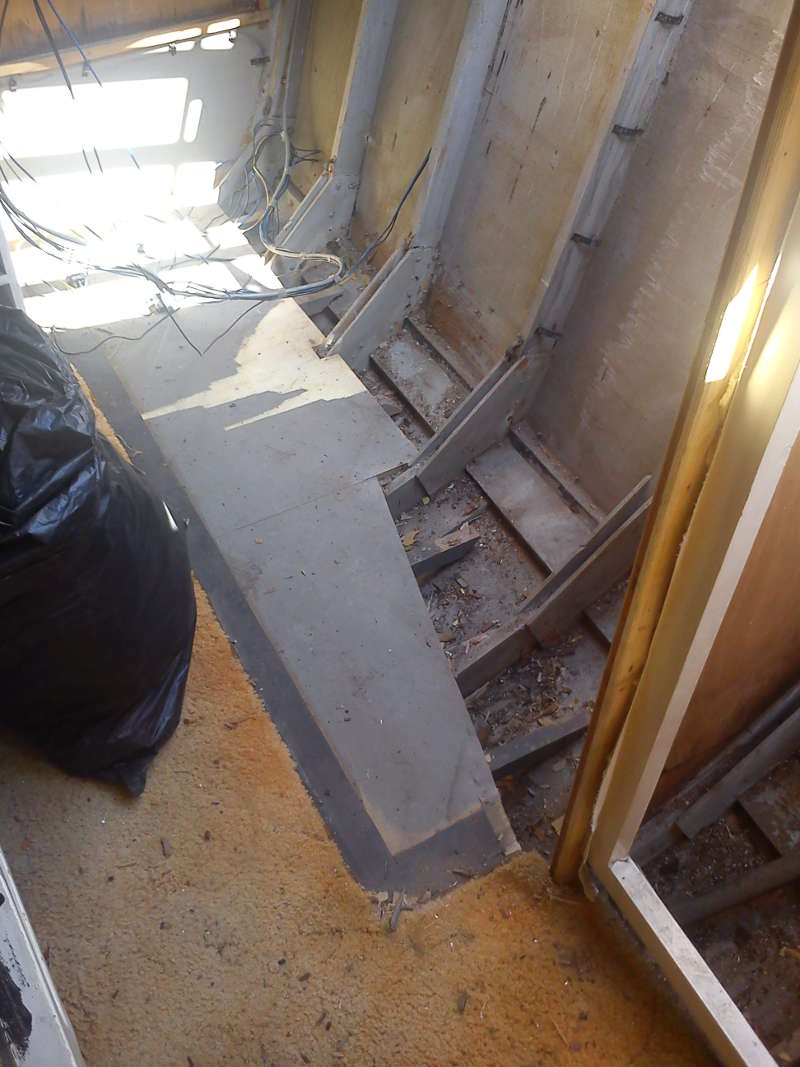
The following pic shows how the 2nd cabin floor is organised. Where the carpet ends the bed starts, but flooring UNDER the bed??? why?
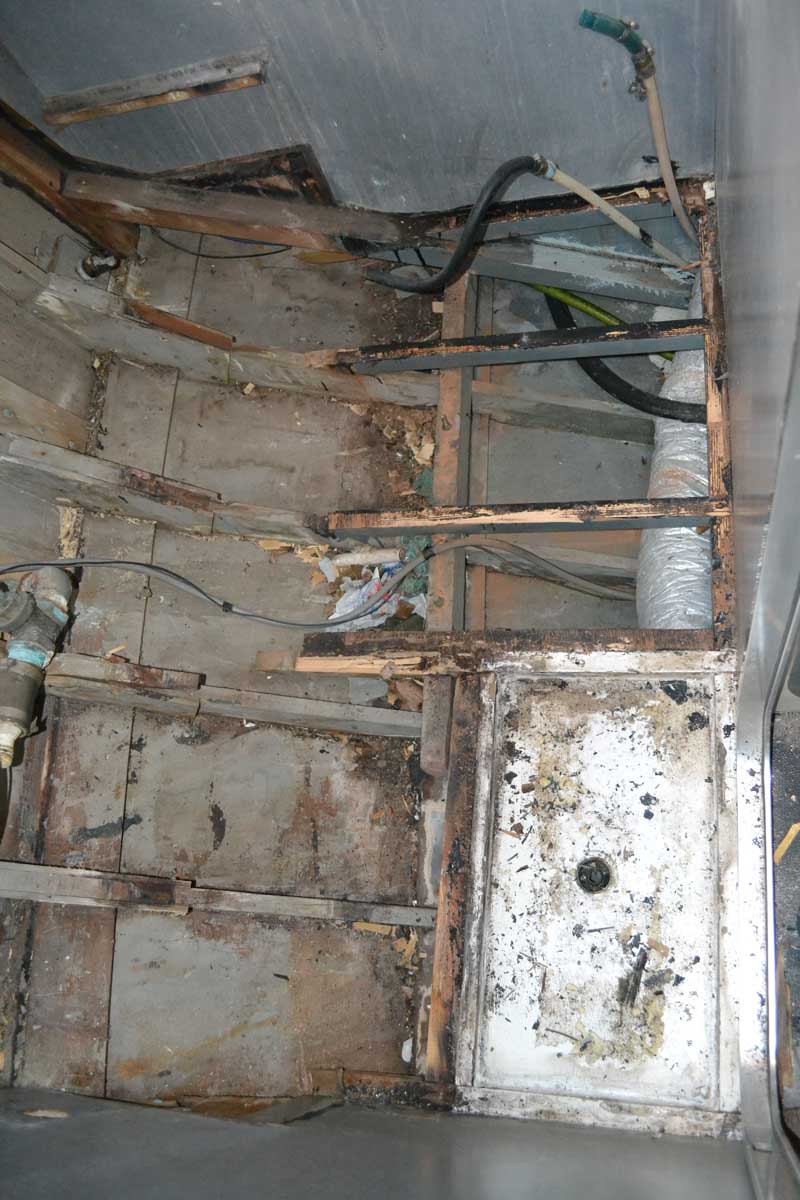
The second pic is the stbrd side with everything removed (but not cleaned-it's even worse right now :D ).

portcabinfloor_1.jpg


dismantling_heads6.jpg


Regarding bilges, the iroco frames every 300-400mm are good for structural stability but awkward as far as managing bilge waters.
Cannot possibly have 30bilge pumps one on each section to be able to empty the lot so atm have to resort to evaporation due to heat for that :p
I can see there are some through section holes in places and I wonder if it would be acceptable to have just above the keel limber holes on the frame to let the water move and be extracted from wherever the bilge pump is... Seems that this is happening on a few framess but not all.

Planning to have 3 bilge pumps (all auto) one in the lazzarette, one in the e/r and one on the corridor to the cabins. Ideas?

I've not described the things v.clearly I'm afraid so i'll come back with clarifications if it's too confusing. Need to take a few more pics as well of the bilges.

cheers

V.
 
Last edited:
Vas,

Clearly with a wooden hull, you do not want standing water, you really want dry bilges. Bilge pumps will not pump the bilge dry, so you need access to all the bilges, so you can mop up any bilge water that the pumps don't deal with.

I guess you will need drain holes in any lateral ribs, so that water can flow through to places you can access to mop.

Apologies if I am stating the obvious.

Raf being grp has 2 separate bilge areas unconnected. The engines have their own bilges, to minimise any opportunity for oil contaminated water to be pumped out. However Raf is a fair bit smaller than your boat, so the 3 bilge areas with their own pumps sounds about right.
 
@bluejasper2: doh, I thought that bulkheads was only for full separation sort of thing, not having doors/corridors through them. Obviously wrong, happy to learn!

@rafiki: you're sort of stating the obvious, but tbh it's not that obvious as I cannot possibly have access to the whole length of the keel to mop and dry with daughter's hairdryer... Not been trained as a marine, there's no way I can enter through a hatch on the corridor and exit through the one in the forward cabin moping on the way :D Nor will I send the 11yo down there (although last few days seen lots of suggestions for "using" or abusing ones offsprings :rolleyes: )
Ideal would be to carve a 10X3mm hole just by the keel on the xmembers making sure water can flow about to be picked up by the bilge pump and me having access to 3 points means I can dry the lot out. I'm just wondering how the other members of the rotting club do it...

LS, BB, MM?

cheers

V.
 
V..

The why flooring under bed piece, is probably to provide some sort of stable level for storage under the bed... which I guess you cound make removable...

In respect to "how" you make water flow across beams, there are probably ways you can make limbering holes (Pipes running at keel level ) without damaging structural integrity... Navigator has built in limbering holes on both crossmember and stringers (lengthwise strengthening) that ensures any water is finding its way down from the hull sides to the keel and is kept within the bulkhead where it can be pumped out...

Fwd sealed bulkheads are up to approx waterline (not measured) :

1) bow to main cabin (crew cabin area and is known to be above waterline)
2) Main (fwd) cabin to companion way
3) Companion way to engine room
4) Engine Room to lazarette

Over and above this I have plugs so I can seal FWD engine room backwards, aft engine room from tankage area, tankage area from lazarette and during longer voyages in open seas these are plugged.

I have a manifold in the lazarette for the main pump which means I can individually extract water from each of the main compartemantalised areas.... but as yet have not put in sensors...
 
Vas, the xmembers are called frames, and the longways stiffeners are stringers. Athwartship deck supports are beams. Holes are limber holes. NB, I am not being pernickety or critical - I often use non nautical terms (including below). I'm only saying cos you asked :-)

1. I would make 3 watertight compartments: e/room, abaft of e/room and fwd of e/room. Of course these are not true w/tight bulkheads becuase they are only up to cabin floor level. This keeps the potentially dirtier e/room water in one place

2. I would put limber holes within each of the three sections to stop puddles. The iroko can handle this.

3. I agree that you only need floor where you can see it. Elsewhere, do what you want and have the peace of mind of being able to inspect all the hull insides whenever you want. There could be noise issues but you have already thought about that

Good luck
 
thanks a lot guys,

it's becoming more clear now.

So, three isolated compartments:
lazarette
engine room
cabin space (mind that may be further split to two as well, but will investigate once everything is removed)

Alf, I do have the manifold (at the e/r though, by the door to the lazarette) with also 4 pipes going through, one is in the e/r two more disappear towards the bow and appear at the corridor hatch, fourth is empty and I fitted a temp flex pipe to pick what I like :)
So I'm halfway through a proper separation.

Once I start paintstripping/checking the iroco beams I'll see if/what type of limber holes were there and act accordingly.

2Qs:

1. what dia for the limber hole? Frame is 25mm thick and at least 120mm tall. Do I treat it somehow special? any copper thin tubing insets, just a spot of epoxy, or what?

2. there's a big fcking keel in the middle :rolleyes:
Approx 200mm wide at least 150 deep to the ply hull.
That means that unless I drill limber holes also across the keel I need TWO sets of holes one to deal with the port side of the keel and one to the stbrd. Is it getting a bit too much? I don't mind doing two sets of them and I understand that structurally wont make any difference. Is that the idea though, and how do you extract the last bit of water? you could ofcourse put a Y junction to the pipe and have two intakes one on each side, am I smart or what? :D

cheers

V.
 
I wouldn't put limber holes across the keel. That is a major weakness, and will create stress points in the keel. Wood is quite notch sensitive (on the subject of jargon, "notch sensitivity" is a proper engineering term in English, Vas).

Though,m I'd accept that 200x150 is a hell of a cross section and can prob cope with lots of holes!

Anyway, it is not practical to drill holes in a 200mm wide section

So I would put 2 limber holes in each frame, one port and one starboard of the keel. The frames are already notched to fit over the keel so the limber holes will not take away any strength.

Then as you say the bilge pumps can have a Y pick up hose, as an experiment at least - the pump might just pump air once the first arm of the Y is dry, which means you'd need to abandon the Y and have a pump each side. If you want to keep dry bilges consider a small diaphragm pump in each bilge area, maybe in addition to the centrifugal pumps. Diaphragm pumps are good at sucking out the last spoonful of water.

Limber hole maybe 30mm dia and done in same paint as bilge I guess
 
Last edited:
Support JFM around no limbering holes in keel (I have keel too and yes I can see the problem)... and my limbering holes in frame are 20mm and could be bigger ... Suprised about your keel beam as mine is approx 20mm wide x 150 - 200 mm high

I have evaluated similar pumping configurations as you are now, but have dismissed many of the options as they are getting too complex for the low volume of water...

I check and if I would happen to draw water I would go down with a vacum pump afterwards (pela pump) and extract the last drops... actually I have toyed with the idea of putting down fixed pipes along the bulkhead down to to each side of the keel, with a flush flange on the deck in the main cabin and companion way for simple connection of the vacum pump under the carpet.. (it is about one meter from deck to keel, so a bit of a stretch to wipe up the last drop withoug going head down getting stuck)... So more than one way to solve the problem, and I would fit water sensors down there at the same time as fitting those pipes...
 
Vas,

The fibreglass mystere's have a sealed compartment in the bilge are below the second cabin, stairway and toilet. This houses the black waste tank and fuel tank.

On mine the fuel tank was moved aft leaving the original space redundant so a previous owner cut a hatch in to allow access to all areas below the floor.

I now have 3 bilge pumps, one in the crew cabin in the bow, one under the bed in the forward cabin and one against the front bulkhead of the engine room. The trim angle when stationary means that any water runs towards the front.

With regard to the storage under the beds, the false floors make a more useable space down there. Especially below the double bed in the main cabin as with both hatches removed the drop from the mattress to the keel is about 6 foot making it unusable for anything requires on a regular basis. We just keep old rubbish in there...
 
ok, so mixing JFM's and Alf's views, I could go for 25mm dia limber holes :D
Look a bit too large tbh, will check how it "feels" on the spot before I start drilling.

Pete, you do have bilge pumps further back in the lazarette and engine room don't you? That means you're up to 4 or 5 bilge pumps in total! You don't have the manifold thing I and Alf have to choose where to pick water from?

I'm pretty sure that I don't have a proper compartment between main cabin and 2nd+heads, but it will become more clear once I remove the flooring.
Will check if I can fit a black water tank down there but I'm afraid of access issues to check hull condition.
Tanks on the ply mystere are just across (or to use the fancy word that JFM used!) athwartship to the front of the engines (and I'm NOT on v-drives) so have all the under floor space around the 2nd cabin and heads to do what I want. If only I could find reasonably sized black water tanks...

cheers

V.
 
The furthest bilge pump aft is against the forward engineroom bulkhead. I have coventional shafts too (not v drives like later mystere's).

On mine the whole bilge area below the lazarette is taken up by a huge integral domestic water tank so no need for a bilge pump there. There is a small area around the stern glands which holds any drips up to about 150mm in depth so this can be contained and will not run into the keel.
 
Top