Buying a used sextant

Oscarpop

Well-Known Member
Joined
31 Jul 2011
Messages
1,053
Location
Kent
Visit site
Am contemplating buying guide a sextant from flea Bay.

It seems as if there are a large number of "antique" versions that saw use historically. I'm not talking about reproductions, but stuff from the 1940's.

My question is, are these going to be any Good?

My theory is that these were made in an age where these were commonly used for navigation, before GPS. They also seem to be very well engineered. If they have been well maintained and boxed, surely they will be as good as one that costs £500 and was made last year.

Or have I got it all arse ended Again?

Cheers
 
There's no reason why an old sextant shouldn't be really good. But the one's from famous makers tend to be quite expensive even second hand. Instrument collectors pay good money for them even though they will never go to sea.

But things to check is that it is a drum sextant and not a vernier, that all the scales are still readable and have not worn away, that the silvering on the mirrors is still perfect, the optics are clear, the frame is not corroded or distorted and any errors can either be corrected or are consistent.

On ebay you're dependent on the seller knowing what he is selling and can accurately appraise and describe the sextant.
 
I have a sextant on board; gifted to me... yes I know how to use it!

In this day and age, unless you want it as a collector item, you get much more "bang for your pound" with a second GPS.

Now watch the back talk from sailors with different opinions... :-)
 
To 'put a touch on the tiller' of this thread, the OP's question was about the relative merits of an old over a new sextant, not over those of a GPS receiver.

FWIW, I too was given a sextant- by a certain HRH - and that led me to sell on my elderly 'tween wars' instrument, which had been protected and cossetted, collimated and calibrated, and still had given reliable sea service. It was in top nick.

How do I know? I knew a bit about sextants, having been instructed in the black art by good professionals AND I knew enough to take my prize to a top professional in Hull for a precision appraisal. Very, very few sextants today in amateur hands are well looked after, IMHO.

You can however learn from some books, and Youtube, how to do a cursory check - enough to know what to look for, to guide your buying.
 
I have a sextant that belonged to my grandfather. Not sure if it was his main seagoing instrument for his (unfinished) circumnavigation in the 70s, or a "second best" one he happened to own as well. But if I was going to take up celestial navigation, I think I would buy a different one. This one has a very small field of view, the scale is a vernier with a sort of jeweller's loupe to inspect it instead of a nice clear micrometer, and it all seems a bit fuzzy and faded rather than crisp and clear.

Pete
 
Very, very few sextants today in amateur hands are well looked after, IMHO.

I'm mortified at the thought of potentially causing harm to my C&P sextant. During your next "coffee break", how about posting a few "do's and don't's"?

To the OP, why not contact the seller and explain that you plan to have it serviced and calibrated. Ask if he/she will take it back if the service agent deems it beyond repair?
 
For some years I owned a MAC sextant- one of the several Europeanised branding Tamaya adopted post war so as to be able to get through the anti Japanese sentiments.
A very good quality item circa 1960s bought in e bay for about £100 and resold for a similar price.
 
For some years I owned a MAC sextant- one of the several Europeanised branding Tamaya adopted post war so as to be able to get through the anti Japanese sentiments.
A very good quality item circa 1960s bought in e bay for about £100 and resold for a similar price.

Used just once, at Pearl Harbour?
 
I bought a Plath sextant on ebay - about £300 - and it has been very good.

If buying an elderly one, unless you are used to reading a vernier scale then a micrometer is far easier and that's what you should look for.
 
Nothing wrong with modern plastic ones. You sometimes even see them advertised on the ybw for sale forum! I bought one from a fellow forumite and have been very pleased with it. I also have a brass one given to me as a present, but I much prefer using the Davis. One day I might even reduce a sight to less than 10 miles error!

Good luck in your search.
 
Am contemplating buying guide a sextant from flea Bay.

It seems as if there are a large number of "antique" versions that saw use historically. I'm not talking about reproductions, but stuff from the 1940's.

My question is, are these going to be any Good?

My theory is that these were made in an age where these were commonly used for navigation, before GPS. They also seem to be very well engineered. If they have been well maintained and boxed, surely they will be as good as one that costs £500 and was made last year.

Or have I got it all arse ended Again?

Cheers
I would certainly not buy a sextant I could not try out first, unless it came from a specialist supplier. The cheap brass repro decorative ones are easily spotted and avoided. But even with a genuine one it's far too easy for someone to have damaged it. You need to check for decent clear optics, smooth arm operation and no sign of damage to the rack, and that any errors are adjustable out. Excessive polishing or any grease or oil is also a bad sign.

My sextant is (just) older than I am - ex US Navy from 1942. Nothing much wrong with a looked-after old sextant, but too easy to buy a damaged one if bought untested. The optics on newer quality sextants may be slightly superior to old ones, but there's really not that much in it.
 
I bought a Carl Plath c 1956 from eBay for £100. I sent the mirrors away to be re-silvered, which cast about £40. Works brilliantly.
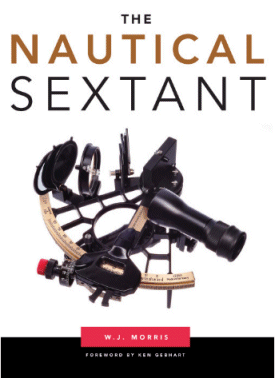
An excellent book about sextants, (though not about how to reduce sights, its by a collector and restorer not a yachtsman) is:-

nautical_sextant.gif


It's not cheap but you can get a Kindle edition for about £8. It covers all the well known models and how to rectify faults, what to do and not to do, how to take care of them and so on.

If you are buying of ebay or elsewhere, look out for:-

Bent frame - most obviously shown up by bent legs on the back
Cracked or broken sun shades - its a lot easier getting a mirror re-silvrered of replaced than it is the darkened glass (that has to optically flat).
Worn scale - often due to over enthusiastic polishing, although this is unlikely if it has been professionally used and isn't simply an ornament
Missing telescope - some come with a star scope separate from the normal scope for sun sights, worth making sure you have what you need, though mine only has the one
Missing mirror adjusting tool - many sextants have proprietary adjusting screws to adjust the mirrors and you will need the special tool that goes with it.
Eccentricity - this is where the axle around which the arm rotates is not central (probably because it had a bash, or possibly die to wear) This wills seriously impinge on your sights because the effect is not consistent across every angle so can't be compensated for by maths.

HTH

Edited to add: if you buy the book, Bill Morris in NZ will answer emails and help you with your restoration etc.
 
I'm mortified at the thought of potentially causing harm to my C&P sextant. During your next "coffee break", how about posting a few "do's and don't's"?

I can offer a few thoughts, based on my own practices and awareness. These are all gleaned from others further up the Tree of Knowledge, and I s'pose there are other useful tips out there. So, in no particular order, but E&OE....

First, the sextant box needs, on a yacht, a really secure place it can call home. I would inspect a prospective purchase's box carefully for telltale signs of a hard life.

Next, the yacht sextant needs a robust fitted camera strap, which goes around your neck so that, in moments of need, you have one hand for the ship and one hand for yourself. A bad lurch as you are negotiating the companionway steps is when yacht sextants get broked.

Next, don't purchase an instrument where the Calibration Certificate ( usually secured inside the box ) shows a large or uneven set of residual 'errors'. These should be small - mostly less than 5' of arc.

Carry some dry tissue to DAB away any rain/spray. Use tissue and fresh water after use to DAB away any and all damp residue from on deck which may contain salt.

When you have focused the telescope(s) to suit your eye, mark the right position with a pencil line so it can be lined-up/preset 'just right'.

Have a small 'Drynotes' notebook and at least TWO pencils to hand, to note down your readings. IKEA 2B 3" pencils are ideal - and free.

A headtorch aids reading the micrometer scale in deep twilight.

Have at least TWO quartz watches, each checked by radio for the day's accuracy. Learn how to 'rate' them.

Always, always, always start habitually with all the shades employed. Beware if you've set these for a 'clouded sun' if there's prospect of the cloud clearing while you are 'bringing the image down'. That could cost you the sight of an eye.

Edit: Got called away.... the book mentioned above looks excellent. Here's another one, which I have on my own shelves.

index_1.jpg


http://www.amazon.co.uk/The-Sextant-Handbook-Adjustment-History/dp/0070052190


Is that enuff for now? ;)
 
Last edited:
My sextant is (just) older than I am - ex US Navy from 1942. Nothing much wrong with a looked-after old sextant, but too easy to buy a damaged one if bought untested. The optics on newer quality sextants may be slightly superior to old ones, but there's really not that much in it.
I find this amusing. My sextant is a Tamaya, made in 1940, error free. I imagine the Imperial Navy made use of it but I don't know for certain. I just hope it did not see use on 7 December 1941. That's the day Pearl Harbor was bombed resulting in a declaration of war against imperial Japan.
 
Top