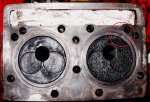
bukh20 - air intake & exhaust (pics)

cimo

Well-Known Member
Joined
11 Nov 2009
Messages
737
Visit site
not a problem as such - its a 1979 bukh20 that's been running very well.

would like to pick the collective forum brain on a couple of observations made during teardown.
(hopefully these photos attach as intended).

The first pic shows the exhaust valve stems, viewed through the exhaust ports (exhaust manifold removed). Pictures taken with each valve in the closed position. The stem belonging to the front cylinder appears (to me) to have a heavier degree of carbon buildup than that at the rear cylinder.

The 2nd pic (next post down) is a view inside the air intake manifold (air filter removed).
Quiet a bit of carbon-ised debris lying in there. (largest piece no more than 0.5mm I'd estimate). I can crumble the particles between my fingers - much like charcoal. Probably not clear from the picture, but the debris appears to concentrate towards the right hand side airway (i.e. the airway to the rear cyliner, which also corresponds with the "cleaner" exhaust valve stem).

Can these be related? It's beyond me how anything could find its way from the exhaust side to the air intake, but then again I haven't been close to diesels that long. Had the rocker cover off too, and everything looks in order there. Planning to remove the head also - for different reasons - although probably not until the new year.

Anyone care to offer a prognosis - likely to be symptoms of a problem in the making? all input welcome.

over to the panel .................
 
Last edited:
As a DV20 owner myself, one thing I can definitely say is that the head needs to come off for a valve regrind from time to time, and if your engine hasn't had this done since 1979, it's well overdue - every 2000 hours is about right - the exhaust seats, in particular, will be burned and pitted. Hopefully a regrind will do the job without having to have new valve seats or valves fitted. It won't hurt to fit new valve springs as well. While you're about it, get the bores honed and fit new piston rings - the overall increase in compression is likely to be considerable!
 
There is something odd about your exhaust port pics. If the valves are both closed why is there no evidence of movement on the right hand one similar to that on the left?

On the inlet pic there may be a little blow-by. However, from recollection, the crankcase vent emerges into one throat in the manifold, via a small drilling. Could the deposit be coming this way?
 
There is something odd about your exhaust port pics. If the valves are both closed why is there no evidence of movement on the right hand one similar to that on the left?

I would have thought that the rear one ( left hand picture) was in fact open and showing a clean section of stem which would disappear into the valve guide when it does close.

The rear one seems to have a normal slightly oily black deposit. The deposit around the front one, which looks as though it is probably closed, does not look normal to me but maybe it's a trick of the lighting
 
Last edited:
Yes, that's what I was saying but maybe more obliquely :(

First thing I thought as well when I saw it, one valve is probably colsed and the other open.

+1 to lapping the valves as it is a pretty easy job. I changed the head gasket when my old BUKH was 6-7 years old. I was told that they all had problems with leaking gaskets after 7-8 years and the gasket design was altered. This was about 30 years ago so I don't remember the details. However, I did have the head off after another 9-10 years and found it worthwhile to lap the valves (though pitting wasn't too severe).
 
thanks for the insights thus far.

just to re-confirm - both valves were snapped in their fully closed positions.
 
Both valves in the closed position - yes looks that way. Rear exhaust valve looks like it is corroded having lost its Chrome plating. Heavier C deposit on front valve stem probably due to injector problem or could be due to shot oil seals on valve stem.
If it were my engine I would remove head, check valve seats, valves and valve guides and have the injectors serviced/repaired. Honing the bores and replacing rings is a major job (engine out) and envolves a full strip down so is to be avoided if possible.
I would start with a top end overhaul but there again I possess the necessary skills and facilities to carry out the work properly. Replacing valve seats and valve guides is not work for the over enthustic amateur.
I suggest you obtain a copy of the WORKSHOP manual and carefully study Section C then decide if you believe you possess the necessary skills, facilities and experience to undertake a proper top end overhaul yourself. If you have then go for it but if in doubt leave it to the professionals - the tolorances are quite tight and the cost of getting it wrong will make your eyes water.
 
......the head needs to come off for a valve regrind from time to time, and if your engine hasn't had this done since 1979, it's well overdue - every 2000 hours is about right ............. While you're about it, get the bores honed and fit new piston rings - the overall increase in compression is likely to be considerable!

although engine history is patchy at best, I'm told it had a top end overhaul 12 odd years ago. Engine hours unknown unfortunately. Top end overhaul every 2000 hours is new information for me - cheers. Plan is to inspect the bores when I take the head off. Probably next Jan. judging by the current rate of progress. Expect more questions from me then! I don't have the means to quantify compression, but it "feels" "adequate" and equal across both pistons. (this is the point where experience leaves me wanting).

There is something odd about your exhaust port pics. If the valves are both closed why is there no evidence of movement on the right hand one similar to that on the left?

On the inlet pic there may be a little blow-by. However, from recollection, the crankcase vent emerges into one throat in the manifold, via a small drilling. Could the deposit be coming this way?

For contrast I will post a pic of the valve stems in the open position in a bit. Thanks for reminding me about the breather. I see now that it vents into the air intake. It comes out directly in the center of the air inlet port. Whipped the rocker cover off again and checked the breather but I can't see any evidence that would indicate the deposit is coming through here. So still puzzled on that one.

The rear one seems to have a normal slightly oily black deposit. The deposit around the front one, which looks as though it is probably closed, does not look normal to me but maybe it's a trick of the lighting

(both valves fully closed). The pics are pretty well representative of what I see. On the rear stem, I'm suspecting that is the grease applied during last overhaul. The front stem has a significantly greater carbon coating. I was undecided as to which would be considered normal. Could all be a red herring perhaps, the front stem not having had its share of grease before reassembly?

+1 to lapping the valves as it is a pretty easy job. I changed the head gasket when my old BUKH was 6-7 years old. I was told that they all had problems with leaking gaskets after 7-8 years and the gasket design was altered. This was about 30 years ago so I don't remember the details. However, I did have the head off after another 9-10 years and found it worthwhile to lap the valves (though pitting wasn't too severe).

thanks for sharing that. I suppose it makes sense to lap them once the head is off. Added to the to do list. Any recommendations for a good de-coking agent?

Rear exhaust valve looks like it is corroded having lost its Chrome plating. Heavier C deposit on front valve stem probably due to injector problem or could be due to shot oil seals on valve stem.
If it were my engine I would remove head, check valve seats, valves and valve guides and have the injectors serviced/repaired.

good point re: chrome coating - the grease doesn't rub off too easy.

Honing the bores and replacing rings is a major job (engine out) and envolves a full strip down so is to be avoided if possible.
I would start with a top end overhaul but there again I possess the necessary skills and facilities to carry out the work properly. Replacing valve seats and valve guides is not work for the over enthustic amateur.
I suggest you obtain a copy of the WORKSHOP manual and carefully study Section C then decide if you believe you possess the necessary skills, facilities and experience to undertake a proper top end overhaul yourself. If you have then go for it but if in doubt leave it to the professionals - the tolorances are quite tight and the cost of getting it wrong will make your eyes water.

Engine is currently out, so now is probably the best time to do this. My intention was to set out for a top end overhaul initially & make a call on the rings & honing when I get a look at the bores (sometime in the new year). I've heard it said that honing (after a fashion) can be satisfactorily achieved with sand paper at a 30 deg angle - I suspect you do this for a living? - would be interested in your opinion on that.

Must be said, this engine burns next to no oil. I did have a blue smoke episode for a while, but changing from multigrade to the recommended monograde oil resolved that. Greatly appreciate the advice - no doubt you'll see more questions from me!
 
Last edited:
for contrast - here's the stems fully open.
(the pictutre quality isn't as I hoped for the rear stem - the smudge is caked grease).
 
If you already have the engine out, it's worth doing a full overhaul while you have the chance, as you have access to parts that are difficult to get to once the engine is installed.
Once the head is off, check the bores for wear - after you've cleaned the carbon off, the bores should be smooth - if there's a ridge at the top, you probably need a rebore and new pistons. If not, get the bores honed (professional job but shouldn't be expensive) and fit new piston rings. While you're about it, replace all the crankshaft bearings and bottom end bearings.
Lap in the valves and check the seats - if you can get a good clean valve seal without recessing the seat, no problem - otherwise you'll have to get new valve seats fitted. Get an experienced mechanic to check the valves and the valve guide wear - replace if needed. Fit new valve springs and stem seals.
Get the injectors serviced. Rebuild with new gaskets, treat everything to a new coat of red heatproof paint and you should be good for years to come!
 
If you already have the engine out, it's worth doing a full overhaul while you have the chance, as you have access to parts that are difficult to get to once the engine is installed.
Once the head is off, check the bores for wear - after you've cleaned the carbon off, the bores should be smooth - if there's a ridge at the top, you probably need a rebore and new pistons. If not, get the bores honed (professional job but shouldn't be expensive) and fit new piston rings. While you're about it, replace all the crankshaft bearings and bottom end bearings.
Lap in the valves and check the seats - if you can get a good clean valve seal without recessing the seat, no problem - otherwise you'll have to get new valve seats fitted. Get an experienced mechanic to check the valves and the valve guide wear - replace if needed. Fit new valve springs and stem seals.
Get the injectors serviced. Rebuild with new gaskets, treat everything to a new coat of red heatproof paint and you should be good for years to come!
Rebore and new pistons? you are joking of course, arn't you? - fit new liners and keep original pistons (fit new rings though) RTFM :D
 
Rebore and new pistons? you are joking of course, arn't you? - fit new liners and keep original pistons (fit new rings though) RTFM

Quite right, of course - but my DV20, despite having done 3500+ hours, hasn't yet needed new liners, so I haven't got that far in the manual!
 
Quite right, of course - but my DV20, despite having done 3500+ hours, hasn't yet needed new liners, so I haven't got that far in the manual!
Lucky you - Ive been through it to the last page - twice at least - magic engines the Bukhs - built like brick shithouses and just keep going..... - Should not even think about liners until 10,000 + hours then it is a case of "thinking" about them.
 
...... there may be a little blow-by.

blowby alright.
It appears to be old damage from what I can determine & largely confined to the liner rim.
Significant pitting on the front cylinder piston & valves (which probably weren't seating 100%).
All good fun!

I would expect 6 water ports on the block to match the 6 on the head. My block has only got 3.

block1.jpgblowby2.jpg
 
Last edited:
Top