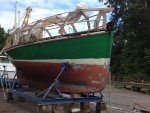
Boat cover and winter in a marina

pmagowan

Well-Known Member
Joined
7 Sep 2009
Messages
11,836
Location
Northern Ireland
sites.google.com
I presume this has been a topic many times before but I can't seem to find what I am looking for in the forum search function.

I keep my boat (28' wooden honeybee) in the water all year, it has a lot of varnish etc as it is entirely wood. Each winter there is serious deterioration and a lot of work the next year patching up. I was thinking of a cover but there are a number of problems. What about the increased windage in a marina? Can I make one myself as it will cost a small fortune to have one made? How, when the boat is in the water, do you keep the cover down? (I want it to overlap the topside a bit to protect the varnish on the toerail). I was thinking of using black plastic pipe attached to the stanchions and looped over to form a 'cage' over which the cover could be attached. The boom would help.

Also, we keep getting topside damage during storms as the boat rubs against the dock even with loads of fenders. Does anyone know of a good dock-fender to prevent this? My personal idea is one like an elongated wheel so that as the boat rises and falls the fender rotates instead of just rubbing. I can't find any like this except for massive ferries and suchlike.
 
A cover as you describe will be your best investment ever. A good one will last a long time and more than pay for itself in reduced work and money. If you keep it at boom height windage should not be a problem. I had mine made in two parts, for and aft of the mast and secured to the guard wires, but it is possible to have a skirt down to gunwhale level. Various methods of tying down depending on boat and your imagination. Worth talking to professional suppliers who have experience of making such things as they will probably have solved the problems before and can discuss ideas with you. Also best to get it made professionally as they are not easy things to get right.
 
Cheap tarps are exactly that. I have used them for three years now and they cause as much damage as they stop.

You can cut and weld PVC coated wagon sheets. You need a silicone roller and heat gun for pressure welding and an iron and greaseproof paper helps fold it.

Put grommets in every 300mm as the more tiedowns you use to keep it tight the better. Ball ties are better than bungees, with the balls on the outside, the shockcord keeps the grommet off the surface
 
I have exactly the same problems. Here are my solutions:

1) When you have the boat nicely varnished in the summer, have covers for the varnished bits. These can either be UV proof cloth professionally made, or plastic "tarp" ones made up at home using a domestic machine and eyelets. Domestic sewing machines won't really cope with the weight of cloth acrylics, but can cope with plastic woven sheeting ok. Of course the plastic home made ones will not look the same as items from a proper cover maker, but be vastly cheaper and though they will need replacing a lot more often. So, a question of budget and aesthetics.

Primarily, though, keep the varnish hidden from sunlight unless you are on the boat. Make sure you put on the full 8 coats too - no skimping.

2) For a wooden boat, you ought to use cotton canvas. This can be bought proofed, but a well designed cover should not collect or retain standing water, so will last for good 10 years. You could use PVC (my last choice) but in that case you MUST have large vents in the PVC to allow free airflow. Other synthetic materials are now available, but for longevity either a good loom-state or rot-proofed cotton canvas is your best bet. It has two advantages. It is a reasonably cheap material, and it will not sweat, and breathes water vapour out. My first choice for a cover for a wooden boat.

IMG_0812.jpgIMG_0878.jpg

3) Framing. You will want to be able, no doubt, to put the frame up and down by yourself. Give some consideration to the design of where you will want to put the feet of the frame and how you will protect the deck. You can make a frame yourself as a garage project. I used 18mm shuttering ply for the "frames" of the frame with 19x38 garden batten for the stringers and essentially built an upside down boat shape on top of the hull. The whole is lashed together and the frames are bolted and fold for storage. This entire contraption fold up and stores in the roof of my garage when not in use.

It is important that the finished item is aerodynamic not to cause windage. With a honeybee shape (60's cruiser, you can hold the hull skirts down with a rope running around the hull under the transom and bow. If necessary, bamboo poles can be used to hold the topside skirts down.

It all depends on what you actually want to do with the covers on. I designed mine to allow me access to the deck over winter. If your varnish is good, you could just get away with a two or three section over-boom tarp secured to the toe rails. This will be hugely cheaper. For your class of boat, a full canvas winter cover will be about £2-£3k, but only £600+ for an over boom solution

Your best bet -and I assume its the cockpit and coachroof sides that cause you the most heartache- is to get a professionally made cockpit tonneau cover and roll-up side skirts for coachroof in acrylic for summer use and an over-boom tarp set in cotton canvas for winter. Keeping the varnish covered in the summer is the best solution to longevity.

And declaring my interest - I am a professional cover maker.
 
Thanks all. Quite a lot of information to take in. I often like to DIY it to get things how I like but this can mean things never get done. The next time I am onboard I will have a good look at the best way to design it. I may have to call in the pros as I don't want a bodge job flapping around in the wind.

I like your frame idea but it looks very heavy duty. I was wondering if I could get away with something a lot lighter such as PVC pipe such as I use for making mini poly tunnels for the veg garden.

I guess in the end of the day I pay my money and get what I pay for. 2-3k is close to what I paid for the boat and trailer but I guess this is the price for a quality job made to measure.

Thanks again
Paddy
 
I had in mind to design a frame to support a heavy cover that I could actually almost stand up under, that would fit around the mast either up or down. As it happens the current frame isn't really big enough, but is too heavy. I suppose its a work in progress anyway, so version 3 will make the boat look like a zeppelin, but thats deliberate. Version 1 was a big square greenhouse, which wasn't very aerodynamic, but was very warm and windproof even with a tarp over the top. I was once underneath in a January force 8, and not only was it warm enough to varnish, a naked flame didn't move, despite the racket outside.

Version 3 will be larger and rounder with eventually a cotton canvas cover down to the waterline - this is a big job even for me and I have a sail loft to work in- but it will be designed so that Cleone can be moored in either a marina or even moored in open water with no ill effects. Partially as a winter liveaboard cover if that is needed. Polytunnel pipe is fine, but for a fitted cover you need to have a repeatable shape, so that when you take the frame off in the spring, you get the same frame back in the autumn. However, with a bit of built in wiggle room this is easily achievable. The key is having strong yet flexible (ie., lashed) joints. And loads of lashing points to the toe rail.
 
Having an aged teak deck I decided it needed some winter protection for my 31' boat and had two sections of reinforced PVC made up to my measurements by a local company - it wasn't cheap, ca. €1000. One was tapered to cover the bow up to the mast, the other rectangular from mast to stern. The width was planned to extent over the stanchions and lifelines to be tied down by zig-zagged elastic cord under the lower lifeline.

To support the forward section I ran a stout line from mast to pulpit with a hinged fore-and-aft bar and strut braced on the foredeck to stop sagging and for the aft section a line from boom end to backstay extends the boom support - I have a boom strut so no topping lift. The simple shapes limited coverage at the mast due to the triple shroud configuration that the forms were not cut for.

To set up and take down extended my lay-up and fitting-out by a full day and the weight of the two sheets was such that the whole exercise was exhausting - especially difficult alone and despite being healthy enough, at 78 I may not have quite the strength of earlier years.

So after four years of fighting those heavy covers I have capitulated and visited my local cover maker who will be visiting me on-board next week to assess the best solution. He has already shown me a sample of material - infinitely lighter and easier to manipulate than what I have (and which he assures me is very durable) and I have seen examples of his work on neighbouring boats - completely covering and still in two manageable sections, but properly formed and fitted to fit over the boat entirely.

After my experience I now believe there is no substitute for a professional job with this particular requirement - at least in my case. Your mileage may vary.
 
I don't have all the answers....

....but I've used black rainwater downpipe, slit, and fitted over the stanchion tops and along the guardwires. This is fairly effective in preventing chafe of the tarp cover, but tends to rotate - despite gaffer tape - and the wire 'emerges' from the plastic tube. The answer is more gaffer tape arranged, at the stanchions, to prevent rotation of the tube.

I've use blue PVC water pipe in hoops to provide a 'dome' support for the plastic tarp, and use multiple plastic cable ties to secure the hoop-ends to stanchions, high and low, with the hoop ends tucked inside the toerails. I found I needed several 'longitudinals' to help keep the shape and to prevent 'puddling' of the tarp sheet from holding many gallons of rainwater. These were made from 5mm long grp rod I have, but could just as readily be more PVC water pipe. Again, cable ties and gaffer tape sufficed.

It's always going to be difficult to secure the lower skirts of a tarp or cover down near the waterline, so why not protect your toerails' varnish using slit rainwater downpipe, cut to length? These strips can be secured with cord to stanchions so they don't fly away....

As for materials, cheap Polytarps are available in a range of weights/strengths - 'Google is yoor frend' - and the scrim-reinforced material used by scaffolders is ideal. This stuff can be sewn and glued - see < http://www.polysail.com/products.htm > for ideas. One can even sew/glue to provide 'tunnels' on the tarp/cover to house your PVC water pipe supports....
 
Top