

zoidberg
Well-Known Member
In my refurb fervour, I've discovered the previous bodger had installed two 'lecky bilge pumps c/w two different diameter outlet pipes. These were 'siamesed' into one 2" through-hull outlet.
I'm satisfied the pumps themselves are sound and serviceable, although I'll replace the 'lecky wiring, fuses and switches. I'll supply them from two separate 12V batteries.
The question I need to resolve is whether again to fit 'two-into-one' or provide a new through-hull fitting so as to give each pump its own unimpeded outlet.
What does the congregation think of the balance of advantage?
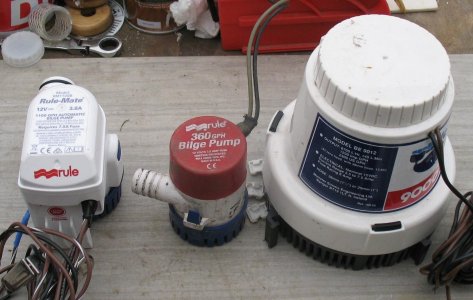
The small one in the middle I'll use in a 'roving' mode to empty cockpit lockers.

I'm satisfied the pumps themselves are sound and serviceable, although I'll replace the 'lecky wiring, fuses and switches. I'll supply them from two separate 12V batteries.
The question I need to resolve is whether again to fit 'two-into-one' or provide a new through-hull fitting so as to give each pump its own unimpeded outlet.
What does the congregation think of the balance of advantage?
The small one in the middle I'll use in a 'roving' mode to empty cockpit lockers.

