Best adhesive sealant with elasticity?

demonboy

Well-Known Member
Joined
11 Oct 2004
Messages
2,237
Location
Indonesia
www.youtube.com
Hi,

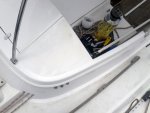
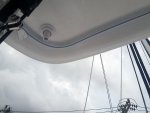
I'm looking to bond a custom-shaped acrylic window around the combing of my cockpit. The lower part will fit around a painted GRP surface and the upper will meet the hard dodger, which has a track for canvas. It will be screwed along the bottom and the sides but the upper part will be sealed with sealant only. Since there is slight movement in the dodger I'm looking for an adhesive sealant that can handle that movement.

Upper corner showing track the window will attach to
corner.jpg

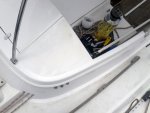
Lower corner around combing
corner2.jpg

The obvious choice is Sikaflex 295 but I'm unsure of its elasticity compared to alternatives. According to a PBO test, Evo-stik's 'Sticks like sh*t' came out on top in tests but I won't be able to source that here in Thailand. I'm probably left with just the Sikas and 3M. I don't want to use straight 5200 as I may have to remove the window in the future, though there's a 5200FC that seems less adhesive. Butyl tape is not an option in this instance.

Should I just stick (geddit?) with 295 UV?
 
Last edited:
A bit left field but have you considered using something like Teak Decking Systems caulking TDS SIS-440?

The elasticity/extension of this product is amazing and it has excellent adhesion properties (eg you don't need to use a primer when used with teak decking).

I don't know if th is product is available in Thailand but it's American so may be. Also it comes in white and grey as well as black.

TDS Deck Sealant is a one-part, paste-like neutral cure system which, when exposed to moisture in the air, reacts to form a tough, flexible, solid rubber compound.
The sealant is a thixotropic material, which does not sag during cure, and, when cured, has excellent temperature stability and chemical resistance.
Because the sealant is neutral cure, it is non-corrosive to all substrates.
SIS440 was strictly developed by TDS for teak deck seams. It is a well tested and proven product in hot or cold climates and needs NO PRIMER.
A one-part silane polymer that forms a solid rubber compound, it is better than the polysulfides, polyurethanes and MS polymers.
It has the highest rating resistance to UV, excellent resistance to chemicals and excellent temperature stability
 
Have a look through the products/spec sheets available from Arbo http://www.arbo.co.uk/arbo-sealants/ or call them.

They did have a great adhesive sealant at one time that you could find in chandlers it was flexible enough to seal inflatable leaks without a patch as an emergency fix. I think it was called 1270? but was branded Arbothane.
 
Have a look through the products/spec sheets available from Arbo http://www.arbo.co.uk/arbo-sealants/ or call them.

They did have a great adhesive sealant at one time that you could find in chandlers it was flexible enough to seal inflatable leaks without a patch as an emergency fix. I think it was called 1270? but was branded Arbothane.

Again, Arbo not available in Thailand. I've had to bring my own Arbo butyl in before now. This is why I'm kinda stuck with either Sika or 3M.
 
How about trying Teak Decking Systems' product distributor in Malaysia?

MALAYSIA
SMS Superyacht Marine Supplies & Painting International Ltd
U0065, 2nd Floor, Jalan OKK Awang Besar
87000 Labuan FT, Malaysia
Tel: (60) 87 417 577
Fax: (60) 87 423 577

Email:
jim@smsmarinesupplies.com
christine@smsmarinesupplies.com
sms.marinesupplies@yahoo.com
jimkant@hotmail.com
www.smsmarinesupplies.com

Excellent, thanks for that. I've been working today so haven't had a chance to do any research other than a cursory check locally. Importing from Malaysia to Thailand can be ok if the package is small so I'll do me research. Once again, thank you for the contact details. :encouragement:
 
Several things you have not considered. I'm pretty sure of these.

1. There will be too much movement. I had a boat with a similar arrangement. Stick with canvas.
2. I doubt acrylic can handle the movement without cracking. Poycarbonate would do better, but it woun't handle the sun for long.
3. Most polyurethanes are incompatible with acrylic. They will cause cracking. I've seen this a number of times.
4. The UV coming through the plastic will break the bond and the polyurethane will come loose in a few years. This is why special primers are required to use Sika 295. Other sealants will generally peal right off, including 3M polyurethanes like 5200. It won't work long term. I've tested this.

I would not try ANY sealant that is not rated for this without testing. Some real disasters are not just possible but probable. sorry for the bad news, but there are reasons only a few sealants are used. additionally, a post supported hard top like that moves too much. I'm afraid you are going to throw bad money at this.
 
Several things you have not considered. I'm pretty sure of these.

1. There will be too much movement. I had a boat with a similar arrangement. Stick with canvas.
2. I doubt acrylic can handle the movement without cracking. Poycarbonate would do better, but it woun't handle the sun for long.
3. Most polyurethanes are incompatible with acrylic. They will cause cracking. I've seen this a number of times.
4. The UV coming through the plastic will break the bond and the polyurethane will come loose in a few years. This is why special primers are required to use Sika 295. Other sealants will generally peal right off, including 3M polyurethanes like 5200. It won't work long term. I've tested this.

I would not try ANY sealant that is not rated for this without testing. Some real disasters are not just possible but probable. sorry for the bad news, but there are reasons only a few sealants are used. additionally, a post supported hard top like that moves too much. I'm afraid you are going to throw bad money at this.

Thanks very much for this comment, I spent a restless night pondering your thoughts! Seriously though, I think you have made a valid point about the movement of the acrylic and it's something we need to think about. The obvious answer is to use 1mm acrylic and somehow attach it to canvas. Since reading your post we've watched a few videos in which the acrylic is glued to Stamoid. Unsure what glue they used. We need to think of a way of either allowing the acrylic to move, or to only fix it at one point (the combing around the cockpit) that doesn't move and work out how to waterproof the sides and top. One option is to run a flap around the top from the track that falls over the front of the top part, but we still need to work out how to waterproof the sides. A 1mm piece of acrylic glued to vertical Stamoid might be the answer.
 
Thanks very much for this comment, I spent a restless night pondering your thoughts! Seriously though, I think you have made a valid point about the movement of the acrylic and it's something we need to think about. The obvious answer is to use 1mm acrylic and somehow attach it to canvas. Since reading your post we've watched a few videos in which the acrylic is glued to Stamoid. Unsure what glue they used. We need to think of a way of either allowing the acrylic to move, or to only fix it at one point (the combing around the cockpit) that doesn't move and work out how to waterproof the sides and top. One option is to run a flap around the top from the track that falls over the front of the top part, but we still need to work out how to waterproof the sides. A 1mm piece of acrylic glued to vertical Stamoid might be the answer.

There are special products for this. Makrolon is a polycarbonate that is either glued in, or in the thinner gauges, sewn. There are also acrylics that are said to last longer, though I have not seen them installed.
http://www.4u2sea.com/enclosures.php
https://www.ez2cy.com/

Google the product names and you will find many installation stories.
 
There are special products for this. Makrolon is a polycarbonate that is either glued in, or in the thinner gauges, sewn. There are also acrylics that are said to last longer, though I have not seen them installed.
http://www.4u2sea.com/enclosures.php
https://www.ez2cy.com/

Google the product names and you will find many installation stories.

Yes, the dodger design was based on the Lightwave design that incorporated sewn polycarbonate corners. We've been looking at various youtube clips of combined Strataglass and acrylic solutions. It's all possible, it's just trying to find the materials here.
 
I would not fix the perspex top and bottom

I would fix it to the bottom as you planed and at the top fix an aluminum channel so the top of the perspex slots into the channel sp its not held rigid.

The channel would be fixed to the underside of the dodger. This would allow for any movement without stressing the perspex and would also allow and expansion and contraction of the perspex due to temperature change.
 
Yes, the dodger design was based on the Lightwave design that incorporated sewn polycarbonate corners. We've been looking at various youtube clips of combined Strataglass and acrylic solutions. It's all possible, it's just trying to find the materials here.

I did not mean to discourage. I had a similar cat with a very similar hard top (see my avitar--I now have a tri) and toyed with the same idea. But I sold the boat before I needed new windows. I never loved soft vinyl.
 
I would not fix the perspex top and bottom

I would fix it to the bottom as you planed and at the top fix an aluminum channel so the top of the perspex slots into the channel sp its not held rigid.

The channel would be fixed to the underside of the dodger. This would allow for any movement without stressing the perspex and would also allow and expansion and contraction of the perspex due to temperature change.

Hi Roger,

Yes, that's my current thinking if I can't source a thinner acrylic which could be stitched or glued to the canvas. What about the sides though? In my design this is a corner so the verticals will meet the front panel in the middle (could be perspex or canvas) and the side panel (also canvas). It has been designed to meet two vertical stainless stanchions. In the following image you can see the corner the perspex will run around and the vertical stainless bar on the left (this bar is now straight and not curved, as pictured). The idea was to weld a flat piece of stainless to the front of the bar, say 2" wide, creating a flat surface for the edge of the perspex to sit against. We'll use some kind of adhesive sealant here but one option is to also through-bolt it. I'm not sure this is a good idea bearing in mind thinwater's point about movement and expansion.

corner2.jpg
 
Expansion and contraction of perspex is always an issue with mechanical fixing. the trick is to have the holes in the perspex over size and to have flat clamping plates on both sides.

What I was trying to say was to have a channel like a sliding window channel fixed to the top and the perspex fixed at the cotton and on the stainless bar but just located in the sliding window channel with no fixing between the perspex and channel at the top.
 
Top