Battery switch replacement - how to select

antaris

Well-Known Member
Joined
12 Jul 2012
Messages
249
Location
Athens, Greece
astarteginfizz.wixsite.com
Hello all,

Looking to replace battery switch (currently single switch on Negative bus) with possible replacements from BEP or Blue Sea.

My Boat:
42Hp Sole engine
2 alternators: 50 and 90 A
2 banks: Start 100Ah and Service (3x90=)270Ah

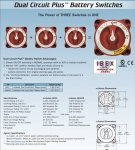
How do we select the appropriate (Safe) amperage for the switch? I see 300, 350 and 600 Amps...

Screenshot 2021-02-26 115420.jpg


Interested in the ON-OFF-COMBINE variety, such as this:

m-Series Mini Dual Circuit Plus™ Battery Switch - Red - Blue Sea Systems
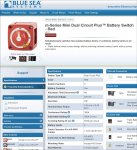
Screenshot 2021-02-26 120239.jpg


Thank you
 

Attachments

  • Screenshot 2021-02-26 114922.jpg
    Screenshot 2021-02-26 114922.jpg
    114.6 KB · Views: 3
You're unlikely to have current approaching 300A, so any of those would do the job.

I wouldn't fit the "Dual Circuit Plus" switch, as it severely restricts your flexibility. For example, you might want to isolate the engine battery (eg to work on the engine) whilst leaving the domestic batteries switched on to keep lights on in the boat (so that you can see what you're doing). The Dual Circuit Plus doesn't allow that.

I like the BEP switches, they look less clunky than the Blue Sea switches. The standard BEP switch is rated at 275A continuous, which would be fine for your needs. It will cope with 455A intermittently or 1250A for 15 seconds. See BEP 701PM battery switch 275A ON/OFF

My preference is to have two simple on/off switches; one for the engine battery, one for the domestics. If you go that route, you could fit a third identical switch to use as an emergency combining switch if you wanted to start the engine from the domestic batteries.
 
Choose an amp rating to cover the largest load you put on your battery ... Probably the starter motor

Id expect the 300amp switch to be more than adequate for the starter on a 45hp engine ... 300 is the continuous rating but you only operate a starter for a few seconds..

Unconventional to have the battery isolator in the negative ... I make no comment .

The Dual plus switch is ideal for people who find operating two switches just too much trouble but has a couple of disadvantages

One is that you cannot, without disconnecting the battery, have one circuit on and the other off. You might for example want the domestic circuits on but the engine circuits off during engine maintenance.

The other is that you cannot leave a failed battery out of circuit and run all loads off the good one ( without disconnecting the failed battery) as you can with two isolators and an link switch which parallels the loads
 
Last edited:
Start by looking at the recommendation from your engine manufacturer - the switch capacity rating should be in the manual. I'm not saying the advice here is wrong, but if the switch fails it will be when you need it most!

Given the relative cost and the infrequency that these are replaced, I always err on the side of plenty of spare capacity. I don't want the battery switch being the weak link in my electrical system, and assume the 'worst case' of both a degradation in performance (rating) for the switch, plus the inevitable increase in electrical load over the lifetime.

TLDR - find out what size switch you need, then buy a bigger switch ;-)
 
Start by looking at the recommendation from your engine manufacturer - the switch capacity rating should be in the manual. I'm not saying the advice here is wrong, but if the switch fails it will be when you need it most!

I've never, ever, seen the battery isolator switch specification in an engine operator manual.

The BEP switch's capability of 1250A for 15 seconds should cope with anything the OP does.
 
I wouldn't fit the "Dual Circuit Plus" switch, as it severely restricts your flexibility. For example, you might want to isolate the engine battery (eg to work on the engine) whilst leaving the domestic batteries switched on to keep lights on in the boat (so that you can see what you're doing). The Dual Circuit Plus doesn't allow that.

The Dual plus switch is ideal for people who find operating two switches just too much trouble but has a couple of disadvantages

I have the Dual Circuit Plus with a poppable thermal breaker on each battery as well. This allows me to have a system which is extremely simple in daily operation - turn switch "on" at start of cruise, turn switch "off" at end of cruise, turn switch one more click if starter battery goes flat - and which can also have either circuit isolated if necessary. But of course there are other ways of doing things which are just as good. I like simple interfaces myself, so that's what I tend to go for.
 
I have the Dual Circuit Plus with a poppable thermal breaker on each battery as well. This allows me to have a system which is extremely simple in daily operation - turn switch "on" at start of cruise, turn switch "off" at end of cruise, turn switch one more click if starter battery goes flat - and which can also have either circuit isolated if necessary.

I didn't know that, how does it work?
 
Unconventional to have the battery isolator in the negative

Yeap, thought so myself - but hey, the boat's French and from the 1970's. One of the previous owners obviously changed all the wiring and followed the same installation layout.

Engine manual:
All I can find is that the starter motor is 1.7kW

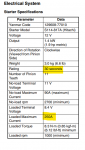
Then, I found this:
Screenshot 2021-02-26 162435.jpg

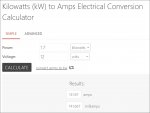
So 141 Amps... (min or max or what>?!)

I will agree that 3 switches and a complex system is much more flexible - yet much more expensive, more connections to fail (and I can always disconnect 1 bad battery).
 
I've never, ever, seen the battery isolator switch specification in an engine operator manual.

The BEP switch's capability of 1250A for 15 seconds should cope with anything the OP does.

Just because you haven't seen something doesn't mean it doesn't exist. The information can be found in the installation manual, as the OP has a Sole engine I presume this is a replacement so they may have the manual, or can get the information from a dealer.

Here's an extract from a Yanmar manual (first thing that came up), note the rating needs to be 250A for 30 sec in this case. This is assuming a direct connection, so losses across the cable length will need to be considered. In this case, I'd probably go with a switch rated at at least 500A for 30 sec to be in the clear with a good margin for error.

1614349946448.png
 
Just because you haven't seen something doesn't mean it doesn't exist. The information can be found in the installation manual, as the OP has a Sole engine I presume this is a replacement so they may have the manual, or can get the information from a dealer.

Here's an extract from a Yanmar manual (first thing that came up), note the rating needs to be 250A for 30 sec in this case. This is assuming a direct connection, so losses across the cable length will need to be considered. In this case, I'd probably go with a switch rated at at least 500A for 30 sec to be in the clear with a good margin for error.

View attachment 110114

You've quoted the starter's spec, not the spec of the isolator switch.

The BEP switch mentioned earlier will cope with 455A for 5 minutes - more than enough safety margin.
 
You've quoted the starter's spec, not the spec of the isolator switch.

The BEP switch mentioned earlier will cope with 455A for 5 minutes - more than enough safety margin.

We are starting to get off post, but as the biggest load in the system (except possibly a bow thruster if fitted) the main consideration needs to be given to the starting current - the switch needs to align with this at a minimum. If it can handle the starter load, the switch will easily handle any other load. In the commercial world I now work in we do electrical load balance charts all the time, and motor currents are one of the prime considerations as their inrush or starting load is significantly higher than any steady draw.

If the switch suggested is capable then no reason not to go with it. I don't know what the starting current is for this engine, the Yanmar one I picked at random - it's a smaller engine (3JH4E)

My point is to make sure the switch is rated high enough, and factor in enough margin of error. One can check the manual as you will (likely) find the minimum rating needed in there. If in doubt, double the starting current rating as this will guarantee enough redundancy.
 
Yeap, thought so myself - but hey, the boat's French and from the 1970's. One of the previous owners obviously changed all the wiring and followed the same installation layout.
Nothing unconventional about it at all. all Jeanneaus, Beneteaus, Bavarias and no doubt many other builders wire isolators into the neutral. However, recent practice is to isolate each bank separately as has been suggested. Fail to see how this could possibly be deemed complicated. Simple also to then put in an emergency switch to use the house bank to start the engine in the unlikely event of a flat engine start battery.

You can leave the negative switch in, just not use it or do away with it by replacing it with a power post.
 
Standard fit on some boats.

Indeed. If I remember correctly, it used to be suggested by some engine manufacturers to help with corrosion protection too, but my brain is foggy on that so I could be mistaken.

But yes, seen plenty of these - mainly on metal hulled yachts.
 
Hello all,

Looking to replace battery switch (currently single switch on Negative bus) with possible replacements from BEP or Blue Sea.

My Boat:
42Hp Sole engine
2 alternators: 50 and 90 A
2 banks: Start 100Ah and Service (3x90=)270Ah

How do we select the appropriate (Safe) amperage for the switch? I see 300, 350 and 600 Amps...


I would use Blue Sea switches, the panel mount one linked to in post #2 or this one: Contour Battery Master Switch | BEP

I have lost count of the number of these i've fitted to boats with similar specs to the ones you quote, including myb own. Never, ever, had an issue with them.


I would fit three of the BlueSea switches, one for each bank and a 3rd one for emergency use, wire them as below, although your charging arrangements might differ.

Charging-2-banks-VSR.png
 
Indeed. If I remember correctly, it used to be suggested by some engine manufacturers to help with corrosion protection too, but my brain is foggy on that so I could be mistaken.

But yes, seen plenty of these - mainly on metal hulled yachts.
See post #12. Don't think it is anything to do with corrosion protection (how could it?) or metal boats. All of the makes are GRP.
 
I have the Dual Circuit Plus with a poppable thermal breaker on each battery as well. This allows me to have a system which is extremely simple in daily operation - turn switch "on" at start of cruise, turn switch "off" at end of cruise, turn switch one more click if starter battery goes flat - and which can also have either circuit isolated if necessary. But of course there are other ways of doing things which are just as good. I like simple interfaces myself, so that's what I tend to go for.

I will agree that 3 switches and a complex system is much more flexible - yet much more expensive, more connections to fail (and I can always disconnect 1 bad battery).

I fitted the M-series dual-circuit switch on my previous boat - 20hp VP2003 powered. I was really pleased with it, especially as it was (nearly) foolproof for my crew to operate. Yes the multiple switch approach is more flexible, but if your batteries are accessible any possible shortcoming in the dual-circuit can be mitigated, but in all the years I had that boat I never had to isolate a shorted engine battery or service the engine at night.
 
Top