Battery question

petedg

Well-Known Member
Joined
13 Aug 2006
Messages
428
Visit site
Have to replace the complete battery bank consisting of one starter and two house batteries. Have already purchased an 85Ah starter and was thinking to get two 105Ah house batteries. Are there potential problems having two different Ah ratings, should I get two house units to match the starter?
Your comments/advice would be appreciated.
 
the only problem would be if you had a charging system which could not be switched to choose between the two systems. The danger would be that the 85 would reach full charge before the 210, and the alternator would continue to stuff amps into the 85 when it didn't need any.

As an engine start battery needs different charge characteristics from a deep discharge domestic one, you need to look at systems or gadgets which treat the engine and domestic as separate units; in which case, the two banks are charged independently to their full(ish) capacity.
 
the only problem would be if you had a charging system which could not be switched to choose between the two systems. The danger would be that the 85 would reach full charge before the 210, and the alternator would continue to stuff amps into the 85 when it didn't need any.

As an engine start battery needs different charge characteristics from a deep discharge domestic one, you need to look at systems or gadgets which treat the engine and domestic as separate units; in which case, the two banks are charged independently to their full(ish) capacity.

Have to replace the complete battery bank consisting of one starter and two house batteries. Have already purchased an 85Ah starter and was thinking to get two 105Ah house batteries. Are there potential problems having two different Ah ratings, should I get two house units to match the starter?
Your comments/advice would be appreciated.

No problem provided they are all compatible types, Individually the batteries will only take the charge current they require from a properly regulated alternator output........... it wont "stuff amps" into a battery once it does not need any,

Effectively you have a 85 Ah battery and a 210 Ah anyway !


Rather surprised by Sarabande's reply. Someone whose advice is generally spot on, :confused:
 
I read the OP as having 3 batteries in one parallel layout. If that is the case, if the charger or alternator senses that the 210 bank still needs amps, will it not continue to output into the 85 as well ? (I know such a layout would really be a 295 battery...)

I've never seen such a layout though.

Happy to withdraw my comments if you think them misleading. :)
 
+1 on Sarabande above on the split between the engine start battery charge and the house batteries.

If you use more than one battery in parallel on the house bank in the ideal world they would be identical twins however in pratice provided that they are the same technology not different i.e. vented lead acid - sealed lead acid etc and are in the same condition / age then you could get away with different sizes e.g. 105 Ahr and 85 Ahr.

The key factor is the stress that the system is subjected to, if you have heavy electrical demands and frequently run the house system low then the batteries need to be "more perfect" than if the system is not stressed.

Good Luck
 
I read the OP as having 3 batteries in one parallel layout. If that is the case, if the charger or alternator senses that the 210 bank still needs amps, will it not continue to output into the 85 as well
It's down to the 85 if it accepts any more power or not depending on the voltage and state of charge.
 
Have to replace the complete battery bank consisting of one starter and two house batteries. Have already purchased an 85Ah starter and was thinking to get two 105Ah house batteries. Are there potential problems having two different Ah ratings, should I get two house units to match the starter?
Your comments/advice would be appreciated.

You're getting some strange and incorrect responses. As long as all the batteries are the same sort of chemistry, ie all wet lead-acid, all sealed, all AGM, etc, there is absolutely no problem. As VicS has pointed out, batteries only take the current they need, and the charging current reduces as they approach full charge, you can't "stuff amps" into them.
 
It would perhaps be relevant to know the type of charging system involved. Diode splitter, VSR, manual 1,2 both switch. If the alternator is battery sensed in the case of diode splitting. If there is a fancy regulator or any other gizmos.
 
If as others have said, if all the batteries are the same type, they don't have to be the same size. My engine start is 85AH and the two domestic banks total 490AH. If the engine is running and all are charging at the same time, each bank/battery just takes what it needs, there's no way one can be overcharged.
 
It is very common for all batteries to be in parallel for charging. ie via 1,2,both switch or VSR or any other switching. Essentially the same for diode split systems.It is also very common to have the battery sizes OP suggests. So as said Alternator presents a voltage to the battery terminals then battery current depends on the size of battery and state of charge.
Only at high voltages forced charge froma smart charge controller or charger does the peculiar chemistry of essentially lead acid batteries matter. So standar 14v regulator should be OK if not ideal for all lead acid types.
I would suggest for OP that he have provision to easily isolate each of the 2 house batteries. No problem when they are new but when they start to die of old age it is good to be able to treat (charge nad discharge ) separately. Indeed If the OP does not rely on 12v refrigeration without charge then one house battery may well be adequate.
or I suggest he remove 2 dead house batteries and try his use with just one house battery. good luck olewill
 
No problem provided they are all compatible types, Individually the batteries will only take the charge current they require from a properly regulated alternator output........... it wont "stuff amps" into a battery once it does not need any,

Effectively you have a 85 Ah battery and a 210 Ah anyway !


Rather surprised by Sarabande's reply. Someone whose advice is generally spot on, :confused:

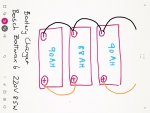
The 3 batteries will be the same type. The old battery bank was wired as shown in the attachment, unfortunately I don't have access to the boat right now but in the summer I see the need to trace the wiring and work out what's connected to what. There is no manual switch For isolating batteries.
Thanks to everyone for taking the time to give me your thoughts.
 

Attachments

  • image.jpg
    image.jpg
    75.1 KB · Views: 0
Actually another thought which just came to mind as I haven't purchased the 2 house batteries yet. I could go with 2 more 85Ah instead of the 2 x 10⁵Ah, total would be 255Ah instead of 295Ah, I'm questioning whether that difference is significant or maybe you can never have enough? I have changed the lighting over to LED so there have been some power savings there, fridge only gets used when on land power.
 
I'm questioning whether that difference is significant or maybe you can never have enough?

Depends on how you use the boat, but most people reckon you can never have enough! Bear in mind that you will often not have fully charged the batteries, and it's bad to discharge them excessively, so with 170Ah of domestic batteries your actual useful capacity may only be 50-60Ah.
 
The total Ah of the 3 batteries is largely irrelevant - presumably you will not be using the engine start battery for domestics, so you will have 210Ah with the 105s and 170 Ah with the 85s, of which only half is usable so the real question is would 85Ah meet your requirements, or do you need 105Ah? How long do you expect/want to be able to run your boat systems without charging and what load do they draw? Personally I would always go for the higher capacity - I have 3 x 130 Ah domestic batteries + a red flash starter.
 
Not a battery expert, but with electrical engineers hat on: Considering each battery as a Thevenin equivalent circuit, ie, a voltage generator in series with a resister, then wiring a fully charged battery (in which it's generated emf is at it's maximum based on the chemistry), any extra voltage applied to its terminals will surely be dropped across its internal resistance and energy be dissipated as heat (and produce more gassing off) would it not? Hence, I'm suggesting better (and safer) to have similarly rated batteries at a similar start of charge if being charged (and used) in parallel.
 
Not a battery expert, (in which it's generated emf is at it's maximum based on the chemistry), any extra voltage applied to its terminals will surely be dropped across its internal resistance and energy be dissipated as heat (and produce more gassing off) would it not? Hence, I'm suggesting better (and safer) to have similarly rated batteries at a similar start of charge if being charged (and used) in parallel.

No you slipped a curly one in the argument. "any extra voltage applied to its terminalswill surely be dropped across its internal ressitance" Actually it will result in a current flow into the battery dependent on the difference between the applied charge voltage and the inherent voltage of the battery. Now the inherent voltage of the battery does depend on charge state not just on the chemistry of the battery. (why I don't know. as seen by different voltages as measured by a DVM high resistance volt meter)
So yes an excessively high charge voltage does result when the battery is charged of heat and gassing it is wrong to suggest that batteries should be matched to avoid overcharge. ie each battery will take what it can or needs but when fully charged and being overcharged a small battery will be damaged quicker than a large battery. But then a regulator is supposed to present a voltage which will not overcharge and damage any battery. good luck olewill
 
.....any extra voltage applied to its terminals will surely be dropped across its internal resistance and energy be dissipated as heat (and produce more gassing off) would it not? Hence, I'm suggesting better (and safer) to have similarly rated batteries at a similar start of charge if being charged (and used) in parallel.
Not sure what you mean by "any extra voltage applied".

If this is the recommended charging voltage for the batteries then if it is left applied when the battery is 100% charged then yes the "energy" from this voltage will "overcharge" the battery which does mean excess gassing.

During the absorption phase of charging the batteries can sit at their gassing voltage of 14.4 volts with no problems, there will be small amounts of gassing which is needed to stir up the electrolyte, but each battery takes the current it needs to charge the battery. It is only when the batteries are fully charged and still sitting at the gassing voltage, but taking very little current, that this voltage will causes the batteries to gas much more heavily. By dropping to Float and reducing the charge voltage from 14.4v to a float of 13.8v or less the gassing will stop. It is worth noting that gassing voltages are based on battery temperature, 14.4v of 25C, 13.98v at 40ºC. A higher voltage than the battery manufacturers recommended absorption voltage will also cause excessive gassing. This is very bad news for sealed batteries.

Batteries in parallel only deliver current based on their Ah capacity, and they take the charge current they want for a given voltage, so if batteries of different Ah capacity are used in parallel and charged in parallel then they will start at the same low state of charge and will arrive at 100% at the same time, but only if they are of the same type AND the same age. Batteries of different ages will have different open circuit voltages for a given state of charge which is why they should not be used together in a house bank as both the discharging and charging will not be optimum.
 
I don't want to start another battery thread so I hope nobody minds if I latch my question onto this one.
I too want to add a designated starter battery to my bank. I was looking at the Oddysesy extreme racing 40. But I am confused by the cca figures below.

Voltage: 12V
PHCA (5 sec): 1100 (Pulse Current)
CCA (SAE): 500 (Cold Start Performance)
Nominal Capacity: 45Ah 20 Hr Rate

It's described as an 1100 cca on the website, however the extract above from the data sheet states only 500 cca

Nevertheless the question is will it be good enough for my Volvo 2002.
It will be housed about 1 meter away from the original bank, going through a 1.2. both switch, so what size cable (in amps) will I need to connect it up.
 
I don't want to start another battery thread so I hope nobody minds if I latch my question onto this one.
I too want to add a designated starter battery to my bank. I was looking at the Oddysesy extreme racing 40. But I am confused by the cca figures below.

Voltage: 12V
PHCA (5 sec): 1100 (Pulse Current)
CCA (SAE): 500 (Cold Start Performance)
Nominal Capacity: 45Ah 20 Hr Rate

It's described as an 1100 cca on the website, however the extract above from the data sheet states only 500 cca

Nevertheless the question is will it be good enough for my Volvo 2002.
It will be housed about 1 meter away from the original bank, going through a 1.2. both switch, so what size cable (in amps) will I need to connect it up.


hijack.gif
Thread Hijacking its called !

Its nearly always better to start your own new thread or answers to your question get mixed up with answers to the original.

However "Pulsed hot cranking amps" refers to short bursts of current ( 5 seconds). More relevant perhaps but something for which there is no official definition AFAIK. Better therefore when comparing batteries to use precisely defined parameters such as CCA or MCA.

The ER40 has a CCA of 500 and a PHCA of 1100 amps but you would have to find out how Oddyssy define PHCA to know what that really means.

A CCA of 500 amps should OK for your VP 2002 but not overly generous Something just a little larger might be sensible

It is a discontinued product ITYWF.

Id suggest the next larger avaialble cable size compared with the existing if the overall cable length is being extended but also replace the existing with it as well so that it is all the same.
 
Last edited:
Top