
Battery Desulphator Experience

  • Thread starter Thread starter catalac08
  • Start date Start date
C

catalac08

Guest
Hi
Some time ago I posted a query about battery desulphators, despite my inherent scepticism about claims made for desulphators (90% of batteries are sulphated rather than knackered-Sterling) I installed one made by Sterling.
On one bank the two x110AH batteries both about 3/4 years old and sometimes badly abused by over discharging would appear to charge up very quickly but fall from almost 13V down to 12v after only a few hours running TV, coolbox, lights etc a demand totalling about 5 amps for about 6 hours.
Before using the desulphator for 2 weeks one of these batteries was about 13.0V fully charged and the acid specific gravities for the individual cells ranged from 1100 to 1175.
At the end of the 2 week desulphation period the battery took much longer to charge up ( 2x Rutland 913's and 80W Solar) the fully charged voltage had fallen to 12.86V and the individual cell specific gravities were all 1280-1290. The battery capacity has increased by perhaps a factor of 4.
The other battery in this bank behaved in a similar fashion.
I transferred the desulphator to the other bank of 3 x110AH batteries and after one week I could see substantial differences in capacity behaviour and an uplifting in battery acid SG.

Nice to buy something that does what it claims-I will buy another desulpahator for the 2nd battery bank.

I understand now why high quality battery chargers have a desulphator built in!
 
I've recovered 3 x 110AH batteries so far that would have been going to the skip with my home made battery sulphator and use them as my domestic bank on my boat now, it does an amazing job and restores most batteries to like new, its only failed me on one battery and thats because it had an internal short between the plates, and from research, theres nothing you can do about a shorted battery.

The only issue i have is as a liveaboard, is the constant noise of the coils discharging the huge current spikes, they are quite loud and it can drive you a bit mad after 4 weeks of it going 24 hours a day!
 
What is your charging system? What sort of regime do the batteries experience?

I do not use any other charging than 2 x Rutland 913's wind generators and an 80W solar panel. At times due to TV,lights,compressor coolbox fridge,laptop,gas blown air heater,nav lights and other miscellaneous power gobblers the battery banks have been much more drained (<12v) than is advisable but in cold periods in late autumn or winter with long cold nights this is hard to avoid. I think this is why my battery sulphation was so bad that the bank capacity behaved more like one 60AH battery than 2x110AH batteries!

I now have left the desulphator connected to my 2nd bank (3x110AH batteries) and it should be doing its reverse spike thing to disperse the sulphation whenever the charging takes the battery voltage up to 12.8v.

The Sterling box is available for about £45 but there other makes for £20 and as the electronics are fairly standard I will get one of those as well for the other bank.

I am told that VHF interference may be produced but I have not seen any effect on instruments so far
 
I've recovered 3 x 110AH batteries so far that would have been going to the skip with my home made battery sulphator and use them as my domestic bank on my boat now, it does an amazing job and restores most batteries to like new, its only failed me on one battery and thats because it had an internal short between the plates, and from research, theres nothing you can do about a shorted battery.

The only issue i have is as a liveaboard, is the constant noise of the coils discharging the huge current spikes, they are quite loud and it can drive you a bit mad after 4 weeks of it going 24 hours a day!

Is that connected to a battery charger?
 
At times due to TV,lights,compressor coolbox fridge,laptop,gas blown air heater,nav lights and other miscellaneous power gobblers the battery banks have been much more drained (<12v) than is advisable but in cold periods in late autumn or winter with long cold nights this is hard to avoid. I think this is why my battery sulphation was so bad that the bank capacity behaved more like one 60AH battery than 2x110AH batteries!

OK, so you realise your problems - and need for special treatment - are basically down to giving the batteries a hard life with unsatisfactory charging.
 
OK, so you realise your problems - and need for special treatment - are basically down to giving the batteries a hard life with unsatisfactory charging.

Yes that is about it; although to me the case for using a desulphator is proven.
 
Will these work only with 'old fashioned' top-up type lead acid batteries, or also with AGM? I'm getting quite interested. Yet another bit of kit I'd never heard of and now seem to need!
 
I have tested a couple of desulfators using very accurate testing methods and not found a single one that has made a "measurable" improvement. An equalization charge or two does yield slight improvements but I have yet to test a desulfator that does.

My guess is the OP's batteries were chronically undercharged so any full charge resulted in these differences. The voltage observations also do not appear to be "resting" voltage readings as both were above a fully charged wet cell. This would make both readings inconclusive. You really need 12-24 hours of "rest" before checking both SG and open circuit voltage...

I will call Adam at Sterling USA and test one of those too. As of yet I have not found one that works.. One US manufacturer who makes some rather lofty claims never even tested the product.:eek: When I called to ask what they were using for test methods to note "improvements" there was an uncomfortable silence on the phone. "The concept is sound" was the answer I got..
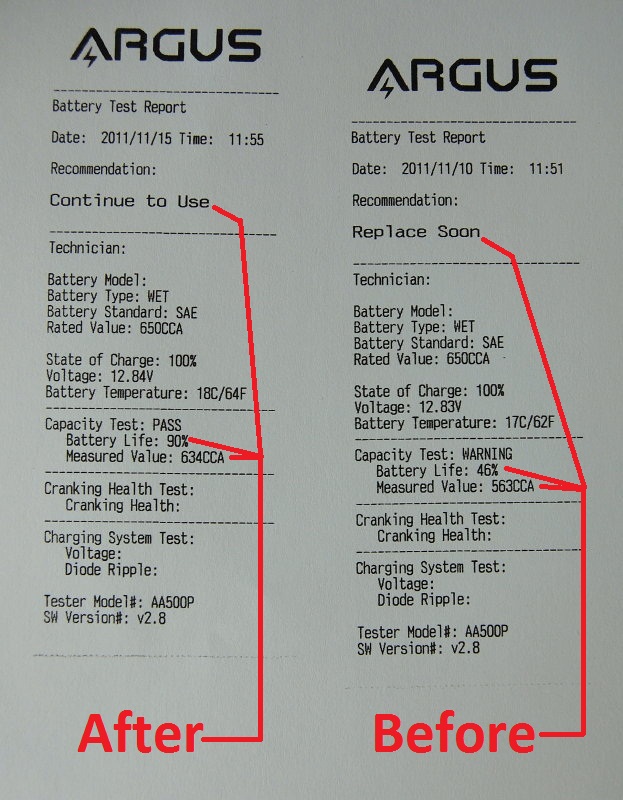
So far I have used pulsed load (Argus), capacitance (Midtronics) and 20 hour discharge testing and not one of them showed any improvement beyond a standard smart charger and equalization..

I have about six batteries in the shop right now I can do more testing on...
 
Maine Sail - it sounds as though you know what you're talking about so thanks for the input.

Are you saying the entire principle is of desulphation is flawed, or more simply that the units offered don't do what the promise?
 
Maine Sail -

Are you saying the entire principle is of desulphation is flawed, or more simply that the units offered don't do what the promise?

I think the on-paper "principle" looks good. I think in the real world a real equalization cycle with a good quality charger is far more effective at restoring "some" loss.

I have looked for any data where they used real testing measures to prove desulfators work but have yet to find one. If anyone knows of true third party independent testing please let me know. Capacity testing, impedance or even pulsed load testers like the Argus are pretty darn hard to fool yet I've found no third party independent tests that show these work and my own testing, up to now, satisfies my own curiosity..

The best I can find is a PS test where they really did not do a very good job at laying out the study design criteria and the results were in the margin of error and less than what I can see with an equalization charge. the other stuff are some before and after pics of battery plates that they claim were the result of a "desulfator" but I don't buy it based on my own testing.

Perhaps it works marginally better if you used it from brand new but to "fix" aged batteries I've not seen it make any real measurable improvement beyond a regular charger with equalization. I am always willing to try and test more of them but after a few it begins to feel like I'm buying snake oil...

Here is the result from one four hour equalization cycle at 15.5V with a standard charger.
139656285.jpg


It took Practical Sailor 30 days and twenty charge discharge cycles to see a minuscule 30 CCA improvement, which is within the realm of error with these testers... I did that in 4 hours....
 
Last edited:
I think the on-paper "principle" looks good. I think in the real world a real equalization cycle with a good quality charger is far more effective at restoring "some" loss.

I have looked for any data where they used real testing measures to prove desulfators work but have yet to find one. If anyone knows of true third party independent testing please let me know. Capacity testing, impedance or even pulsed load testers like the Argus are pretty darn hard to fool yet I've found no third party independent tests that show these work and my own testing, up to now, satisfies my own curiosity..

The best I can find is a PS test where they really did not do a very good job at laying out the study design criteria and the results were in the margin of error and less than what I can see with an equalization charge. the other stuff are some before and after pics of battery plates that they claim were the result of a "desulfator" but I don't buy it based on my own testing.

Perhaps it works marginally better if you used it from brand new but to "fix" aged batteries I've not seen it make any real measurable improvement beyond a regular charger with equalization. I am always willing to try and test more of them but after a few it begins to feel like I'm buying snake oil...

Did the ones you tested have crocodile clips on to attach them to the battery ?

The principle of desulphation is that you pulse very large currents through the battery to knock the sulphation off the plates, If you only have croc clips attaching it to the battery, its likely that you have reduced the output of your desulphator by more than 50% because of the resistance the croc clips have introduced and rendered it worse than useless, they need to be bolted to the battery terminals with large surface area connections and thick short length cable.

The other thing that makes batteries start to apparently loose capacity is stratification of the electrolyte which is where the acid and water partially separate and sit at different levels in the battery. You cant store a charge in water, so you get less capacity, I have found that a good shake of my batteries every 3-6 months or so (or go out in a force 8+!!) also maintains their capacity and keeps them in peak condition.

As a liveaboard, I depend on my batteries more than most people on here do so monitor them closely and know each of them quite well
 
The other thing that makes batteries start to apparently loose capacity is stratification of the electrolyte which is where the acid and water partially separate and sit at different levels in the battery.
What causes that to happen ?
 
What causes that to happen ?

Its mainly due to not fully charging a battery frequently, or long periods of no use, the specific gravity of the acid in the electrolyte varies as you charge and discharge a battery, and this can cause it to separate out and a decent fast balance charge that gets your battery gently bubbling remixes it, which is why a decent equalisation charge appears to rejuvenate an apparently tired and ageing battery, and its the good quality chargers that do this, not because of the quality of the charge they provide, but because of the higher current outputs that they are capable of
 
Top