Battery Charging - Absorption Voltage - Calcium/Calcium Batteries

pmyatt

Well-Known Member
Joined
5 Jul 2004
Messages
686
Location
No Fixed Abode
Visit site
We have recently replaced our domestic bank of batteries. We now have 4 X 10⁵ Ah Varta LFS105. These are Calcium/Calcium maintenance-free. The battery charging is either shore power/generator through a Victron Multi 12/2500/120 inverter/charger, or a 75 amp alternator controlled by a Balmar MaxCharge 614 controller. At the moment, the absorption voltage on both systems is set to 14.4 Volts. Both charging systems have temperature sensors and voltage sensors at the batteries for temperature and voltage compensation to limit gassing. Recent research on the internet indicates that calcium/calcium batteries can be charged at a significantly higher absorption voltage than lead/antimony batteries, whose maximum is 14.4 Volts. Queries to battery dealerships and equipment suppliers have produced advice that calcium/calcium batteries should indeed be charged at higher voltage than 14.4 Volts, but the advice has varied from a low of 14.7 Volts to a high of 16.0 Volts.

Despite considerable research, I have been unable to find a single authoritative source on the subject. Should anyone have definitive information on the subject, I would be grateful for details of the source.

Indeed, as lead/antimony batteries have now been almost completely removed from the market to be replaced by calcium/calcium batteries, it is perhaps timely for most boat owners to be questioning whether the advice they have been given concerning charging voltages is still extant; persistent under-charging causes premature battery failure just as much as over-charging.
 
Last edited:
Lead/Calcium means that only one plate has calcium added to the lead; the other may well have antimony (it certainly won't be pure lead as that would be too fragile); hence the recommendation of only 14.4 Volts, which is the recommended maximum for Lead/Antimony. Calcium/Calcium means that both plates have calcium added to the lead instead of antimony; note, not the paste in the lead framework. The advantage of calcium/calcium is that the battery plates are substantially stronger physically and, more importantly, the parasitic decay when not being charged is reduced to about 1% per month, instead of 6% - 10% per month with antimony; also, the water loss is much less. The trade-off is that the calcium/calcium battery is harder to charge and requires a higher voltage. Higher voltages would be a problem in a lead/antimony battery because of gassing but calcium/calcium gasses at a higher voltage - around 16 volts at 25℃. I have numerous sources supporting this but what I am looking for is some form of technical article/paper on the matter - hence my query.
 
Last edited:
Have just gone to the Vetus site and the battery advertised not only looks physically identical to ours, but has identical dimensions and weight - interesting! This may well be a case of re-badging. Varta, although appearing to be an independent company are actually owned by Johnson Controls. Johnson Controls bought the Delphi Freedom plant in the USA, and that is where these particular batteries are manufactured. Perhaps Vetus just put their own labels on them?
 
I've found lead-calcium batteries to be generally less satisfactory, in service, than lead-antimony, though longer-lived. Rather than increasing the charge voltage, above that recommended by the battery manufacturers, I'd suggest extending the period of absorption charge. Mine are charged @ 14.4v for 4 hours.
Lead-calcium is claimed to be less likely to lose water - hence most sealed-for-life batteries appear to be lead calcium.
I must confess that I've never heard of the two types of plate being mixed in a cell or even in a battery.
But then my experience has mainly been with the GM Delphi batteries which definitely have all plates with calcium as the alloying substance.
 
Last edited:
Lead/Calcium means that only one plate has calcium added to the lead; the other may well have antimony (it certainly won't be pure lead as that would be too fragile); hence the recommendation of only 14.4 Volts, which is the recommended maximum for Lead/Antimony. Calcium/Calcium means that both plates have calcium added to the lead instead of antimony; note, not the paste in the lead framework. The advantage of calcium/calcium is that the battery plates are substantially stronger physically and, more importantly, the parasitic decay when not being charged is reduced to about 1% per month, instead of 6% - 10% per month with antimony; also, the water loss is much less. The trade-off is that the calcium/calcium battery is harder to charge and requires a higher voltage. Higher voltages would be a problem in a lead/antimony battery because of gassing but calcium/calcium gasses at a higher voltage - around 16 volts at 25℃. I have numerous sources supporting this but what I am looking for is some form of technical article/paper on the matter - hence my query.


The above sounds like the Delco Freedom battery that came out in the late 1980's, Westerly fitted them and had a lot of trouble with charging. Delco supplied a lot test documents, and the problem was stratification, the electrolyte was separating out as the batteries were not gassing. On a car this was not a big problem, the vibration and bumps had a stirring effect, but on a yacht there was little or none.

Now when I went through the papers I found the gassing level was at a lot higher voltage, now this is going back a long way, but I remember around 15.4 volts to get the battery gassing. To this end we used to make a special mains battery charger for Westerly that charged to 15.4 volt, and ran at 14.4 or 14.6 ( old age ) float charge. We used to use a lower capacity ( slower charge rate ) then, this gave us a deeper charge, avoiding absorption phase as charge current would fall to 250 mA.

The big problem was the alternators were only running at 13.6 - 13.8 volt, no smart regulators then, coupled with the battery having a memory. This memory caused the battery to loose capacity if left part charged, i.e. over winter. If you gave it a correct bench charge at the start and end of season, this maintained the capacity. then by limiting discharge, and charging regularly, this would cover alternator problems.

I still do not like the absorption phase, there are better ways, but it gets more technical, and modern marketing is to sell what you already have, or can buy of the shelf.

Brian
 
Last edited:
Thanks Brian, we seem to be getting to the core of what I am trying to find out. By chance I was referred to an old Delphi sales/semi-technical brochure which advocated charging at up to 16.0 Volts at up to 25 Amps - albeit with exhortations to check battery temperature ever half-hour and to continue this charging regime for no longer than 4 hours.
 
Thanks Brian, we seem to be getting to the core of what I am trying to find out. By chance I was referred to an old Delphi sales/semi-technical brochure which advocated charging at up to 16.0 Volts at up to 25 Amps - albeit with exhortations to check battery temperature ever half-hour and to continue this charging regime for no longer than 4 hours.

They sound similar, the Freedom had a very low lose rate, you could almost leave them, as long as fully charged, over Winter and not loose any charge, looked after they used to last 10 - 12 years.

I wonder in retrospect how many Westerly owner's fitted new mains chargers because the thought the voltage was to high at 15.4 volt :)

Brian
 
I think it quite likely that the Vetus battery is pretty much identical as you surmise.

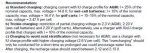
However the Varta manual for your actual battery is available on http://jci_media.s3.amazonaws.com/v...12/9257/FINAL_Booklet_Professional_150x75.pdf, and it has the identical instruction to use 14.4V. A snippet is shown here.

Varta snippet.jpg

However it also mentions the stratification issue and says that, for a short time, charging to 2.6V / cell, ie 15.6V can avoid stratification. How short a time is short isn't spelled out.

I'm not sure it's needed however, supposing my Vetus batteries are similar chemistry. In summer I use 14.4 / 14.0V Adverc cycling charger when running the engine and nothing else (we're on a mooring), and in winter they're on float charge with a MasterVolt charger which again only goes to 14.4V max and floats at 13.25V. The batteries show no observable degradation after 8 years of use.
 
Last edited:
No doubt you have read the interesting posts from Halcyon; they support the higher voltage regime as well. Separately, it has been put to me today that the reason, possibly, that 14.4 Volts is recommended has nothing to do with the actual "best" charging regime for these batteries, given that they seem to survive low charging voltage abuse for a number of years anyway; rather it is to do with the fact if the proper charging regime were recommended, then everyone using calcium/calcium batteries would have to change their charging system and regulators, and they wouldn't buy the calcium batteries - they would ask for something else; very cynical, I know.
 
I think it quite likely that the Vetus battery is pretty much identical as you surmise.

However the Varta manual for your actual battery is available on http://jci_media.s3.amazonaws.com/v...12/9257/FINAL_Booklet_Professional_150x75.pdf, and it has the identical instruction to use 14.4V. A snippet is shown here.

View attachment 32420

However it also mentions the stratification issue and says that, for a short time, charging to 2.6V / cell, ie 15.6V can avoid stratification. How short a time is short isn't spelled out.

I'm not sure it's needed however, supposing my Vetus batteries are similar chemistry. In summer I use 14.4 / 14.0V Adverc cycling charger when running the engine and nothing else (we're on a mooring), and in winter they're on float charge with a MasterVolt charger which again only goes to 14.4V max and floats at 13.25V. The batteries show no observable degradation after 8 years of use.

I think you'll find a progressive deterioration in performance of the lead/calcium battery over a period of years - unless you're a liveaboard you'll probably not notice it.
Of course the high voltage charge prevents stratification - by gassing the battery it stirs the contents up - and all batteries suffer from stratification to some extent. In fact Trojan, in the States, recommend an annual "conditioning" of their batteries - it needs to be on a bench and involves some very aggressive discharge/recharge behaviour.
I, personally, agree with Charles Sterling - the whole battery market is smoke and mirrors with claims made to extract the maximum profit out of the gullible.
In terms of value-for-money you'll always do best with the cheapest, crudest batteries you can find - they'll have thick plates, be open lead acid have a low cranking voltage and, probably, a low AH capacity for the case size.
Keep your AGM, gel, fancy materials...
 
Why link to this site with a ridiculous - ignorant article - by Charles Sterling? It contains no information about Calcium batteries.

Irrelevant posts - with a commercial signature - are a waste of time.

When someone asks for the time they don't want to be told which watch to buy!

I think you'll find a progressive deterioration in performance of the lead/calcium battery over a period of years........

The OP is asking about Calcium/Calcium batteries, not Lead/Calcium! I am keen to hear more knowledgeable answers to the OPs interesting question.
 
Last edited:
No doubt you have read the interesting posts from Halcyon; they support the higher voltage regime as well. Separately, it has been put to me today that the reason, possibly, that 14.4 Volts is recommended has nothing to do with the actual "best" charging regime for these batteries, given that they seem to survive low charging voltage abuse for a number of years anyway; rather it is to do with the fact if the proper charging regime were recommended, then everyone using calcium/calcium batteries would have to change their charging system and regulators, and they wouldn't buy the calcium batteries - they would ask for something else; very cynical, I know.

That I agree with.

!4.4 was set in history as a value that a old ( as it's life ) lead acid battery would reach, I used 14.2-14.3 for a safety margin, the same as why does a VSR switch at 13.6 volt, no other reason than a alternator back the late 70's regulated at that value. So like 14.4 volt, it has no technical reason, but modern marketing will invent one to up the product appeal, or justify not doing the job correctly.

The biggest problem with the Freedom battery was the memory, where it assumed a lower capacity and which was not reversible, charging at 14.4 volt was okay if around every 5/6 months you gave them a full charge to the high voltage.

Brian
 
Many thanks for the link to the Sterling Power site; I had in fact seen it already, along with other of Charles' technical posts - he produced an interesting article on the merits of charging "ordinary" flooded lead acid batteries to 14.8 Volts instead of 14.4 Volts; it is on the Sterling site and merits reading.

Sadly, I think this post has probably run it's course and that I am unlikely to find, in the short term, the sort of technical article/document for which I am searching - though, please feel free to continue looking on my behalf

Many thanks to all who have taken an interest.
 
I am familiar with NiCad batteries developing a memory but am sure I read somewhere that this was not the case with FLA batteries; although not everything one reads on the internet is true!!! Perhaps the "memory" of the Freedom batteries was to do with reduced capacity caused by partial sulphating; the sulphating being reversed by the shock of charging at the higher voltage every so often - and I have just gone and dumped 4 batteries upon which I could have tested this theory - b****r.
 
Many thanks for the link to the Sterling Power site; I had in fact seen it already, along with other of Charles' technical posts - he produced an interesting article on the merits of charging "ordinary" flooded lead acid batteries to 14.8 Volts instead of 14.4 Volts; it is on the Sterling site and merits reading.

Sadly, I think this post has probably run it's course and that I am unlikely to find, in the short term, the sort of technical article/document for which I am searching - though, please feel free to continue looking on my behalf

Many thanks to all who have taken an interest.

Had similar problems when I changed to Lead/Calcium, but I should have read the manual, Cristec seem to understand the situation:

http://www.cristec.fr/images/stories/documents/cps3-1m-2m-deb.pdf
 
Why link to this site with a ridiculous - ignorant article - by Charles Sterling? It contains no information about Calcium batteries.

Irrelevant posts - with a commercial signature - are a waste of time.

When someone asks for the time they don't want to be told which watch to buy!


The OP is asking about Calcium/Calcium batteries, not Lead/Calcium! I am keen to hear more knowledgeable answers to the OPs interesting question.

Sailing legend still has a tart tongue - perhaps it comes as part of being a film-maker.
 
Top