
Ballast Keel Cracking

ducked

Well-Known Member
Joined
6 Oct 2024
Messages
1,982
Location
Tainan, Taiwan
Visit site
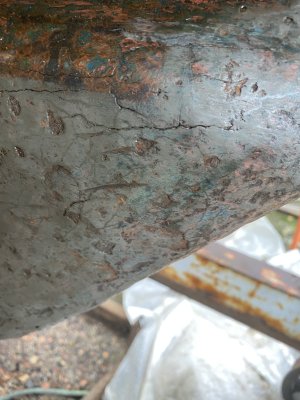
How alarmed would you be about these, and what, if anything, might you do about them?

Local yardy opinion is its just surface filler. I dunno about that (the grey stuff is aluminium I ground on) but they have more experience than me…

I suppose a twin keel Trident might work?
 

Attachments

  • 88431F82-D12F-40DA-9DF0-EBC413D4EE00.jpeg
    88431F82-D12F-40DA-9DF0-EBC413D4EE00.jpeg
    1.7 MB · Views: 93
What is the ballast - iron or lead?

If they are not weeping rust, I would clean and fill carefully, then monitor their development.

You are at the cutting edge of grp aging - 60+ years?
 
How alarmed would you be about these, and what, if anything, might you do about them?

Local yardy opinion is its just surface filler. I dunno about that (the grey stuff is aluminium I ground on) but they have more experience than me…

I suppose a twin keel Trident might work?
Only sensible thing to do is to have the keels blasted then you know what you are dealing with. Highly unlikely the casting is cracked.
 
What is the ballast - iron or lead?

If they are not weeping rust, I would clean and fill carefully, then monitor their development.

You are at the cutting edge of grp aging - 60+ years?
Keel is cast iron, but the surface (lightly ground over with a flap disk in an angle grinder, a mesh disk in a drill, and then pop cans in a drill), is lumpy and quite...er... heterogenous, with filler/paint/antifouling ( ?) inclusions.

Whatever, it isnt GRP, though there is a minor hull concern I'll post about separately.
 
Only sensible thing to do is to have the keels blasted then you know what you are dealing with. Highly unlikely the casting is cracked.
Well, if its "Highly unlikely the casting is cracked.", it would seem that another sensible thing to do is nothing, (apart from maybe filling the surface cracks) so thats what I'm inclined to do.

The other side didn't seem to have any cracks and has already had a couple of coats of black bitumen, wee experimental control stylee.

This keel side has already been painted over with a couple of treatments of sunflower oil and ground-on aluminium, which, based on an ex-girlfriends glass engraving experience with similarly sticky masking tape resists , seems likely to be a PITA to sandblast. I'll paint this over with bitumen when/if it goes off, which takes a very long time in Scotland.

IF I could and did get it sandblasted where it is and it still had cracks, I wouldn't seem to be much further forward, though of course I would have a cleaner surface for painting, and would be pretty much obliged to apply expensive and nasty epoxy to it. I get skin trouble lately and am not at all keen on using epoxy if avoidable.

I like bitumen though.
 
Last edited:
Well, if its "Highly unlikely the casting is cracked.", it would seem that another sensible thing to do is nothing, (apart from maybe filling the surface cracks) so thats what I'm inclined to do.

The other side didn't seem to have any cracks and has already had a couple of coats of black bitumen, wee experimental control stylee.

This keel side has already been painted over with a couple of treatments of sunflower oil and ground-on aluminium, which, based on an ex-girlfriends glass engraving experience with similarly sticky masking tape resists , seems likely to be a PITA to sandblast. I'll paint this over with bitumen when/if it goes off, which takes a very long time in Scotland.

IF I could and did get it sandblasted where it is and it still had cracks, I wouldn't seem to be much further forward, though of course I would have a cleaner surface for painting, and would be pretty much obliged to apply expensive and nasty epoxy to it. I get skin trouble lately and am not at all keen on using epoxy if avoidable.

I like bitumen though.
Essentially do nothing is probably the best way forward, just cover it over. But you did ask what would I do about it - no point in asking and then ignoring advice :eek: No problems using epoxy to coat. Just roll it on, no need to touch the stuff. Personally much prefer that to mucking about with messy bitumen coatings.
 
Last edited:
Essentially do nothing is probably the best way forward, just cover it over. But you did ask what would I do about it - no point in asking and then ignoring advice :eek: No problems using epoxy to coat. Just roll it on, no need to touch the stuff. Personally much prefer that to mucking about with messy bitumen coatings.
Fair enough, except you did say it was the only sensible thing to do, giving it a bit more scope than simply what you would do.

If one was obliged to always act on advice:-

(a) No one sane would ever ask
(b) One might be faced with a quandry if the forum delivered conflicting advice, though that would probably never happen, right?
 
Last edited:
If you want a bit more advice.......

The cracks could be either filler on the keel or excessive layers of antifouling. Possibly some reaction between different products like hard antifouling applied over self polishing antifouling without a barrier coat.

Your choice is do a quick fill and see if it is any worse the next time you scrub or remove all the affected area back to bare metal and treat accordingly. My process would be to treat the bare metal with Fertan rust converter, apply at least 6 coats of Primocon and then antifoul.
 
No problems using epoxy to coat. Just roll it on, no need to touch the stuff. Personally much prefer that to mucking about with messy bitumen coatings.
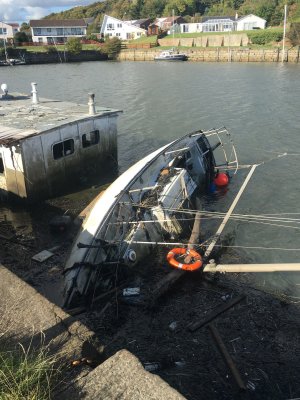
One isnt strictly speaking obliged to touch bitumen either, but when putting it on in the narrow crawl space between the bilge and ballast keels, I find some contact occurs, as I'd bet money it would with epoxy, too.

Its was touch dry overnight, and fortunately, that night stayed a degree or two above 0C, though at this time of year, in the open, on the Boness shore, this can not be assumed.

I dunno if epoxy would be quite so accommodating, and am not anxious to find out the hard way.

This is perforce a quick and dirty (and, less perforce, a somewhat experimental) job. Depending on how it turns out, I can consider the counsels of perfection approach next time around, if there is one.
 
Last edited:
As a Trident Owner myself, what I'm seeing there is a massive casting with a bit of surface or filler damage which is purely cosmetic. I'm a little concerned at the depth of the pits where the casting is exposed. Those ballasts stubs were fairly rough cast, and some people applied a layer of filler to reduce any drag they were causing. If that is the case with yours then other than the fact it will continue to shed lumps and produce cracks it's nothing to spend a lot of time and money on. But, like old paint an expensive overcoating will continue to come off with it! So a cheap easily patched solution is preferable.

You could try whacking it hard with a lump hammer to see how well it is still attached. If it was the bilge plates, I would suggest the steel is scaling, and needs to be needle gunned back to sound metal, as the scale will drop off as corrosion advances.

In either case, grinding will not help as it does not stress the adhesion enough to show whether its failing at all seriously. It simply s,mears the surface metal over itself, and doesnt quickly remove the substrate material. But as above a cheap, easily repaired solution is preferable. Epoxy coatings are a bit of a no-no. The weight of the boat is sitting on the stub when it's aground, and epoxy will not take the abrasion for more than a few weeks of daily low tides! Even soft mud makes an effective grinding paste!
 
As a Trident Owner myself, what I'm seeing there is a massive casting with a bit of surface or filler damage which is purely cosmetic. I'm a little concerned at the depth of the pits where the casting is exposed. Those ballasts stubs were fairly rough cast, and some people applied a layer of filler to reduce any drag they were causing. If that is the case with yours then other than the fact it will continue to shed lumps and produce cracks it's nothing to spend a lot of time and money on. But, like old paint an expensive overcoating will continue to come off with it! So a cheap easily patched solution is preferable.

You could try whacking it hard with a lump hammer to see how well it is still attached. If it was the bilge plates, I would suggest the steel is scaling, and needs to be needle gunned back to sound metal, as the scale will drop off as corrosion advances.

In either case, grinding will not help as it does not stress the adhesion enough to show whether its failing at all seriously. It simply s,mears the surface metal over itself, and doesnt quickly remove the substrate material. But as above a cheap, easily repaired solution is preferable. Epoxy coatings are a bit of a no-no. The weight of the boat is sitting on the stub when it's aground, and epoxy will not take the abrasion for more than a few weeks of daily low tides! Even soft mud makes an effective grinding paste!
Thanks, makes sense.

I had initially intended to stress it a bit more, with SDS chiselling, but was warned off, (cast iron being considered too soft), and then the drill I borrowed wouldnt do non -rotational hammering anyway. Since I've already put some surface coatings on it which I'm reluctant to sacrifice, I'm pretty much limited to a bit of filling this time around.

Might hit it a bit harder in the future, if there is a future.
 
Thanks, makes sense.

I had initially intended to stress it a bit more, with SDS chiselling, but was warned off, (cast iron being considered too soft), and then the drill I borrowed wouldnt do non -rotational hammering anyway. Since I've already put some surface coatings on it which I'm reluctant to sacrifice, I'm pretty much limited to a bit of filling this time around.

Might hit it a bit harder in the future, if there is a future.
It isnt clear from your description, however, why epoxy should actually be worse than any less durable/cheaper coating, though I suppose a tough impermeable coating that is inevitably breached at its lowest point is likely to retain and wick salt water next to the metal. I had this happen with Hammerite on a boat trailer, and I think its why thick underseal coatings on cars are now generally recognised as a bad thing.

Except perhaps by Americans, who have a thing about POR15 (epoxy) that I tried and failed to dissuade them from before I was banned from BITOG. Most extreme example: a crash barrier of no intrinsic/aesthetic value subject to regular damage for which sunflower oil and aluminium would do fine. The favoured solution? Sprayed epoxy. Nowt so queer as folk.
 
A example from near you @ducked.

The Forth Rail Bridge has been coated with a glass flake epoxy formula paint which should suffice for about 25 years. It replaced an inferior paint system that had been in use since the bridge was built. These types of coatings are useful and many have used similar technologies on their keels to increase time between coatings, which is their main advantage. Of course there are lower cost options which will work but maybe requiring more frequent attention.
 
Success with epoxy on poor cast iron is all about preparation, hence the need for blasting rather than grinding or needle gun. It is not common to do the bottom of the keel unless you are lucky enough to be able to lift the boat high enough to get good access. The keel on my Bavaria was ground from new and failed within 3 years - but only where adhesion was poor. It was mostly sound at the edge where the epoxy stopped at the bottom of the keel bulb. Hopefully the second attempt - blasting and immediately rolling on Hempadur (then Coppercoat) was more successful, but I sold the boat a couple of years after doing it.

On my present boat The keel is GRP with encapsulated ballast . the GRP is epoxied and still sound after over 40 years. The bilge plates though are mild steel and I had them blasted and epoxied before antifoul. about £700 and still sound after 3 years.
 
It isnt clear from your description, however, why epoxy should actually be worse than any less durable/cheaper coating, though I suppose a tough impermeable coating that is inevitably breached at its lowest point is likely to retain and wick salt water next to the metal. I had this happen with Hammerite on a boat trailer, and I think its why thick underseal coatings on cars are now generally recognised as a bad thing.

Except perhaps by Americans, who have a thing about POR15 (epoxy) that I tried and failed to dissuade them from before I was banned from BITOG. Most extreme example: a crash barrier of no intrinsic/aesthetic value subject to regular damage for which sunflower oil and aluminium would do fine. The favoured solution? Sprayed epoxy. Nowt so queer as folk.
Quite simply, epoxy will last a bit longer, but not long enough to justify the cost and effort. As Tranona points out successful epoxy coating on metal is all about preparation. But in any case a large lump of cast iron like that isnt going to wear or corrode away in a hurry. Its the one bit of a Trident I never heard of anyone having trouble with - except when we tried to detach one from a boat being broken up. Even several hours with a big kango hammer failed to shift it!

As your yard says, its an old boat, filling and fairing every few years is all it neeeds. Many owners just go on slapping antifoul on: build up enough layers it fairs off quite well too! I wire brushed mine to bare metal, and gave it a coating of VC Tar, but it had rubbed off on all the ground contact points on a drying mooring by the end of the first season, so I reckoned it was a waste of money.
 
A example from near you @ducked.

The Forth Rail Bridge has been coated with a glass flake epoxy formula paint which should suffice for about 25 years. It replaced an inferior paint system that had been in use since the bridge was built. These types of coatings are useful and many have used similar technologies on their keels to increase time between coatings, which is their main advantage. Of course there are lower cost options which will work but maybe requiring more frequent attention.
I snuck onto the Forth Bridge at night once. Scared myself rigid, but before that happened it looked to me as if they were doing a pretty thorough preparation job, with the bit of the structure being treated fully enclosed so protected from the elements, and probably thoroughly cleaned to the bare metal, which is steel, on a unique and internationally recognized irreplacable cultural icon, using skilled and (I hope) highly paid operatives.

None of this applies to my ballast keel.

Except the irreplacable cultural icon bit, a bit.

They arent making any more of them.

capsize_qt.jpg
 
Last edited:
The key to succesful epoxy coating (pun intended!) is removing every trace of rust and corrosion. No easy task as corrosion pits the metal. Any corrosion pocket left under the coating will before long be reactivated and start lifting the epoxy layer. Grinding is no good as it smears the metal cross the pitted areas, hiding corrosion pockets. Shot or sandblasting is best as it can get into every crevice. Needle guns are good on lightly corroded surfaces, but cannot penetrate deeper cracks and crevices. A 50 year old keel will have plenty of pits and crevices - which is sort of where we started!
 
Top