
B&G speed impeller

danielefua

Well-Known Member
Joined
29 Nov 2005
Messages
390
Location
Ancona, Italy
Visit site
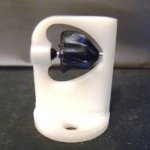
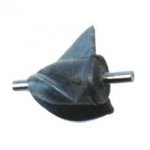
A few days ago I took off the small impeller, in the sense that I unscrewed the nylon bushing that holds the shaft in order to free it completely from the rest of the structure - the bushing is the black bulge that can be seen at the rear of the impeller in the attached picture. Apparently there was no problem but then I noticed that the face of the small shaft, on the side that fits into the bushing, is hollow as if made to match the surface of a small ball and with some imagination this can be observed in the other picture; at that moment it was too late, if a small ball was indeed inside the bushing, it had already fallen and disappeared on the floor.
Does anyone know anything about it?

I might be able to get a tiny ball from somewhere but I'm curious to have a confirmation regarding the original assembly and to understand if the reason for the hollow surface is the one I guess or another. In case: which is the material of the original ball?

Daniel
 

Attachments

  • B&G_kemetal.jpg
    B&G_kemetal.jpg
    51.5 KB · Views: 2
  • B&G110-10-B21.JPG
    B&G110-10-B21.JPG
    4.6 KB · Views: 3
A few days ago I took off the small impeller, in the sense that I unscrewed the nylon bushing that holds the shaft in order to free it completely from the rest of the structure - the bushing is the black bulge that can be seen at the rear of the impeller in the attached picture. Apparently there was no problem but then I noticed that the face of the small shaft, on the side that fits into the bushing, is hollow as if made to match the surface of a small ball and with some imagination this can be observed in the other picture; at that moment it was too late, if a small ball was indeed inside the bushing, it had already fallen and disappeared on the floor.
Does anyone know anything about it?

I might be able to get a tiny ball from somewhere but I'm curious to have a confirmation regarding the original assembly and to understand if the reason for the hollow surface is the one I guess or another. In case: which is the material of the original ball?

Daniel
Ther is a ball bearing embebed in the plastic screw. If you shine a torch into the hollow end you should see it shining back.
 
Just to write that I am following the replies and I am thankful.
I will shine a torch and check and, yes, I do understand what you mean by ruby bearing. In the former case I will see a small embedded ball bearing, in the second case the ruby has gone but I may find a suitable one among my collection of old broken clock parts.

Daniel
 
Top