Army Surplus Perkins 4108 Link

teredo

Well-Known Member
Joined
27 Dec 2015
Messages
139
Visit site
Mods, I'm nowt to do wi' this, just came upon this and thought lots of people might be interested in the sale.

Non marinised 4108s for sale, loads of them. Hours appear to be really low. Used as Aux Power Units on tanks so presume hard to thrash or mistreat them.

http://army-uk.info/equip.php?ID=688
 
Mods, I'm nowt to do wi' this, just came upon this and thought lots of people might be interested in the sale.

Non marinised 4108s for sale, loads of them. Hours appear to be really low. Used as Aux Power Units on tanks so presume hard to thrash or mistreat them.

http://army-uk.info/equip.php?ID=688

It would depend on the price. A Bowman manifold/heat exchanger is about £700 and gearbox + drive plate, adaptor another £8 or 900, so upto £2k extra to get it ready to fit.
 
I contacted them a while back and they want £1300.....

That's not bad, although it would be pot luck as to the condition. If I still had my 4108, I'd probably get one for spares. or strip and check it then swap it over.
 
Out of curiosity, what would marinising one entail?

Bowman combined heat exchanger / exhaust manifold, sea water Jabsco pump, flywheel housing, gearbox drive plate, gearbox (eg ZF10), possibly engine mounts, + sundry hoses, hose clips, throttle and gear cable / control. Lancing Marine probably have all the parts on the shelf.

http://www.lancingmarine.com/pricebook2013/page10.html

About £3k inc vat using all new parts but you can buy a brand new 2.2L 46bhp engine with gearbox from Marine Power for about £3600 + delivery. (I have one which replaced a 35yr old 4108 and it is excellent, lower revving and quieter)

http://marine-power-solutions.com/prices.html
 
Last edited:
I had a friend with a blown 4.108 who bought one of those to use as a core engine. Many parts were not quite the same as the ancient boat engine and eventually ended up using a complicated mish mash of parts to build up a full engine. Not as simple as it looks in theory..... it appears there are many 100's of casting variations of 4.108 engines.....
 
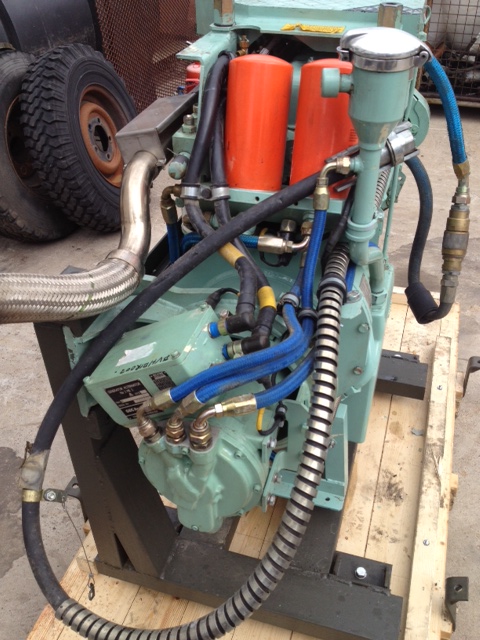
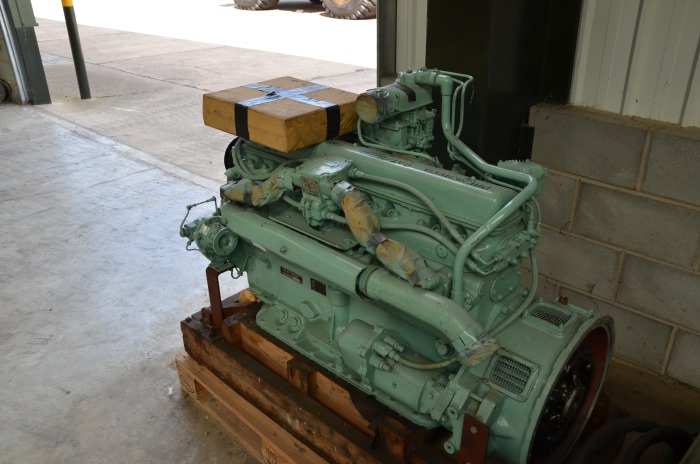
Some odd bits attached to those engines...

What looks like an enlarged sump - gives longer oil changes, I suppose, but seems to extend below the normal one and might make fitting tricky in a shallow-bodied boat. You're going to want to rearrange the oil filler too unless you have a lot of headroom (but what a nice easy funnel to fill!)

Is that an extra-large fuel filter on the front of some of them? In the way of the belts, but I suppose you could shift it to a bulkhead and have improved bug-resistance (if you can get hold of the elements for it).

Looks like they're driving a big DC generator (judging by the size of the cables running forward over the top of the motor!). At first I thought it was a hydraulic pump, based on the hoses, but they seem to be connected to the lube oil system so I guess they're just lubrication for the generator bearings.

...and some other bits I can't identify.

Not convinced by the claim of "only used to start the main engine" - as I understand it the tankies run their APUs to keep the systems powered up most of the time on the battlefield (real or exercise) when they're not actually moving. Probably still adds up to relatively low hours though.

Interesting find :)

Pete
 
Pete that is a hydraulic pump that will drive the turret and gun barrel lifting.

If these were driven off the main engine it would reduce the power available to drive the tank and the variable speed would slow the turret speed.

The double filters are for the hydraulic oil and the black and white "pipe" looks like a mechanical tach drive.
 
Pete that is a hydraulic pump that will drive the turret and gun barrel lifting.

I think you're right, the lines are way too big for lubrication. I guess the "extended sump" is in fact the hydraulic tank, I was mislead by the dipstick but of course a hydraulic tank would still need one as well as the sump :culpability:

That said, I still think there's a dirty great direct-drive alternator in there as well. All combined in the same housing as the pump (I guess to fit compactly in the tank's engine bay). Just behind the blue hydraulic hoses in this pic is surely the rectifier box:

703_photo5.JPG


and I reckon the two chunky black lines leading away over the front of the engine are the DC output - in one of the other pics the other ends have red tape on one and black on the other. I've only changed a starter motor on a Challenger tank once and that was 15 years ago, but in my unreliable memory I'm sure the electrical connections looked a lot like the boots on the ends of those lines to the box...

Pete
 
Last edited:
My thinking is that the box you think is a rectifier, is an electrical control for the hydraulic pump. It could be a control for a swatch plate variable flow pump or a valve for flow direction. I think the former.

An big alternator would have cooling fins or be open type with a fan to cool the windings. The open fan cooled type is not what you want on a tank.

I have a pump like this in my garage that came from a road sweeper also driven by a 4.108 that I sold some years ago.

This could be used in a boat without the need for a marine gearbox as the pump could drive a hydraulic motor connected to the prop shaft..
 
Last edited by a moderator:
...and I reckon the two chunky black lines leading away over the front of the engine are the DC output - in one of the other pics the other ends have red tape on one and black on the other. I've only changed a starter motor on a Challenger tank once and that was 15 years ago, but in my unreliable memory I'm sure the electrical connections looked a lot like the boots on the ends of those lines to the box...

I'm with you on this. The unit is said to be from a Challenger tank, which I believe had a GUE to provide auxiliary electrical power. If you look at the box with the black lines leading away from it, you'll see a black plate on it, and the sales site has a pic of this saying it's a "generator set". The electrical generator may well be oil cooled, which would explain all the plumbing!
 
I think you're right, the lines are way too big for lubrication. I guess the "extended sump" is in fact the hydraulic tank, I was mislead by the dipstick but of course a hydraulic tank would still need one as well as the sump :culpability:

That said, I still think there's a dirty great direct-drive alternator in there as well. All combined in the same housing as the pump (I guess to fit compactly in the tank's engine bay). Just behind the blue hydraulic hoses in this pic is surely the rectifier box:

703_photo5.JPG


and I reckon the two chunky black lines leading away over the front of the engine are the DC output - in one of the other pics the other ends have red tape on one and black on the other. I've only changed a starter motor on a Challenger tank once and that was 15 years ago, but in my unreliable memory I'm sure the electrical connections looked a lot like the boots on the ends of those lines to the box...

Pete

351_eg.jpg


This is another pic which seems to me to be a different kind of unit
 
Bowman combined heat exchanger / exhaust manifold, sea water Jabsco pump, flywheel housing, gearbox drive plate, gearbox (eg ZF10), possibly engine mounts, + sundry hoses, hose clips, throttle and gear cable / control. Lancing Marine probably have all the parts on the shelf.

http://www.lancingmarine.com/pricebook2013/page10.html

About £3k inc vat using all new parts but you can buy a brand new 2.2L 46bhp engine with gearbox from Marine Power for about £3600 + delivery. (I have one which replaced a 35yr old 4108 and it is excellent, lower revving and quieter)

http://marine-power-solutions.com/prices.html

Not really something for a novice, then. Thanks.
 
Sounds like its a no go for use in a yacht and not particularly cheap unfortunately.

It would be a risk especially unless you have the skills to strip it down and inspect.

Unless you have an old donor engine the marinisation parts add significantly to the cost and that's before any extra costs which may be incurred overhauling the engine.

Probably best regarded as a replacement for an existing clapped out 4108 with useable marinisation parts.
 
Unless you have an old donor engine the marinisation parts add significantly to the cost and that's before any extra costs which may be incurred overhauling the engine.

Probably best regarded as a replacement for an existing clapped out 4108 with useable marinisation parts.

Worth noting that in a reasonably roomy engine bay there's nothing to say that the heat exchanger has to be a specialised part mounted on the engine. The engine just wants its freshwater circuit cooled somehow, and if that means piping it off to a separate fabricated or repurposed heat-exchanger mounted on a bulkhead (or even a keel-cooling tank on a metal boat) then that's fine. Same as the secondary fuel filter doesn't need to be mounted on the engine - the builders put it there because they (quite reasonably) want to ship you a single drop-in lump, but there's no reason not to shift it to a bracket nearby if that's more convenient.

Still not a project for a novice though :)

Pete
 
Worth noting that in a reasonably roomy engine bay there's nothing to say that the heat exchanger has to be a specialised part mounted on the engine. The engine just wants its freshwater circuit cooled somehow, and if that means piping it off to a separate fabricated or repurposed heat-exchanger mounted on a bulkhead (or even a keel-cooling tank on a metal boat) then that's fine. Same as the secondary fuel filter doesn't need to be mounted on the engine - the builders put it there because they (quite reasonably) want to ship you a single drop-in lump, but there's no reason not to shift it to a bracket nearby if that's more convenient.

Still not a project for a novice though :)

Pete

Indeed, and no requirement for a water cooled manifold or a wet exhaust. There's many a fishing boat has a dry exhaust either straight through the side or vertically to above the wheelhouse, with insulation or a grille to prevent burns.
 
Top