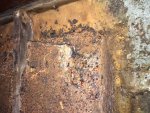
Any idea whats coming out of my floor??

madmat99

Active Member
Joined
13 Jun 2017
Messages
65
Visit site
hi guys and gals.
i have an issue with what looks like rust balls coming out of all the cracks in the floor and swelling up of the wood leading to it cracking.

i was inspecting the keel as i am antifouling and spotted some rust on the back of the keel weight, thought i would check inside under the floor to see if it was coming through.

this is what i found..

IMG_1261.JPG

IMG_1262.JPG

IMG_1263.JPG

IMG_1264.JPG

any ideas??
 
Last edited:
I hope I'm wrong, but it looks as though you might have an encapsulated keel filled with steel punchings. If water gets in, the steel corrodes, swells, and cracks the GRP. Nasty.


What's the boat, and do you know how the keel is constructed?
 
Im told the boat is a 1970 russel marine, that is all i know about it. it looks fine on the outside, no cracking or rust showing apart from right at the bottom of the keel.
ill see if i can find a picture of the outside.
 
this is from the outside.
i don't know if it gives any idea of the construction?

sorry i don't think its a russel marine. can't remember the make.
might do another thread to see if it can be identified

IMG_0302.jpg

sorry my knowledge of these things is limited!
 
Last edited:
I hope I'm wrong, but it looks as though you might have an encapsulated keel filled with steel punchings. If water gets in, the steel corrodes, swells, and cracks the GRP. Nasty.


What's the boat, and do you know how the keel is constructed?

It does look like water ingress into an encapsulated keel, hope it isn’t.
Sorry don’t recognise the boat.
 
this is from the outside.
i don't know if it gives any idea of the construction?

sorry i don't think its a russel marine. can't remember the make.
might do another thread to see if it can be identified

View attachment 72779

sorry my knowledge of these things is limited!

That does look like an encapsulated keel . . . with extra bits bolted on. A shoe to let it take the ground without cracking the GRP perhaps? The lump on the forward end may be an earlier attempt to fix a problem with rusting steel punchings.

Sorry, can't think of anything positive. If water has got inside the keel, and if the ballast is steel punchings, I don't think there's much that can be done.
 
A friend had something like this with his SeaWych, water entered the encapsulated keels, it then froze over e winter and the ice expansion split the keels and part of the hull.
Another friend recently refurbished his boat entirely (a Colvic hull I think), dug out all the iron pellets from the keel, washed, dried and replaced them and re-sealed the keels.It took a long time.
 
Is the shoe at the front of the keel a metal repair to cover repeated groundings? If so, then the encapsulated keel may have split here and the top sealing of the keel is now beginning to break open from rust in the steel punchings, with the potential it may sink your boat. I have heard of the problem on several encapsulated keels.

Also worth checking if the hull was moulded in two halves and then bonded together. This was fairly common in early fiberglass hulls and there may be a split in the join.
 
Was lucky enough to be at the yard at the same time as a surveyor today and he cast an eye over it.
Yes it’s steel punching
Yes it’s been wet and swelled.
Got my overalls out and am starting to dig it out.
The advice he gave was get it all out. Weigh it and replace it with lead or stainless punchings.
Will take a few pics along the way in case it helps anyone else with the same issues.
 
Digging it out from the top?
It might be easier to cut away a sizeable panel from the side of the keel and get at the ballast that way. You will almost certainly need to get at every part of the keel, inside and out, to do an effective repair.
 
Before digging I would start by drilling a hole from inside, between the floors, to get a good idea of what lies underneath. You might find that it is just plates of internal ballast that were added and covered with GRP to hold them in place and, later, water has managed to seep under the GRP and wet the plates.
 
Top