
Any experience with charcoal heaters?

DennisF

Well-Known Member
Joined
16 Dec 2011
Messages
273
Visit site
I'm looking at heating options for my 31ft Westerly Berwick, and after excluding Webasto type heaters due to cost and likely relative infrequency of use I've been considering either bulkhead diesel heaters or solid fuel charcoal heaters.

2 companies I've had a look for solid fuel heaters are Hampshire heaters and the Cole heater from charcoalheaters.com. Has anyone had any experience of using these, or indeed charcoal heaters in general? I'm particularly interested in whether you get any smoke in the cabin when lighting, or much smoke or ash from the flue, and how controllable the heat is.

I'd also value advice about siting. The Berwick has a similar layout to the Centaur and the only likely candidate is inside one of the wet lockers as in the attached photo of a Centaur. Again, any good or bad experiences with this approach? I'm assuming I'll need to use some sort of shielding.
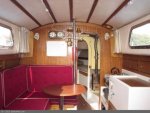
image.jpg
 
I too have considered similar heaters which I understand give a good dry heat which seems to be perfect for a boat. The only issues I would be concerned about are whether there may be hot spots as the movement of heat from such a heater around the boat may not be as good as other types of heaters. I do know that some people have installed a computer fan somewhere (I think low down just above floor level would work) which would help move the air around. I am only guessing this would work but it would be quite cheap and easy to install. I don't think such fans are expensive or would draw too much current.
 
There's been lots of discussion on here about the best sort of heater. My understanding is that solid fuel or drip feed heaters need space around them not least to allow the heat to spread. The other thing to bear in mind is that a flue is needed and they can't be used when the boat is underway.
I seem to recall that, on balance, most were in favour of Ebers or Webber's despite their heavy electric use and alleged unreliability.
 
Has anyone had any experience of using these, or indeed charcoal heaters in general? I'm particularly interested in whether you get any smoke in the cabin when lighting, or much smoke or ash from the flue, and how controllable the heat is.

I'd also value advice about siting. The Berwick has a similar layout to the Centaur and the only likely candidate is inside one of the wet lockers as in the attached photo of a Centaur. Again, any good or bad experiences with this approach? I'm assuming I'll need to use some sort of shielding.

I've used a Bengco charcoal heater (no longer made, I believe) a couple of times on our 'project boat'. Didn't get smoke in the cabin when lighting, but as the initial lighter (designed to be meths, but I used a firelighter) is in the base/ash pan which has to be attached after lighting the initial lighter there was an brief smell of the firelighter. Smoke certainly visible out of the flue while it's getting going, but once charcoal properly alight little visible smoke. I didn't notice any ash coming out of the flue. The heat seemed very adequately controllable using the adjustable air intake vent.

You need a backing plate on the bulkhead behind the heater to reflect/distribute the heat, and anywhere else within a few inches. (Small sheets of stainless and brass, etc., available off internet.) I envisaged having to put an insulating sheet of some description behind the metal sheet (mine mounts on a varnished ply bulkhead), but seem to recall being advised on this forum that wasn't necessary.

Due to space restrictions mine is mounted halfway between cabin sole and roof, but ideally would be as low as possible. The previous owner used a small wall mounted 12v fan to help distribute heat downwards. I've not used the heater 'in earnest', so don't know how necessary/useful this is.

If you get one, a tip for getting charcoal cleanly into the heater is to bag it up in small paper bags, tied closed with cotton, before bringing aboard, and drop the bags into the heater as required.
 
I've used a Bengco charcoal heater (no longer made, I believe) a couple of times on our 'project boat'. Didn't get smoke in the cabin when lighting, but as the initial lighter (designed to be meths, but I used a firelighter) is in the base/ash pan which has to be attached after lighting the initial lighter there was an brief smell of the firelighter. Smoke certainly visible out of the flue while it's getting going, but once charcoal properly alight little visible smoke. I didn't notice any ash coming out of the flue. The heat seemed very adequately controllable using the adjustable air intake vent.

You need a backing plate on the bulkhead behind the heater to reflect/distribute the heat, and anywhere else within a few inches. (Small sheets of stainless and brass, etc., available off internet.) I envisaged having to put an insulating sheet of some description behind the metal sheet (mine mounts on a varnished ply bulkhead), but seem to recall being advised on this forum that wasn't necessary.

Due to space restrictions mine is mounted halfway between cabin sole and roof, but ideally would be as low as possible. The previous owner used a small wall mounted 12v fan to help distribute heat downwards. I've not used the heater 'in earnest', so don't know how necessary/useful this is.

If you get one, a tip for getting charcoal cleanly into the heater is to bag it up in small paper bags, tied closed with cotton, before bringing aboard, and drop the bags into the heater as required.

Thanks, that is very helpful. What do you think about the proposed location? Does convection result in decent heat throughout or am I at risk of heating the wet locker but not the cabin?
 
I briefly had a Pansy heater fitted to my Vega (fitted it shortly before I sold the boat). Had significant problems with downdraft until I extended the flue above boom-height. You can't easily extinguish the fire so may be waiting hours for it to go out, unless of course you trust it to burn unattended, which I didn't.
Heat shielding is easily achieved by using thin stainless sheet behind the heater and flue, mounted not directly onto thr bulkhead but spaced a few mm off it e,g, using a nut or stack of washers.

You really do need to mount it at floor level, otherwise there will be a pocket of cold air- although if you always sit with your feet up on the berths then you won't notice as much.

A drip feed diesel heater has many similarities but is more controllable, and in some ways less hassle as it simply feeds off your diesel tank. No need to buy a different fuel or to top it up every few hours. The downside is the occasional whiff of diesel, and you can't opportunistically burn driftwood etc.
 
I briefly had a Pansy heater fitted to my Vega (fitted it shortly before I sold the boat). Had significant problems with downdraft until I extended the flue above boom-height. You can't easily extinguish the fire so may be waiting hours for it to go out, unless of course you trust it to burn unattended, which I didn't.
Heat shielding is easily achieved by using thin stainless sheet behind the heater and flue, mounted not directly onto thr bulkhead but spaced a few mm off it e,g, using a nut or stack of washers.

You really do need to mount it at floor level, otherwise there will be a pocket of cold air- although if you always sit with your feet up on the berths then you won't notice as much.

A drip feed diesel heater has many similarities but is more controllable, and in some ways less hassle as it simply feeds off your diesel tank. No need to buy a different fuel or to top it up every few hours. The downside is the occasional whiff of diesel, and you can't opportunistically burn driftwood etc.

I'd worry about a sooty exhaust ruining my deck and sails, (and my neighbours) or am I showing my ignorance here?

Not a charcoal stove, but here is a series of videos of a chap installing a Refleks diesel stove onto an Albin Ballad, I'm sure a lot of the principles will be the same, just a a different fuel.
https://www.youtube.com/watch?v=zePPqHDsekI
 
I'd worry about a sooty exhaust ruining my deck and sails, (and my neighbours) or am I showing my ignorance here?

Not a charcoal stove, but here is a series of videos of a chap installing a Refleks diesel stove onto an Albin Ballad, I'm sure a lot of the principles will be the same, just a a different fuel.
https://www.youtube.com/watch?v=zePPqHDsekI

Charcoal actually burns very cleanly, not sooty or tarry like a coal or wood fire.
The main benefit I saw in the charcoal option was that they can have a very small flue diameter- although perhaps this was why I had problems getting it to draw.

Edit- forgot to say, you can also get the Taylors paraffin heater which uses a very small flue
 
2 companies I've had a look for solid fuel heaters are Hampshire heaters and the Cole heater from charcoalheaters.com. Has anyone had any experience of using these, or indeed charcoal heaters in general?

I fitted a Hampshire Heater to my 26-footer three years ago and used it for the first time last summer. Damn you, weather gods.

I had nowhere to mount it at floor level and I am glad I did not. It gets very hot and I would not want it low down where stuff and feet could easily come in contact. Instead I mounted it halfway up the main bulkhead, on a sheet of 2mm mirror polished stainless (offcut from a local fabricator) with 10mm silicate heat insulation board (from a local stove installer) behind it. That seems to work well, as even when its running at full heat the other side of the bulkhead barely gets warm. There is about 18" of flue inside the cabin and a further 12" outside in the screw-in stove pipe. I haven't had problems with coolness below it.

I haven't found it easy to light. The official method is to soak a glass fibre wick held in a tube in the ash pan with meths and then light that, but I have rarely been able to get enough meths to soak in. The wick is very tightly packed and the top soon gets sealed with fine ash. For this year I plan to mount a circular disk with a spike in the middle on the tube and impale a firelighter on the spike for lighting.

Once it's going - I have never failed to light it, eventually - it's excellent. The heat is very controllable with the air vent, so you can have anything from gentle warmth to a real blast, with the firebox visibly glowing red inside the outer wrapper. I suspect that that is overcooking it a bit.

At a moderate heat a fill of charcoal lasts around six hours (the website says twelve). There is some smoke on startup, but as soon as the charcoal is properly alight there is none at all.

All in all ... I love it. It's not just the warmth in the evening; it's having a dry boat with dry clothes and dry towels on dank, cold Scottish summer mornings. Not as convenient as an Eberspächer, but no smell outside, no noise, no battery drain ... and a quarter of the price.
 
I had a Pansey Atkey on my previous boat, a flush decked 24' gaffer. I too had to extend the flue, in my case, 18" above the deck in order to supply enough draught for it to burn properly.

I loved the smell and the dry heat it produced. The case quickly became seriously hot and crew suffered a nasty burn through brushing against it, so they need to be treated with respect. There was certainly a fair bit of smoke in the cabin when refuelling, but I quite liked the smell and the 'old English pub' ambiance. No fumes or smoke otherwise. I also fitted a 12v computer fan on the deckhead above it to distribute the heat, with only limited success. There were always cold spots around the boat.

Current boat has a Webbie, and I am sorry to say it knocks the spots off the Pansey in terms of genuine t-shirt temperatures and fully distributed even heat.

I still am rather fond of oil lamps and charcoal heaters for that Arthur Ransome feeling!
 
Good evening, I also had a Pansy on a 24 footer, lived aboard through a UK winter. It was rubbish as a heater and the boat got sooty, inside and out, despite using the reccomended, and extremely expensive lumpwood charcoal.
Now have a Dickinsons Newport, drip feed diesel, it is absolutely fantastic. It will burn diesel, paraffin, lamp oil equally well. I would never contemplate charcoal heating ever again.
Aviation turbine fuel is like paraffin, and Easyjet etc only pay a few pence per litre, I wonder where to get some?
Enjoy the sun LD
 
Thanks for all the ideas. It's a tricky decision, especially as I'd worry about the location of a bulkhead mounted unit, either diesel or charcoal. If I wanted it in the main cabin I'd be sacrificing quite a bit of the L shaped seat that converts into a double berth, in order to keep fabrics well away from the unit. Putting one in the wet locker area may not heat the cabin well. A Webasto costs ££££. Tricky......
 
I have two diesel heaters on my boat. A Sigmar 100, bulkhead mounted and has a carburettor type fuel valve. The other is Webasto STC2000 blown air heater.
The Sigmar is great at anchor. You can see the flame and it gives the cabin a very cosy feel. In my case it's gravity fed from the main fuel tank and no electrics are involved. Canadian made and sold by Kuranda Marine
A disadvantage is that it doesn't like strong winds, it really needs a balanced flue to cope with them.
The Webasto is brilliant for instant heat and can be left on unattended. Great for winter sailing, I'm aboard now and it's been running continuously for the past week.
Neither heaters are cheap though.
Samphire stoves introduced an interesting bulkhead heater a couple of years ago. The design had the intake air coming down a double lined chimney thus giving a balanced flue. There was no "flame" as such but you could see a heated gauze through the window, rather like drip feed paraffin heaters of old. The Samphire ran on paraffin or diesel. Their website appears to be under reconstruction so I don't know if they are still around.
 
Think you have to accept that solid fuel heaters have their limitations as do bulkhead diesel or paraffin ones. For a boat of your size the only really effective heaters are blown hot air, either diesel or gas fired. Gas fired such as Propex are much cheaper than an Ever type but not as versatile and need a gas supply. However for occasional use worth considering.
 
Top