Any Corgi gas guys here please ? - re gas pipe ?

Joined
12 Aug 2007
Messages
2,008
Location
Currently La Coruna Spain
Visit site
Hi Folks..
Need to replace the main gas pipe from the locker to the cooker on our Seastream 34 Ketch. (About 6 Mtrs)

Bought normal 10mm microbore, but.. on looking at the old pipe, it seems to be of a MUCH thicker wall thickness.
Is there a special type of gas pipe for this run ?...
If so, what do I ask for, I am visiting the UK in a few weeks so can get it there.

Many thanks in advance for the advice.

Joe n Jayne.
Yacht 'Ruddles'
La Coruna.
 
Are you sure the old pipe is 10mm and not 3/8"
If it was fitted in the UK it is more likely to be 3/8"

Wall thickness of 10mm pipe is 0.7mm while that of 3/8" is 20gauge which is 0.91 mm.
 
I am not Corgi registered but I am a plumbing and Oil heating engineer.

10mm coils and fittings purchased from a reputable plumbing merchant will be fine for a gas installation.

comment above sounds like a reasonable answer to your conundrum re thickness.

I wont presume to tell you how to best install the pipe runs and reduce the number of connection inside!

A handheld gas detector would be a useful addition to your toolbox to check all your connections. - solder wherever possible - compression fittings can work loose!
 
[ QUOTE ]
solder wherever possible - compression fittings can work loose!

[/ QUOTE ]

I'm not a CORGI, either, but it is my understanding that soldered fittings are a no-no for gas, as they become un-soldered in a fire. It is also my understanding that compression fittings should be fitted with soft copper olives for gas (sometimes purchased separately), rather than the the brass ones they sometimes come with.

As I said earlier today on another thread, it would be immensly helpful if the standards for this sort of thing were in the public domain.

Open to correction...

Andy

(edit: typo)
 
[ QUOTE ]
I'm not a CORGI, ..............rather than the the brass ones they sometimes come with.

[/ QUOTE ]

I'm not a CORGI, either, but it is my understanding that soldered fittings are a no-no for gas, as they become un-soldered in a fire. It is also my understanding that compression fittings should be fitted with soft copper olives for gas (sometimes purchased separately), rather than the the brass ones they sometimes come with.

Calor recommend the copper olives although other suppliers say that the brass one are suitable. I'd fit the copper ones I think
 
OK maybe I stand corrected - but they do use soldered fittings in domestic gas installations! - your comments make sense and in oil installations we only use compression fittings!

Anyway it is possibly not relevant because you do not want any connections between the gas locker and the compression fitting to your flexible pipe attached to the cooker.
Best practice is to run separate lines for each appliance.

You are correct about the olives.
 
I'm not a gas fitter but I replaced my gas system using the Boat Safety Scheme as guidance. They advise using "seamless copper tube which conforms to BS EN 1057 with copper or copper alloy compression fittings" (or you can use stainless steel piping as an altenative).

I got my pipe from the local Plumb Centre store which was much cheaper than specialised places. Check it has BS EN 1057 stamped on it.
 
I notice they also do the plain copper 10mm OD in three wall thicknesses, 0.8mm. 1mm and 1.2 (and the 3/8" in 16, 18, 20 and 22 gauge) but the working pressue of them all is way above the pressure in a gas system.
 
Please tell me me that I have not done it wrong
From gas bottle to regulator rubber gas pipe pushed onto copper pipe and secured with two opposing jubilee clips.Copper pipe runs to locker by cooker and is connected to gas on/off tap.More copper pipe from tap to rear of cooker area then rubber gas pipe again double clipped connected to back of cooker.
This was the installation when I bought the boat.
I would have thought that compression or soldered connections would be likely to be vibrated by the motion of the boat and could work loose.
 
[ QUOTE ]
Please tell me me that I have not done it wrong

[/ QUOTE ] I'm not going to say what is right or wrong (well I am really)

gas bottle to regulator rubber gas pipe High pressure hose I hope

pushed onto copper pipe I think that should have a proper fitting, not just pushed on to pipe.

two opposing jubilee clips I am not sure if two clips are called for but Jubilee type are not the best. I think they should be crimped "O" clips on the HP section

Copper pipe runs to locker by cooker Clipped up at the recommended intervals I hope.

rubber gas pipe again double clipped connected to back of cooker Again not pushed on pipe, rigidly fixed fitting with a hose tail (Fulham nozzle) I hope. Also not keen on worm drive clips here either.

I would have thought that compression or soldered connections would be likely to be vibrated by the motion of the boat and could work loose. The case against soldered joints has already been given. Pipework should all be adequately supported to prevent vibration, which can cause hardening and fatigue(presumably) failure of the pipe.

The Bible is Chapter 7 of the Boat Safety Scheme

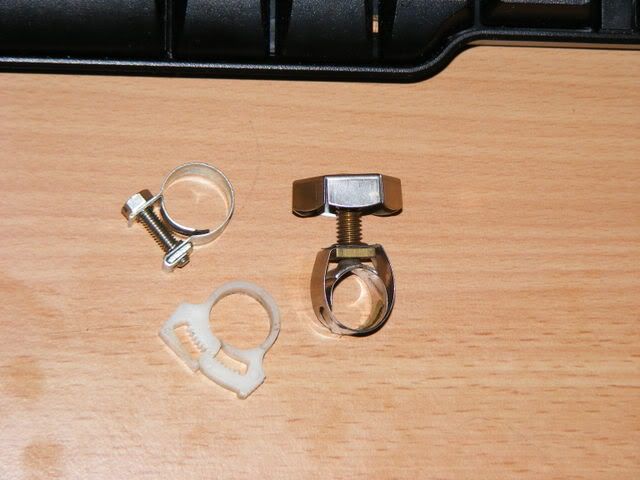
Click the thumbnail below to see some alternative clips. I like the type top left for the lp hoses. For general use and on gas where Iwant to be able to easily undo by hand I like the one on the right, (there are versions that just have a slotted screw) Perhaps I should not admit to using the plastic snapper clips bottom left but they are jolly handy
<span style="color:white"> .......................... </span>


The page on "Clips hoses and nozzles" under "LPG and Oil" on This site shows the fittings to accept LP and HP hoses and the double ear O clips that I think should be used on the HP hoses at least.
 
I was a CORGI registered gas fitter for many years. Although most of the work I did was on domestic appliances. Most of the connections to pipe work was by soldered joints. Generally speaking compresion joints were only used where it was required that pipe work would need to removed for servicing. There is a rule that compresion joints must not be used in any situation where they are inaccessable once the installation is complete such as under floors or buried in walls. Any pipes going through a wall was reqired to be sleeved, thus the 15 or 22mm gas pipe would run through a 32 or 38 mm waste pipe both ends were then sealed with a non setting mastic. The reason for this was so that if there was any settlement of the building then the gas pipe would not be fractured, it also ensured that the copper pipe did not come into contact with the mortar which obviously contains cement which is an alkali which could corode the copper. Any underground pipes were PVC coated which had the advantage of protecting the pipes, and by useing Yellow coloured PVC this helped to identify them as gas pipes.

Most gas fitters would prefer to use soldered fittings, the reason being that once the joint was made and tested it was likly to be sound virtually indefinately. A compresion fitting is always possible to be moved and have a leak develop. There is of cause the other reason, solder fittings are cheaper than compresion.
 
Blimey!
People do have some funny ideas about stuff:)

Ok. For gas pipes and fittings on boats that are older than about 10 years here in England you will find most are the old imperial measurements.
You can find out which you have by tying a metric compression fitting olive on the pipe and an imperial one
The vast majority are imperial.
Go to a good chandelery and you will find that they will sell imperial gas fittings and pipe.
Personally if you are going to replace it all i would still go for imperial as most engineers and boatyards would most likely stock these sizes in the future if anything ever goes wrong.
Use compression fittings and never solder. As solder will melt in the case of a non connected fire and allow the pipe to fail much more quickly.
Use the special bulkhead fitting that are available where the pipe runs through any bulkheads and the pipe itself should be clipped up with copper pipe ( not plastic ones ) clips every 6-10 inches or so.
At the gas locker the last fitting that is there should be a bulkhead fitting.
From the bulkhead fitting get a rubber gas pipe made up at the chandelery that you used to buy the pipe and fittings with proper swaged ends the vorrect size to stretch to the bottle. And again iether swaged onto the gas valve or a jubille clip.
At the other end the last fitting should iether be a bulkhead fitting with rubber pipe the same as the bottle end,Gas tap with rubber pipe same as bottle end or the actual gas appliance itself.
Try not to use jubilee clips anywhere
I like to use a bit of calortight paste that you can buy to help seal the compression fittings but this is up to you as some corgi people say its not good practice and some say its ok but at the end of the day thats what its made from.

If its an inland waterways boat then i would go by the bss booklet which to be honest is also good for sea boats as a good guide

Hope this helps
Joe
 
I have a nine year old boat which was manufacturer fitted with a gas run from a locker at the stern to the cooker with two lengths of flexible 'rubber' on copper pipe. I would like to replace them and have bought new rubber and fittings to do so but cannot get the old rusty unions off.

I have chosen to leave well alone. No obvious faults and fearing I will do serious damage if I use maximum force on quite small stuff. I have obvioiusly soaked it in WD40 to no avail. Please, has anyone any novel ideas besides completely renewing the otherwise fault free system?
 
Milfordsam and Joe,

Some issues raised in your posts.

<u>Compression vs soldered joints.</u>
Whatever gas fitters prefer to do on domestic installations is one thing but the Boat Safety Scheme (B.S.S.) chapter 7 paragraph 7.8.3/R says
"All LPG pipe joints must be compression fittings on copper pipework
or compression or screwed fittings on copper alloy or stainless
steel pipework."

Regardless of the reasons you will find that solder fittings are not readily available in small imperial sizes (1/4" & 3/8"). Calor do not appear to offer them and I cannot find them on the BES website.

<u>Bulkhead fittings</u>
It is not necessary for bulk head fittings to be used whenever a pipe passes through a bulkhead. Paragraph 7.8.2/R of the B.S.S. says
"LPG pipes passing through metallic bulkheads or decks must be
protected by the use of sleeves, grommets, or bulkhead fittings."

Note that is only a requirement to protect pipe from abrassion where it passes though a metal bulkhead

The exceptions will be where it is necessary to maintain the watertight integrity of a bulkhead and the exit from the gas locker where this is below the level of required gas tightness. Even in these situations it may be possible to avoid unnecessary breaks in an otherwise continuous pipe run by boring through the bulk head fitting to remove the "land" in the centre thereby enabling an uncut pipe to be threaded through it. Particularly useful, I suggest, for the gas locker exit.

Bulkhead fittings are available, I believe, with a hose tail (Fulham nozzle ) on one end which could be useful in installations where the regulator is bottle mounted.

<u>Pipe support</u>
The B.S.S. recommends that pipework is clipped in position at a minimum of 500mm (20") intervals.
 
Thanks for the suggestion. It might just get me going. Sorry but there is no room. One of them is on the back of the cooker, on part of it. The other two appear to be onto screwed bulkhead type fittings with no exposed pipe.

Getting at the copper pipes will require a lot of disassembly of glued in internal lockers and bulkheads and/or surgery on glass fibre.

It would be quicker and easier to cut a hole in the top sides and get at the pipe running down the back of the cockpit side bench that way!

If I ever see the copper pipe I will completely replace it somewhere I can find it again. In fact when I can ever get up the 'get up and go' I will just leave the old one in place and run a new pipe in a better place.

Thanks again.
 
OK so you need a proper penetrating oil rather than WD40

- the bulkhead fittings and cooker fitting - do they have a back nut to hold on to? to stop the fitting spinning while you try and undo the nut?

If it wasn't Gas I would say apply some heat!! however probably a little tapping hammer all around the fitting will help loosen things but it may be the original fitter used a sealant that has set.

Best option if you can get the fitting off the cooker would be to run a new pipe.

Good Luck!
 
Top