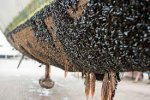
Antifoul stripping and keel shot-blasting

edwardcs

New Member
Joined
13 Nov 2007
Messages
4
Location
Surrey; boat in Essex
Visit site
This winter, I need to strip off the build up of old uneroded erodible antifouling withiout damaging the preventative epoxy underneath - any ideas, recommendations as to suitable products / techniques? Also, advice on products / techniques/ firms to shot-blast the keel as rust is an increasing problem.

Many thanks!
 
We have had the hull and keel of a previous boat grit blasted. The operator said he would be very careful and only remove the anti-fouling, but he took the epoxy coating and some of the gell coat off as well. It revealed a load of blisters I hadn't known about so all was not lost. It did involve lots of filling and fairing afterwards.

Our current boat needs blasting/cleaning off and we are having it soda-blasted in a weeks time. I will let you know how we get on. I have had several people say how 'gentle' the process is, so I am crossing my fingers that all will be well with the preventative epoxy we have on the bottom. The hull is reasonably dry, so I am hoping it won't get disturbed too much...
 
I've done some blasting of hulls. The basic problem is that if the epoxy coat isn't well bonded or thin it will come off. There is a spread of energy in the blast pattern, it is not uniform in the macro or micro level so unless there is a wide separation in the degree of bond and/or thickness of the coatings it will be difficult to selectively blast. Only way to know is to try.
 
Had my Mustang 30 slurry blasted and I was told this would take off most of the gelcoat - the yard's quote included two coats of epoxy, filling and fairing and two coats hard anti-fouling which I have wet and dried back a little. Have to say the result was worth it (but not cheap) because before the bottom was awful and my feeble efforts were pretty hopeless! Don't know who did the blasting but trusted the yards assurances as their subby was a regular supplier.

Fancy half a Mustang 30 capital and running costs anyone? PM me if serious and broadly racing inclined.
 
The quality of job is very much down to the bloke holding the blast nozzle, no matter what medium is used.
All other things being equal, dry blasting is most aggressive and best if you are stripping steel or an iron keel back to bare metal. You should get a first coat of primer on as quickly as possible after the blast.
Slurry is less aggressive and a good operator should be able to peel back coat by coat.
Soda is least aggressive and you can control the result to a high degree so if just removing antifouling it gets my vote every time. If you find the epoxy needs removing when you get to it because it is not in good condition soda can be quite slow.
Both soda and slurry involve some water with the aggregate so not ideal on iron keels but often the only option available. Get the keel dry as quickly as possible and a coat of primer on.
I would insist on being present when blasting is done to control how far to go - and when to stop!
 
Many thanks for the advice received. I should add that I keep my boat in Essex (Walton), so if anyone knows of reputable firms that do this sort of work or places that hire out the necessary equipment for a DIY job, I would be grateful for recommendations.
 
Sorry it's nothing to do with quality. It's all to do with how well bonded the antifoul is to the epoxy and the epoxy to the gelcoat. If you wish to blast off the antifoul only an the antifoul is harder and stuck to the epoxy more fimly than the epoxy is to the hull you are going to end up blasting off both. It's not an ideal world and inevitably there will a lack of uniformity over the whole hull so what might apply to one area of the boat might not apply to others.
Slurry blasting is generally lower energy per sand grain and there is a cushioning effect as well (from the water)so it will enable the operator to work down the layers if it's going to be possible. It's possible to create the same effect by dry blasting with smaller grit size and less pressure. If the epoxy isn't well stuck it's not going to stay on it's as simple as that.
The matt surface left on the gelcoat by blasting is a benefit, it enables the coatings to bond very well, the ideal surface. It's almost worth having it done on a new boat.
Dry ice and soda have the benefit of not leaving residues both on the boat and on the ground but they are lower energy processes and will take longer and cost more both in time and materials.
 
I'm afraid I think it's a lot to do with the quality (skill) of the operator. I've seen too many holes in boats from poor quality blasters. Obiously there is also an element of coating quality too but I was assuming a well adhered epoxy as a starting point. I agree with you if the coating is in poor condition it will give way at the weak points first but that is what you want to happen - even if you don't like what you see at the end.
If the coating is in good condition throughout antifouling will give way before an epoxy breaks down. Go through an epoxy that is well adhered and you will almost certainly damage the gelcoat and possible the laminate too.
 
[ QUOTE ]
I'm afraid I think it's a lot to do with the quality (skill) of the operator. I've seen too many holes in boats from poor quality blasters.

[/ QUOTE ] Holes?. Due to what? The only holes I've ever seen blasted are osmotic cells and voids in the lay up. Neither can be avoided however skilled the blaster.

The 2 "skill" elements otherwise are being able to keep the nozzle moving so that the blast is reasonably even and choosing the right grit size and blast rate. Too large a grit tends to be fast and coarse too small is OK but there will be difficulties with blockages and will be slower, that's it, it really isn't rocket science.
 
We had a Malaysian shot blaster fall asleep in one of our cargo tanks and blasted his way through 3/8" steel, luckily he woke up before doing similar to his foot. My boat doesn't have cargo tanks just my ship, well not mine, it's where I work.
 
Holes due to pressure too high, lack of care/skill/training of the operator. As Davellis says, it happens on steel structures (not just in Malaysia) and it certainly happens on GRP boats. A GRP boat coated with high build epoxy, blaster gets bored and turns the pressure up and when through the epoxy he goes deep into the laminate very quickly.
There are some very good blasters around but anyone can set up in business with a modest capital outlay and little knowledge and that can be disastrous.
With steel there are clear standards for blasting but any shipowner will still expect independent supervision of the work. GRP has no standards and we tend to assume the blaster is the expert on how far to go, osmosis, gelcoat and laminate quality etc. Generally a false assumption in my opinion.
 
Shot blasting the hull
The following.
A good dry hull ie with low moisture readings should
Never be shot blasted . Once a hull has been shot blasted dry or wet
the gelcoat will become porous, very much like that of a pumice stone
Hulls should be hand scraped always then lightly abraided and primed
/ anti fouled .
Iron keels can be shot blasted dry not slurry type
Immediately after apply an anti rust agent then
Epoxy coat fill and fair back
If a hull has high moisture readings or signs of
Blisteres ie osmotic so on then unless you have
£1000s of pounds on the ready and miss out on
Sailing season Don't go for blasting
Scrape down is cheaper and the best option
I am happy to pass on reputable company should
Anyone require further
Happy sailing
 
Shot blasting the hull
The following.
A good dry hull ie with low moisture readings should
Never be shot blasted . Once a hull has been shot blasted dry or wet
the gelcoat will become porous, very much like that of a pumice stone
Hulls should be hand scraped always then lightly abraided and primed
/ anti fouled .
Iron keels can be shot blasted dry not slurry type
Immediately after apply an anti rust agent then
Epoxy coat fill and fair back
If a hull has high moisture readings or signs of
Blisteres ie osmotic so on then unless you have
£1000s of pounds on the ready and miss out on
Sailing season Don't go for blasting
Scrape down is cheaper and the best option
I am happy to pass on reputable company should
Anyone require further
Happy sailing

Well, as the question was asked 9 years ago, I suspect the OP may have resolved the issue one way or another.
 
I see the shot blasting failed :)

Here is a common scenario

The hull of a boat is found to have excessive build up of old anti foul and some appears to be falling off.
The owner decides to have the anti foul removed ,to make betterment and start afresh .
When he returns to his freshly shot blasted hull there are a few things he notices
1. All the skin fittings have acquired an abrasive finish thus allowing them to degrade at double there required lifespan
2. The speed and depth log appear to look as thou they've survived a nuclear explosion.
3 . The shaft and trim tabs now have a real rough finish for marine life to get excited about.
4 the hull oh wow look how clean it looks , this is a tragedy in itself.
5 The rudder has acquired a different shape with the top and bottom spacers/bearings worn away where it's been thoughtlessley cleaned.
Then I phone the master blaster because I'm not happy .

Things like this type of boat is known to have lots of voids , or this is a common problem with hulls of this age , or you boat has osmosis .........this is normall

Shotblasting is for steel boats and keels only
There are company's out there who scrape hulls by hand for half the price of a master blaster this is a no brainier people please .

Then the epoxy coating story comes into play and I ask the question how come are there 30 year old hulls with there gel coat in good order but epoxy coatings breaking down after 10 years
I've recently bought a sailing yacht and after moisture readings were carried out the most important was that she hadn't been blasted to me .
Another thing to be very aware of is retro fits on boats .
Hope this free advice helps all you guys out there
Happy sailing
 
Had my boat done with the Farrow system when it was first introduced and the result was brilliant. He managed to remove all the A/F and the primacon but did no more than key the gelcoat. Mind you, it took him almost 2 days on a 35 foot bilgie. I suspect that the issue most people have is a cheap quote and a guy determined to do it in a day so the pressure gets cranked up and gel gets removed.

Its sensible to plan on a couple of coats of epoxy on a DIY basis. The water resistance of epoxy depends on thickness just like any other coat so the thicker the better.
 
Top