Anti foul-remove or not

Sailfree

Well-Known Member
Joined
18 Jan 2003
Messages
21,676
Location
Nazare Portugal
Visit site
Reading of so many scraping it all back -why?

I thought anti foul was self eroding so doesn't the stuff underneath work?

I do have a problem from inadequate hull preparation when new but only in certain areas.

I was intending to feather the edges - it is only a cruising boat - and then apply new anti foul.

Why and when do you decide to remove it all?
 
The yard I winter in uses a BFO diesel pressure washer when they lift out ... the accumulated layers of eroding antifouling get thinner every year.
 
Reading of so many scraping it all back -why?

I thought anti foul was self eroding so doesn't the stuff underneath work?

I do have a problem from inadequate hull preparation when new but only in certain areas.

I was intending to feather the edges - it is only a cruising boat - and then apply new anti foul.

Why and when do you decide to remove it all?

I am in the middle (middle? I wish!) of scraping back to gel-coat because when I bought the boat 4 years ago the old a/f or whatever had seriously built-up into corrugated ridges, along with other significant blemishes.

I take the above points and hope never to have to repeat this excercise. the coats of a/f I put on did indeed virtually wear away to nothing.

Good luck
 
Camelia came out of the water last October with just a thin layer of slime. The yard have a monster jetwash machine that removed a lot of the antifoul I slapped on last spring and some of the older stuff. Lots of comments about you having to scrape "that lot" back to gel coat. I asked why, if after a few years of them lifting and blasting with the monster jetwash machine they would do the job for me?

I've slapped another single coat of the cheapest stuff I can find, going in on the 31st, and I'll see how we get on next October.
 
Why and when do you decide to remove it all?

I guess the tipping point comes into sight when the old paint loses its adhesion to the hull and starts to flake off, most irritatingly when you are painting on the new season's coat. Your efforts to feather the old coats in, without damaging the gelcoat/ epoxy coating, have been to no avail ; you have a new crater and bits of old paint littered about the new coat.

So the next time you prepare the hull you try harder to preempt the cratering by scraping off more places that seem susceptible to it, and taking even more care over the feathering. Again to no avail, and you've probably scraped such large areas clean that you are beginning to think that it would be easier to do the lot (it isn't!).

However you can forestall all the above by rubbing down as much of the previous coatings as you can manage, every year. Then the old paint won't tend to flake off in the first place.
 
It can build up over a period of time, but I'm certainly not planning on stripping it back every year - when we do get round to lifting out, it will be a pressure wash and scrub down, let it dry out, then slap on a thick coat of Cruiser Uno and back in. We may do a more thorough stripping back a few years from now.
 
Last edited:
On the Twister I found a problem when applying and the solvent in the new coat migrated through to the old coat underneath, which started unadhereing to the hull as I was trying to put the new stuff on top of it. Persevered for a few years, but then it all began to resemble a close-up of the surface of the moon, and I had it all blasted back to gel.

One reason the new boat was Coppercoated at birth.
 
We did scrape back because, when we bought the boat, there were large patches which had dropped off. 'As it's falling off, it'll be easy to remove' we thought. How wrong can you be?

Anyway, we stripped it back to gelcoat, applied a few layers of Primocon and a coat of eroding anifoul. Every year, on the day of lift out, we rub it down hard with wet-and-dry to remove most of the old a/f. Then add a new coat. Seems to be working, as there's no significant build-up and the new coat of a/f goes on with no problems.
 
I guess the tipping point comes into sight when the old paint loses its adhesion to the hull and starts to flake off, most irritatingly when you are painting on the new season's coat.

This happened to me last winter - the boat was new to us. As we rolled on the new antifoul the roller started to take off the old! Had to bodge it for the season, but have now had it all blasted off and we're currently fairing the bottom before giving CopperCoat a go.
 
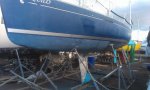
image.jpgI'm almost finished scraping prior to coppercoat. I tried a two handed pull scraper and it was fast but left lots of gouges, squared of chisel is slow but no gelcoat damage at all.
 
I assumed the hull wasn't prepared properly when new and I certainly saw it just put over a jet wash the second year hence don't understand others comments.

Q1. Does the old anti foul "unadhere" when applying further coats even if the base coat was properly prepared in the first place?

Q2. If there appears to be a good thickness of micron extra on the hull does it require more each year if all it is doing is softening the existing so that it flakes off?
 
Q1. Does the old anti foul "unadhere" when applying further coats even if the base coat was properly prepared in the first place?
Not if it's in good condition

Q2. If there appears to be a good thickness of micron extra on the hull does it require more each year if all it is doing is softening the existing so that it flakes off?
Difficult to tell how thick it is, or how effective it remains

I can see your point, why put more on if it is just building up the thickness to the extent it poses a problem. I find it wears very thin in some places, particularly along the waterline where I've wiped/brushed light fouling off during the season, so it's easiest just to paint the whole bottom, and maybe put on an extra coat where I know it erodes fastest.
 
Top