Another Spinnaker advice post

WindermereColvic

Well-Known Member
Joined
20 Nov 2008
Messages
794
Location
Newburgh, Lancs
Visit site
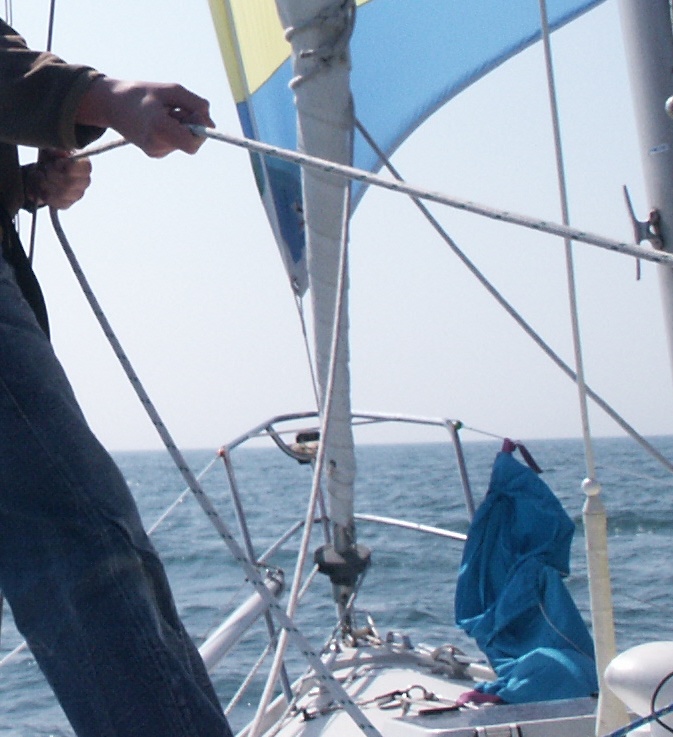
Hi all, can you identify the sail in the picture?
spinny-1.jpg

Ie, is at a symmetrical, which to my mine means both clews flying, albeit one at the end of a pole, or an asymmetric, flown with one clew on the bowsprit or similar?
Bit of background, Ive flown both types on dinghies, but am more familiar with the symmetric setup on a GP 14 say. I have worked out (I think ) how to do this on Solenette with the pole we have, but am still a little ( ok very) confused, especially since Im not actually sure if what we have is a symmetrical spinny.
Few other points: The edge leading from the head to the port clew seems shorter and hemmed differently to the opposite one.
There is a short length of thick, at least thicker than the sheets, rope spliced onto the stbd clew. Any ideas what that’s for?
Finally, there was only one sheet in bag with the sail, and although I have acquired another, I wonder if it points to how its been used previously.
spinnyclew-1.jpg

Thanks, Matt
 
Almost impossible to say just from pics, but the clues you have given points to asymetrical, especially what appears to be a short tack line.

Most coloured sails have a label in each corner - head, tack or clew. If you have 1 head and two clews it's symetrical, one head, one tack and one clew is asymetrical. If you have no labels then just get a tape measure out and measure the edges.
 
Another spinnaker advice post

I think from the photos that you have an assymetric spinnaker, looks too flat for a cruising chute. The rope in the photo is the tack rope, you'll need sheet and guy to the other clew.
If you've not used one before you can change the power quite a lot by releasing/tightening the tack without altering the sheet tension.
Gybing ,it needs the guy and sheet to be kept under tension as it passes across the bow.
Lots of practice = lots of power = sparkling performance!


ianat182
 
Hard to be certain but it looks very similar to my Jeckells cruising chute. The short rope spiced to the tack is used to tie this corner down to the bow; I pass it round the bow roller and make it fast to one of the mooring cleats. The sheets go from the other bottom corner to turning blocks on the quarters and thence to the winches. Some people only use one sheet and carry it round the bow when they gybe.
 
I pass it round the bow roller and make it fast to one of the mooring cleats.

Thanks to all so far. DJE, not being picky or anything, just wanting to understand how everythings set up, We have a block on the back of the forestay plate, pic, but the tack line is way to big to go through it.Supose it could go through the bow roler though. Is your setup something like this? (diagram)
Thanks, Matt
P2080008.jpg


spinnakerp1.jpg
 
Oi! Mooring Warp alert!

That pipe has gone opaque. Next it will turn brittle and crack where it passes over the roller. Then it will chew throught the warp.
Check it out.
Just use a nylon warp over the roller without the pipe. It'll not wear through.
 
Thanks to all so far. DJE, not being picky or anything, just wanting to understand how everythings set up, We have a block on the back of the forestay plate, pic, but the tack line is way to big to go through it.Supose it could go through the bow roler though. Is your setup something like this? (diagram)
I don't have the connection to the forestay that you show in the diagram, just the rope strop that is spliced to the tack. You need to tie this down as far forward as possible so that the sail can pass in front of the forestay in a gybe. A block would be nice (preferably fixed to a short bowsprit) so that the tack line can be adjusted and released from the cockpit but I've never got round to fitting one so the strop just goes round the anchor roller and back to one of the bow mooring cleats. I adjust the luff tension with the halyard. Hope this makes sense. You can just about make out the arrangement here:

Chute1.JPG
 
Have to agree with davidwf, the red and green at opposite ends of the foot make it a spinnaker i.e.symmetric AFAIK.
 
Last edited:
Have to agree with davidwf, the red and green at opposite ends of the foot make it a spinnaker i.e.symmetric AFAIK.
My cruising chute has red, green and yellow corner patches. It's more important to know which bottom corner is which on a chute or assymetric than it is on a symetrical spinaker. Swap the corners on a symetrical and it will still fly inside out, that won't work with an assymetric.
 
Top