Anode arrangement confusion

LittleSister

Well-Known Member
Joined
12 Nov 2007
Messages
20,379
Location
Me Norfolk/Suffolk border - Boat Deben & Southwold
Visit site
I am intending to buy a boat that has question marks over its arrangement of anodes, with three different surveyors saying three different things about it. I've read around a bit about cathodic protection, and find a lot of repetition of basic theory, but little consensus on the practical application of it.

The situation is elderly GRP boat, conventional shaft drive, with
1) stainless shaft with rope-cutter and Brunton Autoprop, no obvious signs of corrosion, not fitted with or connected by wire to any anode except the integral anode on the nose of the Autoprop, which does not appear at all eroded;
2) external stern cutless bearing holder, no signs of corrosion, externally wired to small anode which has clearly been eroding, seemingly satisfactorily;
3) mild steel shoe (somewhat corroded) on back of long keel to support heel of rudder, externally wired to another small anode, only slightly eroded.
4) stainless rudder shaft and brackets (GRP rudder blade), no sign of corrosion, not directly fitted with or wired to any anode.

Surveyor A said (10 years ago, before Autoprop fitted) arrangement satisfactory;
Surveyor B said arrangement unsatisfactory, replace existing anodes with one connected to engine.
Surveyor C said replace existing anodes with one connected internally (because better than external wire) to bolt inside hull securing external cutless bearing holder.

What does the team think?
 
There is no need to have an anode on the stern tube or housing as there are no dissimilar metals - just bronze.

The rope cutter if it is a Stripper or one of some of the disc type will be the same material (316) as the shaft so no anode required.

The rudder shaft is also one material so no anode required.

The autoprop definitely needs its own anode.

This leaves the shaft/propeller assembly where you do have two dissimilar metal in contact. To an extent the prop anode gives some protection, but it is common to wire a hull anode to the shaft via the gearbox housing, possibly with a bridge over the coupling if it is the flexible type. However as there is no sign of corrosion (dezincification) of the prop it may not actually need an extra anode.

The anode on the mild steel shoe is not eroding because it is probably not doing anything. If the shoe is just mild steel with galvanised fastening and a non metallic bush for the rudder stock bearing the shoe will just eventually rust and as that is not galvanic an anode wont help. However if there are stainless fastenings that are not well bedded in sealant you may get localised corrosion around the holes. So, might as well just leave that anode on.

No need for anodes on any of the seacocks.

Many older boats never had any anodes because more compatible materials were used and electrics much more basic. So if there are no signs of corrosion after all these years then don't see any real need to add any.
 
Completely agree with everything Tranona said above. If there is space on the shaft I would probably add an anode there as back up for the prop anode rather than fitting a hull one. If no space on the shaft then a hull anode might be worth adding.
Most rust on the rudder shoe will occur when you are out of the water if fixings are galvanised steel. In the water nothing will be happening there so it's just a case of looking on it as a slowly deteriorating consumable item
 
This leaves the shaft/propeller assembly where you do have two dissimilar metal in contact. To an extent the prop anode gives some protection, but it is common to wire a hull anode to the shaft via the gearbox housing, possibly with a bridge over the coupling if it is the flexible type. However as there is no sign of corrosion (dezincification) of the prop it may not actually need an extra anode.
I know it is common but I wonder about the effectiveness of that sort of arrangement. The voltages involved are so small that I wonder if that sort of arrangement can actually provide protection (because of the resistance involved.

If it were a concern I would tend to suggest an anode on the shaft itself
 
I know it is common but I wonder about the effectiveness of that sort of arrangement. The voltages involved are so small that I wonder if that sort of arrangement can actually provide protection (because of the resistance involved.

If it were a concern I would tend to suggest an anode on the shaft itself

Very effective if the bonding is resistance free. Many boats such as the OP is looking at simply do not have exposed shafts. These came in when P brackets became popular and are a good solution. Conventional stern tubes need a small amount (15-20mm) min clear shaft aft of the bearing for water to flow. Putting any anode in there is wrong. Plus the boat has a rope cutter which will be installed so that gap is maintained.

You need to look at each boat, analyse the potential problems and devise the most appropriate solution. However, like many things to do with boats it is easy to throw out the one size fits all solution - even from people who should know better.
 
Very effective if the bonding is resistance free. Many boats such as the OP is looking at simply do not have exposed shafts.
Won't be resistance free unless they are using superconducting wires that are not common in such situations :)

The path from the anode to the gearbox and back along the shaft (s/s so not the best conductor) will have significant resistance in the context of the voltages involved. Worse at those very low voltages any corrosion could effectively break the circuit.
 
Won't be resistance free unless they are using superconducting wires that are not common in such situations :)

The path from the anode to the gearbox and back along the shaft (s/s so not the best conductor) will have significant resistance in the context of the voltages involved. Worse at those very low voltages any corrosion could effectively break the circuit.
It works. Thousands of boats are fitted with this arrangement. If you have difficulty in getting a good path to the shaft you can buy a device from MG Duff that bears directly on the shaft. However, if the coupling is solid there is normally no difficulty in going through the gearbox housing. What can be problematic is a flexible coupling but this is usually overcome by a bonding wire from a bolt on the gearbox side over to a bolt on the shaft side.
 
Passing any current through the gearbox bearings may not be a good idea. It's seen as an absolute 'No' in other fields.

Ohmic resistance is generally not going to be a big deal, the currents are low, the problem is that the tend to flow 24/7.
 
Passing any current through the gearbox bearings may not be a good idea. It's seen as an absolute 'No' in other fields.

Ohmic resistance is generally not going to be a big deal, the currents are low, the problem is that the tend to flow 24/7.

Never heard of any problems with this arrangement. Thousands of boats have anodes wired this way from new.
 
Never heard of any problems with this arrangement. Thousands of boats have anodes wired this way from new.

It doesn't make it right.
Anodes seem to be one of those areas where people largely copy what has been done historically rather than understanding what's going on on their own boat.

I wonder how many boats have anodes that are not really doimg much?
e.g. hull anodes that are simply too far from the prop to be effective?
Luckily we have mostly fairly corrosion resistant parts in the water.
 
It doesn't make it right.
Anodes seem to be one of those areas where people largely copy what has been done historically rather than understanding what's going on on their own boat.

I wonder how many boats have anodes that are not really doimg much?
e.g. hull anodes that are simply too far from the prop to be effective?
Luckily we have mostly fairly corrosion resistant parts in the water.

See post #6. Could not agree more that boats often have anodes that are not doing anything.

The big issue for most is the now almost universal use of manganese bronze props and 316 stainless shafts where the difference in potential means the prop is prone to dezincification. While it is easy to fit shaft anodes on boats with exposed shafts underwater it is less easy when the shaft comes out through a skeg or external bearing housing. One solution which Beneteau use is an anode screwed onto propeller boss. However the bulk of such anodes is small and life is short.

The difficulty for most is is getting an anode in the water connected to the shaft inside the boat. The Duff electro eliminator is the ideal method, but few boats have space to fit it. So the only alternative is through the gearbox. Whether you approve or not it is the method used for the last 50 years or so. Not only successful in providing protection, but does not seem to affect the gearbox.

For new boats the problem has gone away as most are either P bracket or saildrive (which has its own issues). however there are thousands of boats built in the 1960-2000 or so which cannot use shaft anodes, so imperfect though it may be the hull anode bonded through the gearbox is the only alternative.

You are right about many boats having too many anodes (or not enough) and "experts" who can't agree - as per the original post. There is an element of "fashion" here as bonding everything metal was popular for a time, and still is in powerboat circles. Following the basic principles on yachts does not support this vies.
 
You are right about many boats having too many anodes (or not enough) and "experts" who can't agree - as per the original post. There is an element of "fashion" here as bonding everything metal was popular for a time, and still is in powerboat circles. Following the basic principles on yachts does not support this vies.

The difficulty comes when one has a 'fashionable' boat where everything is bonded, has been since it was built and has no electrolysis problems. Does one start to de-couple everything but the prop/shaft?
Or, does one accept the status quo and leave well alone?
It will take a stronger will than mine to make any changes.
 
The difficulty comes when one has a 'fashionable' boat where everything is bonded, has been since it was built and has no electrolysis problems. Does one start to de-couple everything but the prop/shaft?
Or, does one accept the status quo and leave well alone?
It will take a stronger will than mine to make any changes.

You don't know whether the lack of corrosion is due to the anodes, unless of course the anodes waste away regularly. Ideally one would apply the principles to each metal item under water and determined if there is a connection between two different metals, either in the construction or being connected to another metal.

An example where care is needed is perhaps stainless rudder fittings where if different metal has been used for fastenings underwater where an anode may help or better replace the fastenings. That however introduces the possibility of crevice corrosion. An anode will not help there, but bedding the fastenings in sealant to isolate the fastening from the fitting will.

In the past it was common to use anodes on seacocks, partly because they were often attached to other metal bits inside. Now, however plastic hoses are almost universal so a seacock is isolated in a GRP boat and does not generally need an anode.
 
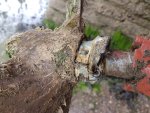
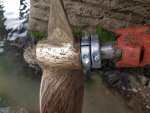
I would like to ask for a comment on my prop shaft anodes - pictured below, before and after replacement a few days ago. They came to this state in less than 4 months on a swinging mooring, nowhere near a marina or any AC power. The width of the anode is 15mm. Shaft 30mm. Is this amount of corrosion excessive?

There are no other anodes on the boat. Shaft has a flexible coupling. Electrics are fairly simple & frugal on the boat, a Rival 34 built 1977. Original prop I suspect.

Last year I had one anode on the shaft and it had fallen off before I had the chance to inspect it around this time halfway through the season.

Thanks

20180727_125655-1008x756.jpg
20180727_132213-1008x756.jpg
 
That looks like a lot of anode erosion in just 4 months. If you have no shore power etc I can't think why it would be that bad, other than an unhappy match of prop material and stainless shaft but that seems very unlikely. I assume that there is not supposed to be an isolated prop hub? It doesn't look like it.

I think I would test the resistance of the shaft to see whether there is any connection with the engine or gearbox on the engine side of the coupling. If there is no connection, and I guess that there won't be, then I'm bereft of ideas other than fitting a larger volume of zinc. :confused:

Richard
 
There seems to be no sign of dezincification on the prop so the anode is doing its job. However, i don't think this is the original set up and suspect what has happened is the flexible coupling has been added and the shaft pushed back. The overhang of shaft aft of the bearing is far too much and would never have been made like that, neither would there have been shaft anodes.

The shaft anodes are far too small - that is why they are eroding so quickly. Normally this set up would have a large hull mounted pear anode which would be roughly twice the weight of your current anodes, bonded to the shaft through the gearbox and a bridge over the flexible coupling. Such an anode would probably last two seasons.

Suggest you remove the shaft and have it shortened so that there is only 20 mm of shaft showing (unless you intend fitting a Stripper which would require more space, but not as much as you have now) and fit a hull anode. That would take it back to how it was originally.
 
I would like to ask for a comment on my prop shaft anodes - pictured below, before and after replacement a few days ago. They came to this state in less than 4 months on a swinging mooring, nowhere near a marina or any AC power. The width of the anode is 15mm. Shaft 30mm. Is this amount of corrosion excessive?

There are no other anodes on the boat. Shaft has a flexible coupling. Electrics are fairly simple & frugal on the boat, a Rival 34 built 1977. Original prop I suspect.

Last year I had one anode on the shaft and it had fallen off before I had the chance to inspect it around this time halfway through the season.

Thanks

Are you sure that they are zinc. Not fitted magnesium ones by mistake ?
 
thanks for the advice RichardS, VicS and Tranona. They are zinc anodes.

The suggestion that the shaft was not shortened when the flexible coupling was installed is very plausible indeed & the recommendation to shorten the shaft now and fit a hull anode makes sense. It looks like the shaft could be shortened by 30mm and still leave enough space for water to enter the bearing.

However given the hassle and expense involved I don't mind continuing with a mid-season dry out each year (for free alongside the pier) and anode replacement, as long as the current arrangement is not detrimental to propellor performance, ie speed in forward gear. Steering seems fine (again talking about forward gear only... until I change the prop to a non-fixed type I am not concerned with performance in reverse).

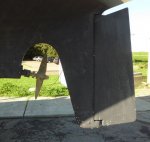
Here is a pic of the prop - taken when the boat lived in freshwater (Den Oever, NL) and the shaft anode was not being consumed.
Is the gap between the rudder and prop sufficient do you think, or is there any performance benefit to be obtained by shortening the shaft?

Thanks

prop.JPG
 
Top