Angelo Lavranos Holiday 34 / L34 by Robertson (SA) - Rusty Keel Bolts...?

SonicArmin

Member
Joined
1 Jan 2020
Messages
32
Location
Tel Aviv
Visit site
And yet another potential bride has appeared on my radar, a Holiday 34, the cruising version of the L34 racer, which was built in South Africa in 1990. There is little to no information out there - anybody here knows something about this type? I would kill for drawings, you'll see why in a minute...

The specific boat is has been used as a live aboard for 4 years, and has not seen any sailing action - what a crime. There is a lot of work to be done to get her back to life, but what concerns me the most are the nuts on the most forward two keel bolts, which are located in the shower bilge, have corroded to a level that I was able to crumble them into pieces with my bare hands. Now, I have to say I am not even sure those are keel bolts - who would put keel bolts into a section of the bilge that is wet continuously by design (without glassing them over, say)? Also, the other bolts looks somewhat different, they are staggered while the two most forward bolts are at the same position across from each other. The others need some TLC but look salvageable. I have no idea what those bolts could be other than keel bolts, so a drawing would be extremely helpful.

Assuming those rusty chunks of metal are really the most forward keel bolts - I wonder how difficult/risky it is to pull those and replace them - there is nothing left to hold on to, for starters. I guess one would have to drill into them, cut a left handed threat and screw a bolt that allows to put some torque on whatever is left and screw it out - is that the way to do it?
 
Angelo Lavranos designed my boat and I have had contact with Angelo and was very helpful by E-Mail

Lavranos Yacht Design

There are a number of L34 and H 34 in Durban and can contact the owner when the lockdown is over.

Durban Marina will know the owners but will not give you their contact details but will give your details to the owners so they can contact you if they wish.

Try contacting angelo first.
 
And yet another potential bride has appeared on my radar, a Holiday 34, the cruising version of the L34 racer, which was built in South Africa in 1990. There is little to no information out there - anybody here knows something about this type? I would kill for drawings, you'll see why in a minute...

The specific boat is has been used as a live aboard for 4 years, and has not seen any sailing action - what a crime. There is a lot of work to be done to get her back to life, but what concerns me the most are the nuts on the most forward two keel bolts, which are located in the shower bilge, have corroded to a level that I was able to crumble them into pieces with my bare hands. Now, I have to say I am not even sure those are keel bolts - who would put keel bolts into a section of the bilge that is wet continuously by design (without glassing them over, say)? Also, the other bolts looks somewhat different, they are staggered while the two most forward bolts are at the same position across from each other. The others need some TLC but look salvageable. I have no idea what those bolts could be other than keel bolts, so a drawing would be extremely helpful.

Assuming those rusty chunks of metal are really the most forward keel bolts - I wonder how difficult/risky it is to pull those and replace them - there is nothing left to hold on to, for starters. I guess one would have to drill into them, cut a left handed threat and screw a bolt that allows to put some torque on whatever is left and screw it out - is that the way to do it?
As others on here have found out, the rusty nuts and washers are just cosmetic, they remove bolts to find them pristine, remove the rust with a hammer and wire brush, convert the rust with a proprietary product and paint them. The keel bolt worries stem from the days of wooden boats where they would waist and rot. AWBs are much less prone to this
 
Angelo Lavranos designed my boat and I have had contact with Angelo and was very helpful by E-Mail

Lavranos Yacht Design

There are a number of L34 and H 34 in Durban and can contact the owner when the lockdown is over.

Durban Marina will know the owners but will not give you their contact details but will give your details to the owners so they can contact you if they wish.

Try contacting angelo first.
Thanks, I will try that first. Much appreciated!
 
As others on here have found out, the rusty nuts and washers are just cosmetic, they remove bolts to find them pristine, remove the rust with a hammer and wire brush, convert the rust with a proprietary product and paint them. The keel bolt worries stem from the days of wooden boats where they would waist and rot. AWBs are much less prone to this
I was going to post the same but it appears from the OP that the studs are heavily corroded also. He seems to be saying that they are corroded so badly that he cannot attach anything to them. There is clearly doubt in his mind whether they are actually keel bolts anyway. Seem that more investigation is required.
 
Discovery Sailing Project runs a Holiday 34 "Alexander Fairey" on behalf of the Alexander Fairey Memorial trust. She used to be called Paloma, and was used as a school boat on the East coast. The keel is a 1.5 m draft wing type in steel / cast iron, and because of this she is a fairly tender boat. The top of the keel has a sort of flange, with around a dozen tapped holes down either side. Therefore there are 2 rows of keel bolts, which go through the hull, with substantial backing washers, and into these tapped holes. The bolts themselves are not big - around M16 size, say 100 mm long (I'm going off memory here, and they could well be imperial) but as there are 2 doz of them, they have done the job since 1989. We replaced them all a few years ago, at the request of our surveyor, but I can't remember all the details. I seem to recall the new bolts were quite high strength mild steel, and they do rust, particularly those in the heads, where the keel stepped mast sits, regularly introducing water to the bilge. We pull a couple out each year, when she is on the hard, and they have always been in good condition since replacement.
 
I was going to post the same but it appears from the OP that the studs are heavily corroded also. He seems to be saying that they are corroded so badly that he cannot attach anything to them. There is clearly doubt in his mind whether they are actually keel bolts anyway. Seem that more investigation is required.

Spot on. In the meantime I found some low resolution pictures of the underwater hull, and judging the position of the suspicious bolts relative to the mast and the keel I have to conclude that those are indeed the most forward keel bolts. And yes, the studs are badly corroded, the threads are all but gone. I have no clear concept how to get them out. Other than drilling and threading like I described in the OP (for which I would have to find left handed thread cutting tools..) I thought that maybe I can weld nuts onto the studs and then unscrew the resulting contraption. And then it occurred to me that even if there were nuts and threads, I would still not know how to get to bolts out of the keel, but that is something I can look up elsewhere...
 
Discovery Sailing Project runs a Holiday 34 "Alexander Fairey" on behalf of the Alexander Fairey Memorial trust. She used to be called Paloma, and was used as a school boat on the East coast. The keel is a 1.5 m draft wing type in steel / cast iron, and because of this she is a fairly tender boat. The top of the keel has a sort of flange, with around a dozen tapped holes down either side. Therefore there are 2 rows of keel bolts, which go through the hull, with substantial backing washers, and into these tapped holes. The bolts themselves are not big - around M16 size, say 100 mm long (I'm going off memory here, and they could well be imperial) but as there are 2 doz of them, they have done the job since 1989. We replaced them all a few years ago, at the request of our surveyor, but I can't remember all the details. I seem to recall the new bolts were quite high strength mild steel, and they do rust, particularly those in the heads, where the keel stepped mast sits, regularly introducing water to the bilge. We pull a couple out each year, when she is on the hard, and they have always been in good condition since replacement.
Thanks, great help! So the sad, rusty objects in the heads bilge are indeed the most forward keel bolts (although there may one more pair in the forward cabin bilge, just a bit forward of the mast step, I may have missed those looking around the boat). With all the others I have seen looking sort of okay would you say it’s safe to wait for the next time she goes onto the hard anyway before addressing these two? Or are two bolts not taking any weight an emergency to be dealt with before any serious sailing takes place?
Unrelated: What do you mean by “tender”? English not being my mother tongue I’m thinking steaks or women relate to tenderness, but a yacht? Just kidding, please tell me more about the Holiday 34!
 
By tender I mean she tends to heel over easily, and therefore benefits from being reefed early. Ours has a conventional slab reefed main, with 3 reefs, and the third reef is used. She does go well in light airs though. She is an excellent boat for what we want, (teaching Day Skip and Comp Crew courses, and chartering her out to members coming up through the Project, so they can get experience of being in command of a yacht, and the experience needed for YM exams). She handles predictably in reverse, and has a bit of prop walk, enough so students get the idea, but not too much that you can't work against it. She is officially 8 berth, and coded as such, but is too crowded with more than 6 on board. Easily sailed by a couple though. Biggest down side is the mast in the middle of the heads, making access for the salad dodgers difficult, oh and the keel stepped mast meaning there's often water in the bilge.

Note from your reply to Vyv, they are all conventional right hand thread bolts (not studs and nuts, and no LH threads).

The bolts in the heads are the furthest forward, there are none in the forecabin. I can't comment on your desire to use her with obviously weakened keel bolts, as I'm not a surveyor, and haven't seen it...
 
Spot on. In the meantime I found some low resolution pictures of the underwater hull, and judging the position of the suspicious bolts relative to the mast and the keel I have to conclude that those are indeed the most forward keel bolts. And yes, the studs are badly corroded, the threads are all but gone. I have no clear concept how to get them out. Other than drilling and threading like I described in the OP (for which I would have to find left handed thread cutting tools..) I thought that maybe I can weld nuts onto the studs and then unscrew the resulting contraption. And then it occurred to me that even if there were nuts and threads, I would still not know how to get to bolts out of the keel, but that is something I can look up elsewhere...
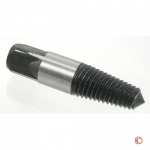
The conventional way to extract bolts like these is to drill down their centres and use an extractor, Easy-out type, which are left hand threaded for the purpose. As in the picture. 1587285340664.pngHowever, I see from Kwik Decision's posts that they are M16 steel bolts, which means they will be hardened, maybe 8.8 grade. Not easy to drill and likely to be well rusted into the keel, so this will not be easy. For much the same reason it will be difficult/impossible to make a sound weld to rusty, medium carbon steel bolts.

As I said earlier, it may well be that dropping the keel will be the better solution. Once rebedded using new bolts it will be sound for many years.
 
By tender I mean she tends to heel over easily, and therefore benefits from being reefed early. Ours has a conventional slab reefed main, with 3 reefs, and the third reef is used. She does go well in light airs though. She is an excellent boat for what we want, (teaching Day Skip and Comp Crew courses, and chartering her out to members coming up through the Project, so they can get experience of being in command of a yacht, and the experience needed for YM exams). She handles predictably in reverse, and has a bit of prop walk, enough so students get the idea, but not too much that you can't work against it. She is officially 8 berth, and coded as such, but is too crowded with more than 6 on board. Easily sailed by a couple though. Biggest down side is the mast in the middle of the heads, making access for the salad dodgers difficult, oh and the keel stepped mast meaning there's often water in the bilge.

Note from your reply to Vyv, they are all conventional right hand thread bolts (not studs and nuts, and no LH threads).

The bolts in the heads are the furthest forward, there are none in the forecabin. I can't comment on your desire to use her with obviously weakened keel bolts, as I'm not a surveyor, and haven't seen it...
Thanks. Tender vs stiff, I get it now. I was intrigued by the descriptions of the seaworthiness of the L34, a serious offshore racer for every weather, and assumed the cruising version would be the same, just a bit tamer. Your description makes me wonder if perhaps that view is too romantic and the changes impact the seaworthiness negatively. Would you call her a safe offshore boat? Can she heave to properly, for example?
 
The conventional way to extract bolts like these is to drill down their centres and use an extractor, Easy-out type, which are left hand threaded for the purpose. As in the picture. View attachment 88702However, I see from Kwik Decision's posts that they are M16 steel bolts, which means they will be hardened, maybe 8.8 grade. Not easy to drill and likely to be well rusted into the keel, so this will not be easy. For much the same reason it will be difficult/impossible to make a sound weld to rusty, medium carbon steel bolts.

As I said earlier, it may well be that dropping the keel will be the better solution. Once rebedded using new bolts it will be sound for many years.
Ha, I’m slowly getting there. Happy to see that there is such a thing as the “Easy Out”. When the Corona lockdown allows it I’ll go back to the boat and have a good look at the situation. With the knowledge gained here I’ll be better prepared to understand how severe is the problem. Thanks for your help!
 
Thanks. Tender vs stiff, I get it now. I was intrigued by the descriptions of the seaworthiness of the L34, a serious offshore racer for every weather, and assumed the cruising version would be the same, just a bit tamer. Your description makes me wonder if perhaps that view is too romantic and the changes impact the seaworthiness negatively. Would you call her a safe offshore boat? Can she heave to properly, for example?
Ours was sailed from S Africa to the UK, back in the 90s I think, so they are reasonably seaworthy. She will certainly heave to without problems.
 
My readi
I was going to post the same but it appears from the OP that the studs are heavily corroded also. He seems to be saying that they are corroded so badly that he cannot attach anything to them. There is clearly doubt in his mind whether they are actually keel bolts anyway. Seem that more investigation is required.
ng of it was that the nuts were covered in crumbly rust, something we have all seen, chipped off and all ok?
 
Ha, I’m slowly getting there. Happy to see that there is such a thing as the “Easy Out”. When the Corona lockdown allows it I’ll go back to the boat and have a good look at the situation. With the knowledge gained here I’ll be better prepared to understand how severe is the problem. Thanks for your help!
Be very careful with those, if they break then you are in serious trouble,
 
I looked at them only once during the first walk through of the boat. I didn’t take pictures (stupid) but remember that I was able to crumble what would be the head of the bolts (or the nut if those were studs after all) with my hands to a level that connecting a wrench seemed impossible. Again, post Corona I’ll view the boat again and this time I’m ready to determine what I am looking at and if there is enough healthy metal left to work with, or if I really would have to drop the keel. I’ll keep you updated. Thank you all!
 
Top