
Andersen ST58 winches

Caladh

Well-Known Member
Joined
25 Oct 2009
Messages
1,541
Location
Out there again and no longer dreaming
Visit site
I have said items and have been servicing them. There are two bearings and the smaller one easily came apart, the roller bearing and pawls easily serviced. However the large pawl gear bearing pictured below is foxing me. I removed the circlip expecting the 2 parts to come apart. They came adrift a little to let me see what looked like a ball race rather than roller bearings which is what I expected. I didn't want ball bearings flying all over the cockpit so have come here for advice! The Andersen manual for these is not very explicit in what I'm meant to see and the service instructions say - remove the bearing and grease as necessary. The winches date from 1996 and the online manual is for the Mark IV version of the winch.

Instructions here - :
9. Remove and dismantle the two gear units (17), (18). (the exploded diagram for item 18 is not particularly helpful!!)
10. Clean all parts in white spirits/mineral spirits. Remember to clean the gear teeth and ball track inside the drum (4).
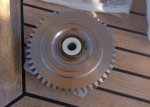
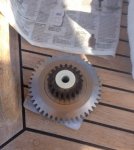
IMG_3683a.JPGIMG_3684a.JPG
 
Hello
Two questions:
1) What do your two photographs show ?
2) Does your concern refer to the component that is labelled No. 18 in the Andersen ST58 Product Manual ?
 
I have Anderen winches and service them about every 2 years. The part you show does come apart, and balls drop out(1) so do it in a big Tupperware container. When re-assembling you have to somehow contrive to keep the right number in place: sticky grease and patience works, but rather more often than I care to admit I get it all together again and then discover a 'spare' ball at the bottom of the Tupperware box.

(1) A very annoying peculiarity of Andersens is that every model is made to a completely different design and indeed principle of operation. Only the big sheet-winches have the loose balls.
 
I have Anderen winches and service them about every 2 years. The part you show does come apart, and balls drop out(1) so do it in a big Tupperware container. When re-assembling you have to somehow contrive to keep the right number in place: sticky grease and patience works, but rather more often than I care to admit I get it all together again and then discover a 'spare' ball at the bottom of the Tupperware box.

(1) A very annoying peculiarity of Andersens is that every model is made to a completely different design and indeed principle of operation. Only the big sheet-winches have the loose balls.
JDC thanks very much. At least I know what to expect now.
 
I have Anderen winches and service them about every 2 years. The part you show does come apart, and balls drop out(1) so do it in a big Tupperware container. When re-assembling you have to somehow contrive to keep the right number in place: sticky grease and patience works, but rather more often than I care to admit I get it all together again and then discover a 'spare' ball at the bottom of the Tupperware box.

(1) A very annoying peculiarity of Andersens is that every model is made to a completely different design and indeed principle of operation. Only the big sheet-winches have the loose balls.
JDC, I am sorry but this cannot possibly be true. There is only one principle of operation for a winch: mechanical advantage derived from a gear system and a lever arm. There may be a few changes in the detailed design but it is incorrect to state, and confusing for anyone faced with servicing one for the first time, that every model is made to a completely different design and indeed principle of operation.
 
JDC, I am sorry but this cannot possibly be true. There is only one principle of operation for a winch: mechanical advantage derived from a gear system and a lever arm. There may be a few changes in the detailed design but it is incorrect to state, and confusing for anyone faced with servicing one for the first time, that every model is made to a completely different design and indeed principle of operation.
I suppose I overstated 'principle of operation' as of course it's gears and pawls all of them as you correctly point out. But the details of the insides of the Andersen winches are very different, so having taken one apart, one starts in on another model with confidence only to find that the procedure just established is wrong for this new one.
 
Top