Anchor Windlass Electrical Connections

[70521]

Well-Known Member
Joined
31 Aug 2011
Messages
22,412
Visit site
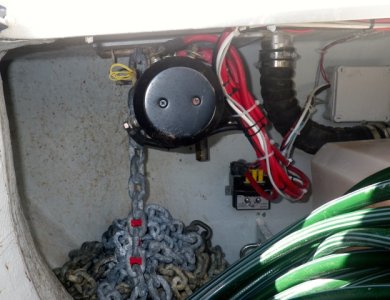
I’ve had to replace the electrical anchor windlass. On removing the old one a previous owned had done a good job and the electrical wiring was what I would describe as ‘semi-permanent’, which I consider a contributory factor to the demise of the old windlass.

Can anybody suggest a waterproof electrical connector, it will be living in the anchor locker at the pointy end, suitable for 8mm2 or AWG 8 wiring to join the power leads.
 
Probably best to make connections inside a a IP 55 or 65 box with cables passing in via grommets. You will probably have to add the grommets and add some additional sealing with Sikaflex or similar.
 
Probably best to make connections inside a a IP 55 or 65 box with cables passing in via grommets. You will probably have to add the grommets and add some additional sealing with Sikaflex or similar.
I had that arrangement at the bottom of the mast for years and it worked well.
 
Probably best to make connections inside a a IP 55 or 65 box with cables passing in via grommets. You will probably have to add the grommets and add some additional sealing with Sikaflex or similar.
Thanks @Fr J Hackett.

Not sure that the sealant would make disassembly easy, but it has given me something to work with.
 
Tie a line to the tripping point, and a cable tie it in parrallel with the chain.

If needed, pulling hard enough will burst the ties leaving it pulling on the tripping point.

Might not run easily through the gysy though.
 
Why introduce another connection? I have just fitted a replacement windlass and the old cables were more than ready for replacement. Run new cables from windlass to solenoid/reversing contactor which will be much better placed for water free connection
 
I would suggest a Wiska IP66/67 206/308/407 junction box with glands.

Joining 8mm2/8AWG is likely to need crimping a pin connector. What Amps rating are you looking for?

Is it 8mm2 or 8AWG (which is nearer 10mm2)?
 
A bit of silicone tape of the self amalgamating type can be good to help seal entry and exit points if you have one of the junction boxes that has a slight flange. The other think is to put a bind in the wire so as any moisture will run away from the box and drip off a low point. Any gland/grommet is hard to do with large cable as the force the cable imparts tends to deform things so a patch up job with the tape and sealant after the event, although less pretty, can be the best route. Alternatively buy very expensive and sturdy junction box.
 
... Can anybody suggest a waterproof electrical connector, it will be living in the anchor locker at the pointy end, suitable for 8mm2 or AWG 8 wiring to join the power leads.
Do you mean a connection to a devise or terminal strip, or do you mean a splice? Not clear.

Splice is easy. Crimp and heat shrink.

If you mean a connector...
a. At the windless end (yup, I seen them there) use lots of waterproof grease and figure on maintaining this.
b. The contactor should not be in a damp place, so move it. They can get warm, so a small waterproof box might not be good. It needs some air.
c. If there is a terminal strip move it. Or replace it with a splice.
If the breaker is internal with the contactor (common) this obviously needs to be accessible in the cabin.
 
Here is the problem.

New windlass has about 200 mm AWG 8 wire. Old windlass had a horrendous connection to battery wires. I'm looking for an elegant connector that I can undo once in a while for servicing and painting the chain locker.

One option might be opening up the windlass and replacing the piddely short AWG wire runs with something longer and replacing the battery cables with AWG 8 allowing for an easier connection.
 
Here is the problem.

New windlass has about 200 mm AWG 8 wire. Old windlass had a horrendous connection to battery wires. I'm looking for an elegant connector that I can undo once in a while for servicing and painting the chain locker.

One option might be opening up the windlass and replacing the piddely short AWG wire runs with something longer and replacing the battery cables with AWG 8 allowing for an easier connection.

One of my pet peeves is how everything these days comes with a piddly length of cable that requires an external connection. Even things like berth lights. I do a lot of taking things apart and connecting the cables directly.
 
The answer is obvious enough, for me. Splice the cables and then paint around them. It's an anchor locker, not a church.

And yes, longer cables would be nice. You paid enough for the windlass and it's not as though it was going to be in a dry place.
 
I think you are being ultra cautious. The motor that drives the windlass will be attached to the windlass and as you retrieve the motor will be splashed with salt and sometimes muddy water. The motor has holes in the, mild steel, thinly painted casing, for cooling, and water enters the motor - are you going to better isolate the motor and protect the casing from corrosion. If you are leaving the motor as is - then it will still be more susceptible to corrosion than cable joints (careful located) and torqued up hard and then sprayed. You obviously want to minimise the cable joints (and/or splice as Thinwater suggests) - but the motor remains the weak link.

With a new windlass I'd be careful with cable joints which you can locate high up and as far away from the wet chain - but I would have much greater focus on protecting the motor than so far implied. For one I'd paint the motor with the sort of stuff they used to sell to protect the underside of cars from salt spray. I might also add a baffle to protect the motor from salt spray.

This one is a really awful installation. The chain actual runs over the casing of the motor. But if you look carefully the chain splashes the side of the locker to the left and the motor casing is much closer to the fall of the chain than the locker side. I don't see the life of this motor being very long. Most modern windlass allow the motor to be located at any angle to the windlass though this might make for a more inconvenient installation - there is a balance from the one off installation and how long you desire the motor to last.

A bit of drift - the chain exhibits white rust (the galvanising is dissolving), it would benefit from washing with fresh water and then allowed to air (to dry it as much as possible)

IMGP5145.jpeg
 
The answer is obvious enough, for me. Splice the cables and then paint around them. It's an anchor locker, not a church.
That would make painting the surface that the windlass is attached to difficult. I am trying to make maintenance easier as I get older.
 
I think you are being ultra cautious. The motor that drives the windlass will be attached to the windlass and as you retrieve the motor will be splashed with salt and sometimes muddy water.
The motor is protected by the mount it sits in, it is just the wiring that needs to be protected from water and mud.

The more I look at this the more I see the old job at a real botch. It could have been done so much better.
 
Windlass should be serviced annually - though one might think a service schedule should be related, at least in part, to usage. The key 'failure' components are: shaft, gearbox and wiring (though there is not much else that can wrong).

My conclusion on windlass installation is - its conducted at the convenience of the person installing - who has no consideration for its usage nor service.

I increasingly think installation is a responsibility given to the apprentice - who have not reached the learning programme to have heard of stainless/aluminium corrosion and certainly have never heard of Duralac.

Jonathan
 
Top