
Anchor riding sail?

Is not an alternative method to stabilize the boat, to lead a line from the anchor rode to an aft quarter cleat and pull the boat so it lays 10 -15 degrees off the wind. The downsides to this would be increased heel and increased load on the anchor rode but very easy to implement maybe in conjunction with a snubber line too!
The real benefit of using a riding sail comes when anchored in heavy winds, say F8 and above. In these conditions you really want to have the boat pointing into the wind as much as possible.
 
Is not an alternative method to stabilize the boat, to lead a line from the anchor rode to an aft quarter cleat and pull the boat so it lays 10 -15 degrees off the wind. The downsides to this would be increased heel and increased load on the anchor rode but very easy to implement maybe in conjunction with a snubber line too!
I think your right in winds up to perhaps 30kts maybe but deffo a valid point. I’ve done this for aligning bow or stern to the swell
 
Great feedback. When the wind gets to that strength that exactly when you’re glad you’re sitting straight and no snatching around.

One thing I did find helps, was a trick a challenge that worked with boreal found... that was to attached a small single cone drogue to the anchor chain and lower it just under the water. As the boat beers off and wants to snatch back in a gust the drogue slows everything down and you don’t get that sharp pull in the anchor.

Perhaps with a decent anchor sail its a redundant method.

Hi. How much cloth or sail size do you have. I have a 41ft boat and trying to get one made just unsure of size.?

Apologies for the delay in this reply.

I think even a small riding sail V-sail will help. The further aft the better of course. And if the vee of the sail sets with the two wings 70+ degrees apart that helps too.

On a trad 38 foot displacement boat, a sail with approx 3 metre luff, 1.2 metre foot and 3.7 metre leech worked fine. We spread the clews with a boathook in use. That's the sail, and boat, that amazed me in a storm 10.

On a Southerly 110, the boat in the picture, we have a bigger sail, (3.8, 1.3, 4.4 ish). This boat has less keel, much more windage and yaws more at anchor so I wanted more effect from the riding sail. That's the boat in the picture, and that sail reduces a 60-70 degree swing to about 20 degrees in F6. The sail is deliberately tall to get up into the wind. No experience in stronger winds on the new boat other than that in general, if your sail reduces yaw, the effect is greater the stronger the wind.

The canvas is strong, like a storm jib. We had them made by sailmakers to dimensions we determined by making string mock ups. I think many shapes of vee will work and much should be governed by where your attachments will be for the luff and the clews. The luff is hauled up very tight - it is the leading edge of the vee. It needs a strong anchor point, (or two, one each side of the deck). The sheets go to the quarters, as wide as possible, and the clews can be spread to help keep the vee splayed. We used a boathook on the old boat, and a custom made pole on the new boat which has a much wider transom. The whole thing looks improbable, but as you hoist the luff it settles down, and then tightening the sheets and it all goes quiet. The sail bends and sways a bit in use of course.
 
Apologies for the delay in this reply.

I think even a small riding sail V-sail will help. The further aft the better of course. And if the vee of the sail sets with the two wings 70+ degrees apart that helps too.

On a trad 38 foot displacement boat, a sail with approx 3 metre luff, 1.2 metre foot and 3.7 metre leech worked fine. We spread the clews with a boathook in use. That's the sail, and boat, that amazed me in a storm 10.

On a Southerly 110, the boat in the picture, we have a bigger sail, (3.8, 1.3, 4.4 ish). This boat has less keel, much more windage and yaws more at anchor so I wanted more effect from the riding sail. That's the boat in the picture, and that sail reduces a 60-70 degree swing to about 20 degrees in F6. The sail is deliberately tall to get up into the wind. No experience in stronger winds on the new boat other than that in general, if your sail reduces yaw, the effect is greater the stronger the wind.

The canvas is strong, like a storm jib. We had them made by sailmakers to dimensions we determined by making string mock ups. I think many shapes of vee will work and much should be governed by where your attachments will be for the luff and the clews. The luff is hauled up very tight - it is the leading edge of the vee. It needs a strong anchor point, (or two, one each side of the deck). The sheets go to the quarters, as wide as possible, and the clews can be spread to help keep the vee splayed. We used a boathook on the old boat, and a custom made pole on the new boat which has a much wider transom. The whole thing looks improbable, but as you hoist the luff it settles down, and then tightening the sheets and it all goes quiet. The sail bends and sways a bit in use of course.
Thank you very much ?
 
Err - what picture?

No need for the picture, I like the idea of a custom made pole, but I prefer as many items to be dual use - so maybe a custom made boathook/pole

We are being tempted to try and make one.

Our major problem is that we are a cat, the boom is very high and the transoms were never built to be load bearing. I find difficulty in conjouring up where we can sheet the clews. My current answer is a boom for the foot of each half of the riding sail (I'm sure a boom on the foot has a name - but I'm too young to know) fix the riding sail booms to the end of the main sail boom and then the sheets from the clews can pass forward rather than conventionally aft using the boathook/pole to stop the two booms pulling apart (if that makes sense :) ). We could hoist up the topping lift with the main halyard.
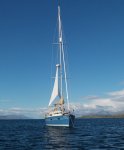
Jonathan
 
Err - what picture?

No need for the picture, I like the idea of a custom made pole, but I prefer as many items to be dual use - so maybe a custom made boathook/pole

We are being tempted to try and make one.

Our major problem is that we are a cat, the boom is very high and the transoms were never built to be load bearing. I find difficulty in conjouring up where we can sheet the clews. My current answer is a boom for the foot of each half of the riding sail (I'm sure a boom on the foot has a name - but I'm too young to know) fix the riding sail booms to the end of the main sail boom and then the sheets from the clews can pass forward rather than conventionally aft using the boathook/pole to stop the two booms pulling apart (if that makes sense :) ). We could hoist up the topping lift with the main halyard.
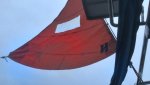
Jonathan


does a cat really slew around at anchor?
 
does a cat really slew around at anchor?

Yes (and no)

We have a series of ocean anchorages, off the Tasman Sea, that are very large bays with low lying land offering shelter from southerly winds (where our fronts come from). The low lying land causes wind shear and it is the shear that causes the yawing. The winds might be typically 35 knots and that's what we would measure at the masthead. There would be little or no chop, we can get close to shore - so there is no fetch. Our practice has always been to deploy 2 anchors in a 'v' - which might be the best practice. We can deploy 2 anchors from the deck - by marking the deployment of the primary, setting it and then motoring to set the second anchor at a position chosen on the chart plotter. We would try to judge the shear such that each anchor was covering , not quite, the 2 extremes of the shear. We obviously use a bridle on the primary anchor, the second anchor is simply chain and a nylon rode..

I like to consider all the options and have been mulling over a riding sail for some time - years. I have no idea if it would offer any advantage. If I can rig one - I'd try it.

We also encounter a similar problem in very tight anchorages when winds might funnel through different valleys ofrgaps in the trees - we commonly solve this with shore lines and 2 anchors off the bow.

Jonathan
 
I'll add to my previous post No 27

I was conducting some anchor rode load tests in which I simply anchored in the lee of some protection and I measured rode snatch loads as the sea breeze filled in. I started measuring at wind speeds of 5 knots from around 11am and worked up to 35 knots at about 4pm. The development of the seabreeze is accurately predicted, though there might be errors in the maximum winds predicted. The weather is usually good, warm blue skies etc.

The data is defined in this article:

Anchor Testing and Rode Loads | Practical Sailor

I measured wind speed gust and maximum load at different scopes. I also measured rode angle and cat bearing angle (because they are different) as I ascertained, as you would expect, that maximum snatch loads were a function of yawing.

I did the testing over a series of days, anchoring at the same (or adjacent) location and using a different scope each day. The location is only about 30 minutes from our mooring. I did not conduct the testing at, or near, our mooring - because depth at out mooring is 10m.

The yawing was caused by anchoring in the lee of 'shelter' around which the Seabreeze would gust, first one side, then the other. If I had used an elastic bridle the snatch loads would have been lower - I was looking for extremes. I was defining what happened if you did not use a bridle, or snubber.

If you watch the introduction to Home and Away - the location was in the sheltered water , not the ocean (or Tasman Sea) side 'behind' the hill on which the light house sits. I could have moved closer to the lighthouse - but then I would not have had any snatch loads to measure. The rode was short and I was, intentionally, using a dyneema bridle. I was only using one anchor. Despite the loads measured the anchor simply dug in more and more deeply and an unanticpated problem (to which I became used) was the difficulty of anchor retrieval. Its amazing how confident you become of your ground tackle if you stress it under controlled circumstances. I marked the anchor location with a dumbbell and buoy - to make sure the anchor did not move and I was measuring 'true' loads.

Jonathan
 
EB882144-5EBC-4697-B04C-CA74E1F5D694.jpeg
So as a matter of feedback I made the riding sail from the squib sail and tested it in the Scilly Isles on Monday night when the Center of the big depression passed right overhead. We had 35 kts from the SE and then a dead calm for about an hour and a bombshell of NE 50kts for about 2 hours.

Numerous boats dragged including the one next to us and shot passed dragging. Another went into the rocks.

Anyway the riding sail was not ideally cut. I did it as best I could with a dyneema line up the puff and as flat as I could but it was still baggy.

Even so... without it we sailed about and snatched around as most other boats were doing. With it we held dead straight. It was awesome!

Am unsure if it contributed to our success of not dragging when lots of others did since we have an excellent Spade, 8:1 scope, a good long snubber and we removed the head sails. More importantly I made sure we reset the anchor when the wind shifted before the big 50ft front hit.

Either way With the success of this riding sail I’m gonna get a V style made as it really did made riding out a big Gale way less stressful!
 
View attachment 118464
So as a matter of feedback I made the riding sail from the squib sail and tested it in the Scilly Isles on Monday night when the Center of the big depression passed right overhead. We had 35 kts from the SE and then a dead calm for about an hour and a bombshell of NE 50kts for about 2 hours.

Numerous boats dragged including the one next to us and shot passed dragging. Another went into the rocks.

Anyway the riding sail was not ideally cut. I did it as best I could with a dyneema line up the puff and as flat as I could but it was still baggy.

Even so... without it we sailed about and snatched around as most other boats were doing. With it we held dead straight. It was awesome!

Am unsure if it contributed to our success of not dragging when lots of others did since we have an excellent Spade, 8:1 scope, a good long snubber and we removed the head sails. More importantly I made sure we reset the anchor when the wind shifted before the big 50ft front hit.

Either way With the success of this riding sail I’m gonna get a V style made as it really did made riding out a big Gale way less stressful!

I'm impressed that you removed the headsails. They are devil to handle to pack up such that you can either lash them flat to the deck or get down below. We have done what you did - its so much easier if you do it in anticipation :)

I'm also all for belt and braces and cannot fault your application. Its the problem with anchoring - you don't know which of the various options you are using contributes to your success (or failure) - what you know is that you got something or a number of things right. But when its blowing 50 knots you are not to go out on deck and release your snubber to see if things get better or worse and in your case you are certainly not going to take down the riding sail - and then put it back up.

The only option I might have employed would have been an anchor in a 'V' but that depends on having the room (and the anchor) and laying the anchors to suit the forecast

A measure of success for the anchor would be how difficult was it to retrieve - if the yacht was lying stable then I would expect the Spade to simply set more deeply - and thus be difficult to retrieve. Not so after 35 knots - because if you power set the engine might produce the equivalent tension to 30 knots (and 35 knots is not much more) but I'd expect 50 knots (on top of a power set equivalent to 30 knots) to make a real difference.

If its not an imposition, how long is your snubber, what diameter, size of yacht, size of chain (I forget) and size of Spade. If your snubber is good then the 8:1 should be unnecessary (I know easy to say - I was not there but tucked up in chilly Sydney).

But thank you for the feed back - invaluable

Jonathan
 
View attachment 118464
So as a matter of feedback I made the riding sail from the squib sail and tested it in the Scilly Isles on Monday night when the Center of the big depression passed right overhead. We had 35 kts from the SE and then a dead calm for about an hour and a bombshell of NE 50kts for about 2 hours.

Numerous boats dragged including the one next to us and shot passed dragging. Another went into the rocks.

Anyway the riding sail was not ideally cut. I did it as best I could with a dyneema line up the puff and as flat as I could but it was still baggy.

Even so... without it we sailed about and snatched around as most other boats were doing. With it we held dead straight. It was awesome!

Am unsure if it contributed to our success of not dragging when lots of others did since we have an excellent Spade, 8:1 scope, a good long snubber and we removed the head sails. More importantly I made sure we reset the anchor when the wind shifted before the big 50ft front hit.

Either way With the success of this riding sail I’m gonna get a V style made as it really did made riding out a big Gale way less stressful!
I was anchored abeam of you and was aware that we were coming and going as we sailed too and fro! A very impressive performance from your old squib sail. Our spade with a 6:1 scope and snubber was up to the job though and, like you, we didn’t budge measurably.
 
I was anchored abeam of you and was aware that we were coming and going as we sailed too and fro! A very impressive performance from your old squib sail. Our spade with a 6:1 scope and snubber was up to the job though and, like you, we didn’t budge measurably.

Viva la Spade!
 
Top