
Alternator Saver?

CaptainBob

Well-Known Member
Joined
7 Nov 2007
Messages
1,477
Location
North Yorkshire
www.yacht-forum.co.uk
Additional to my recent questions on battery wiring, I had a thought.

When you have a setup with engine, alternator, 2 batts and a 1-2-Both-Off switch, if when the engine is running and you switch the switch to OFF you can destroy the alternator. Wondered if by having additional wiring with diodes from alternator to the inputs of the 1-2-Both-Off switch you effectively solve the problem and make it impossible to kill the alternator while maintaining full usefulness of the switch?

Like this:
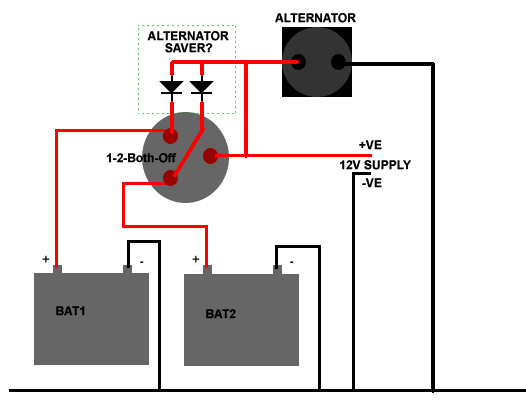
alternatorsaver.gif


??
 
When you have a setup with engine, alternator, 2 batts and a 1-2-Both-Off switch, if when the engine is running and you switch the switch to OFF you can destroy the alternator. Wondered if by having additional wiring with diodes from alternator to the inputs of the 1-2-Both-Off switch you effectively solve the problem and make it impossible to kill the alternator while maintaining full usefulness of the switch?
QUOTE]

First thought, if batt 1 is dead flat or shot, you select batt 2 on switch it has a circuit to batt 1 via diode.

In normal use it would act as a blocking diode charging the bank not connected, so you need to use a blocking diode for the diodes. The rotory switch will by-pass the diode on the bank used to give full alternator voltage..

Brian
 
Last edited:
Yes, I had a boat wired like that.
The problem is, you don't have full isolation of the battery.
Does that matter?

Probably not, except if the wiring to the diodes gets damaged or something.
 
With a split charge diode the alternator is always charging the battery that needs it the most, independent of the 1/2/both/off switch. I have one for sale :D
 
Additional to my recent questions on battery wiring, I had a thought.

When you have a setup with engine, alternator, 2 batts and a 1-2-Both-Off switch, if when the engine is running and you switch the switch to OFF you can destroy the alternator. Wondered if by having additional wiring with diodes from alternator to the inputs of the 1-2-Both-Off switch you effectively solve the problem and make it impossible to kill the alternator while maintaining full usefulness of the switch?

Like this:

alternatorsaver.gif


??

Well done, you've just re-invented the split charge diode!
 
The reason that alternators are 'destroyed' by disconnection whilst running, is that reverse-EMF spikes which are generated by the sudden collapse of the winding's flux-field have significantly higher voltages than the permissible ratings of the alternator's diode pack.

If a method of trouble-free disconnection is being sought, one obvious solution would be to fit 'spike-limiters' as close to the alternator's diode pack as possible. Metal Oxide Varistors, back-to back Zeners, that kind of thing.

Indeed, I can't help thinking that such protection really ought to be included during alternator manufacture. Would only add a few pennies to their cost.
 
Well not quite because I also have the wire to the output from the 12BO switch. Thus avoiding the voltage loss across the diodes to whichever batt(s) is/are selected.

This is true but you might be surprised at the voltage drop across the AB switch at high charging currents, especially if the switch contacts are a bit grotty.
0.01ohm resitance at 40amps is a 0.4 volt drop - around the same as a diode so you can't necessarily assume that any switch has zero resistance!

At least with the diodes you retain a charging path even if the AB switch goes open circuit.

Many of the AB switches I've come across are not particularly well made and a regular squirt of switch cleaner is a good idea, but how many owners just 'fit & forget'?
 
Top