Alternator question

mawm

Well-Known Member
Joined
24 Apr 2007
Messages
167
Location
Auckland
Visit site
A few years back I had my 27 amp alternator replaced with a 50 amp one plus smart charger. This worked extremely well with two 85 ah batteries used to run my auto-tiller, chart plotter/depth sounder, VHF, gas solenoid and various LED's around the boat. I have just finished repowering my boat with a Beta 20hp which came with a very small (in size) 40 amp alternator. There is no place to fit the 50 amp alternator.

The electrician who rewired it says I will burn out my alternator if it is connected to the smart charger. Is this true?
 
A few years back I had my 27 amp alternator replaced with a 50 amp one plus smart charger. This worked extremely well with two 85 ah batteries used to run my auto-tiller, chart plotter/depth sounder, VHF, gas solenoid and various LED's around the boat. I have just finished repowering my boat with a Beta 20hp which came with a very small (in size) 40 amp alternator. There is no place to fit the 50 amp alternator.

The electrician who rewired it says I will burn out my alternator if it is connected to the smart charger. Is this true?


When we replaced the original Mercedes OM636 42hp on a W33 that we owned way back (which had a standard 27A alternator) , with a new Volvo MD22L 50hp which is the same as a Perkins Prima, Perkins said they would not warranty the alternator if we kept our already installed TWC smart regulator. Volvo, however, said with their version of the same Perkins built engine that it would be covered by their warranty so we bought the green painted Volvo version, kept the TWC and it all worked just fine, probably still is for the present owners too.
 
Last edited:
Two things:
The smart charger just makes your alternator work better. It takes more power out of it normally but not such that it burns it out.
Secondly, the Beta 20hp can be supplied with an alternator upgrade (65A); I know because I have one. It is a tight fit against the cooling manifold and mine also has the serpentine belt system on it.
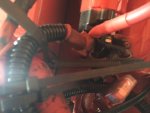
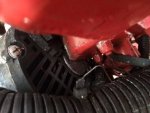
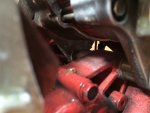
IMG_0473.jpgIMG_0474.JPGIMG_0475.jpgIMG_0476.JPG
1 shows the alternator side on and product no.
3 shows the back of alternator (black plastic) and proximity to manifold
4 shows front view of the mounting

I have the instructions somewhere for wiring the Beta (Iskra) alternator for an Adverc smart charger - pm me if you want them.
 
Thanks for the responses. It still doesn't tell me if putting in a smart charger (which is really a smart regulator, as pointed out by Robin) will burn out an alternator. Increasing the charging voltage reduces the current. I don't know what happens to the resistance in an alternator but if it stays the same then the changes are inversely proportional. Does having a higher voltage (it's only an increase from about 13.8 to 14.8V) really have such an impact?

Peocheng - I am aware that Beta supplies a larger output alternator - it is a 70 amp one now, but I was hoping to install my old 50 amp one so only ordered my engine with the 40 amp one and was caught short by how small their alternators are and how little space their is. Also all the free space on the port side is now taken up by my fridge compressor. Thanks for the offer of instructions, I think I'll go down to the agents for mine and talk to them.
 
Check out the manufacturer of the alternator. It won't be Beta. They will be able to tell you. Your alternator is likely to run hotter if you are forcing more amps out of it. My high output alternator is rated for a higher temperature rating than the trip temperature on my smart regulator. I actually disconnected the temperature function as it was tripping the smart alternator too regularly. We sail in the Caribbean where air temp is very high so our engine room can can get extremely hot.
 
Thanks for the responses. It still doesn't tell me if putting in a smart charger (which is really a smart regulator, as pointed out by Robin) will burn out an alternator. Increasing the charging voltage reduces the current. I don't know what happens to the resistance in an alternator but if it stays the same then the changes are inversely proportional. Does having a higher voltage (it's only an increase from about 13.8 to 14.8V) really have such an impact?

No, it doesn't. If you fit the smart regulator to the new alternator, it will definitely not "burn out" as your so-called electrician suggested. However, modern alternators have regulators set at a higher voltage than in olden days, and you may find that the new alternator is already putting out 14.4v or so, in which case there'll be a much smaller benefit from fitting the smart regulator. As you only have 2 x 85Ah batteries, I'd propose that you should try the system first and see how you get on.
 
pvb - Thanks for your reply. My so-called electrician was contracted by the mechanic and has left me with more problems than solutions including disconnecting my voltmeter from the house bank.

I'll take your advice and see how things go with the new alternator. The old 27 amp alternator was never enough but the 50 amp plus smart charger was more than adequate. Unfortunately I will have to wait for the NZ summer to test it out.
 
The '12 volt doctor' has a very good explanation about alternator function and how the output is boosted. Modern alternator controllers do what this book explains electronically.

Available here along with much other stuff www.motoren.ath.cx
 
I (always !) agree with PVB.
For reference, mine is a 2005 engine with the Iskra alternator in the picture (no doubt same make as yours) and the voltage at the battery is about 14.4v (cannot remember precisely) but enough that I am not rushing to fit the Adverc I already have. So PVB's point about the settings on modern alternators is a good one.
 
I (always !) agree with PVB.
For reference, mine is a 2005 engine with the Iskra alternator in the picture (no doubt same make as yours) and the voltage at the battery is about 14.4v (cannot remember precisely) but enough that I am not rushing to fit the Adverc I already have. So PVB's point about the settings on modern alternators is a good one.
this was yesterday after a night on my mooring, 60 ah paris rhone alternator + adverc
okXkmRe40Jcp5oI3dPg3PbuBkFICzP3KARTLH47LnT8w808-h454-no.jpg
 
this was yesterday after a night on my mooring, 60 ah paris rhone alternator + adverc
okXkmRe40Jcp5oI3dPg3PbuBkFICzP3KARTLH47LnT8w808-h454-no.jpg

Is that (low) voltage because the batteries have been dragged so low (c.45% capacity) so that the normal Adverc full charging voltage cannot be found at the batteries? Charging on my non-Adverc'd alternator shows about 14.2v on a BM1 but I have not had the batteries so low.

I was going to ask why, if 60A alternator, 37A pumping in but assume linked to first question and also you may be using some of that charging power.
 
I find it difficult to see how the Adverc can do anything useful at all at that stage of the charging cycle.

That's correct, the Adverc doesn't start its boost cycle until the batteries have reached 14.0v - until then, the alternator is just working normally.
 
I find it difficult to see how the Adverc can do anything useful at all at that stage of the charging cycle.

What the Adverc does is sense the voltage at the battery and ensure that an appropriate voltage is present at the battery terminals. So a blocking diode or other means of voltage loss between terminals and alternator will be accounted for to ensure that 14. something is at the battery terminals. When I fitted one on a previous boat, charging went through a blocking diode. I also fitted an Adverc meter that could measure voltage at three or four locations and I fixed it so that it measured it at the battery terminals of banks 1 & 2 but also at the alternator terminals. Long time ago but recall seeing about 17v or more at the alternator terminals to ensure that the appropriate charging voltage was available at the battery.

I suspect that Sailorman's readings (13.5v) are because of fairly flat batteries (c40% capacity left) dragging the voltage down at this stage. Also the Adverc has a soft start (about 5mins) so it could be showing that phase.

So, at this stage which I take to be early on in the start up - depending on the electrical set up - the Adverc may add nothing but it is not particularly aimed at this stage of charging. It is when the battery gets to 80-90% and you want to ensure it gets to 100%.

I can be motoring for a couple of hours, hook up electric and put on the CTEK charger (principally to take over the load) and it still it puts Ah into the battery.

So I think an Adverc can still add something in a normal, low-loss set up but, as PVB states, it is not as much as when they were designed because alternator technology has moved on.
 
Also the Adverc has a soft start (about 5mins) so it could be showing that phase.

The Adverc's "soft start" doesn't begin until the unboosted alternator has got the battery voltage up to 14.0v, then, 5 minutes later, it will increase the charge voltage to 14.4v.
 
The engine had been running about 15 > 20 mins when the pix was taken
Thanks for info (don't we all love these battery charging threads :))
Do you reckon it happened to be in the "down time" part of the Adverc cycle to show that voltage ?

The Adverc has transformed the battery performance since it was fitted about 6 months ago
From recollection you have a modern (Nanni ?) engine and alternator.
Interesting then that it has a noticeable effect on modern systems - this encourages me to get around to fitting mine.
 
The engine had been running about 15 > 20 mins when the pix was taken
i do not believe the fuel level meter is accurate on the BM2.
The Adverc has transformed the battery performance since it was fitted about 6 months ago

Your batteries must have been quite low then, if the charge voltage had only reached 13.5 - it would probably need another 30-45 minutes of running before there would be enough voltage to start the Adverc.
 
Thanks for info (don't we all love these battery charging threads :))
Do you reckon it happened to be in the "down time" part of the Adverc cycle to show that voltage ?


From recollection you have a modern (Nanni ?) engine and alternator.
Interesting then that it has a noticeable effect on modern systems - this encourages me to get around to fitting mine.


No, as the amps are high.
it senses what the batteries will accept, as the voltage rises & the amps drop off
 
Top