aircat dinghy

I'm sceptical of using any dinghy/tender in significant waves or high wind. Why would you need a tender under either condition - surely it would also be uncomfortable on a yacht sitting in winds so strong or waves so big that it is dangerous in a dinghy - move to somewhere with some shelter.

Once you get 2 people and an outboard into any tender they change from being flighty to ponderous.

I though of buying one - but thought them expensive (we use a Foldabote).

A tight wallet put me off.

Jonathan
 
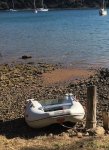
Not one of that brand although I did see quite a few of them in use in New Zealand. When I was in New Zealand and need of a new tender, my previous PVC one at the end of life due to hard usage and sunlight. After much research, I certainly didn't want another dinghy with glued seams. I bought one of these True Kit Navigator - Lightweight Catamaran Yacht Tender
Similar principle, sort of catamaran style hulls with the floor set a little higher that the bottom of the hull tubes, though perhaps not so extreme.
In NZ it wasn't as expensive as UK price.
Must say I have been very impressed so far - rows well and is very stable - I can indeed stand on one of the tubes and it doesn't capsize.
 

Attachments

  • true kit dinghy.jpeg
    true kit dinghy.jpeg
    196.4 KB · Views: 46
I’ve worked with Aqua Marina in our watersports business. They’re arguably the world’s largest manufacturer of PVC inflatable watercraft by volume. Their products are good in terms of design, engineering and support. However, the PVC doesn’t seem that hard wearing. We get lots of pinholes that we’ve deduced must be from shards of mussel shell on the pontoons!

So, although I can get the tenders at cost/wholesale price, I’m not yet convinced to give one a go.

I checked the weights of their larger airdeck SIBs and they’re typically 20-30% lighter than Zodiac etc.
 
I'm sceptical of using any dinghy/tender in significant waves or high wind. Why would you need a tender under either condition - surely it would also be uncomfortable on a yacht sitting in winds so strong or waves so big that it is dangerous in a dinghy - move to somewhere with some shelter.

Once you get 2 people and an outboard into any tender they change from being flighty to ponderous.

No one wants to be in any sort of 'dinghy' in extreme conditions, but tenders are not all equal in terms of their ability to cope with marginal conditions. My point being that I doubted that the Aircat would score well on that particular front.

I'm a cautious type, but I've found myself out in a tender in marginal conditions often enough to know one can't always choose (e.g. if the wind has picked up or changed direction whilst one had gone ashore while at anchor but need to get back to the boat, or the tide is now against the wind and it has become choppy, or the water further out/round the bend/headland is rougher than that which one could see when setting off).

Broadly speaking there's a tension between initial stability and secondary stability. For example, my particular Canadian canoe (my rigid tender likewise) is flat bottomed has high initial stability, great for beginners and in flat water but useless in waves (who wants a boat to be perpendicular to the face of every wave/swell?) as well as hard work to paddle. By contrast my particular sea kayak is quite 'tippy', even in flat water, and would likely scare a beginner, but is well able to cope with serious waves and swell.

The Aquanaut looks to have a very wide flat bottom, and looks rather flat fore and aft, and so is likely to both follow the slope of waves/swell too closely, and be prone to getting flipped if/when the wind gets under a raised edge. It may not be, I've never used one so don't know, but I would want to check that out before I bought such a thing.

The photos I saw via the link all show remarkably flat water. It would be interesting to see a video of one making its way off a beach through breaking waves/swell, being motored through broken water, and/or tethered off the stern of a yacht when a strong gust comes through.
 
No one wants to be in any sort of 'dinghy' in extreme conditions, but tenders are not all equal in terms of their ability to cope with marginal conditions. My point being that I doubted that the Aircat would score well on that particular front.

I'm a cautious type, but I've found myself out in a tender in marginal conditions often enough to know one can't always choose (e.g. if the wind has picked up or changed direction whilst one had gone ashore while at anchor but need to get back to the boat, or the tide is now against the wind and it has become choppy, or the water further out/round the bend/headland is rougher than that which one could see when setting off).

Broadly speaking there's a tension between initial stability and secondary stability. For example, my particular Canadian canoe (my rigid tender likewise) is flat bottomed has high initial stability, great for beginners and in flat water but useless in waves (who wants a boat to be perpendicular to the face of every wave/swell?) as well as hard work to paddle. By contrast my particular sea kayak is quite 'tippy', even in flat water, and would likely scare a beginner, but is well able to cope with serious waves and swell.

The Aquanaut looks to have a very wide flat bottom, and looks rather flat fore and aft, and so is likely to both follow the slope of waves/swell too closely, and be prone to getting flipped if/when the wind gets under a raised edge. It may not be, I've never used one so don't know, but I would want to check that out before I bought such a thing.

The photos I saw via the link all show remarkably flat water. It would be interesting to see a video of one making its way off a beach through breaking waves/swell, being motored through broken water, and/or tethered off the stern of a yacht when a strong gust comes through.

I totally agree - and thank you for taking the trouble to explain

Jonathan
 
Top
