Advice With Electrics

OceanSprint

Well-Known Member
Joined
23 Oct 2012
Messages
557
Visit site
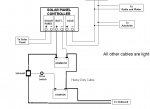
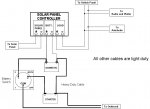
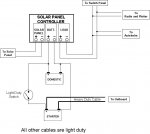
I have attached 2 circuit diagrams - as they are now, and how I plan to change them.

Now: It is almost two separate circuits. The solar panel charges the domestic battery, which drives everything on the boat. The starter battery is connected direct to the outboard, and is charged by it when it is running. There is a link through a light cable and very light duty switch. Hence when this switch is closed the starter battery could act as a backup to the domestic battery, but the domestic could not help the starter battery start the engine as the cable link is too light - with a risk of a fire?

Future: I think my proposed set up will work. With the new battery switch set to "2" it is the same set up as now - with two separate circuits - the starter battery starts the outboard, and is charged by it. The solar panel in this setting still charges the domestic, which is still connected to the switch panel etc. Everything connected to the domestic battery has it's own local switch. But now with the battery switch on "1", the domestic can start the outboard, and when set to "both" the batteries are in parallel.

Can anyone see a snag with my proposed new set up?

Thanks

Bill
 

Attachments

  • Electircs - FUTURE.jpg
    Electircs - FUTURE.jpg
    49.6 KB · Views: 0
  • Electircs - NOW.jpg
    Electircs - NOW.jpg
    46.9 KB · Views: 0
I have attached 2 circuit diagrams - as they are now, and how I plan to change them.

..

Can anyone see a snag with my proposed new set up?

Thanks

Bill
Nothing stands out as being wrong.
Personally I would have used two separate on/off switches rather that the 1,2, both, off one.

I take it that running all your domestic circuits from the "load" terminals does what you want. The load terminals do different things depending on the controller but you have not said what the controller is.
I think I would have run everything from the battery and ignored the load terminals but it depends what they do exactly.


You don't say what the outboard is... Generally the power output is pretty poor unless you are running at highish revs and for longish periods It should be Ok for recharging after starting the engine provided its run for long enough.

Ensure all your "light duty" cables are in fact heavy enough to avoid volts drop. The VHF needs a good supply as does the Autohelm. Any filament bulbs in nav lights must get a good supply if they are to output at their intended intensity. You should take current and total wire length into account when determining the cable sizes.

I take it you are making provision to start the outboard from the domestic battery because you cannot start it manually if the starter battery is flat
 
The outboard is a Yamaha 9.9.

I will see what the controller is when I visit.

The cable up the mast is a normal domestic three core cable with earth as negative, neutral as power to tri light and live as power to all round white. Is this cable not up to it?
 
The outboard is a Yamaha 9.9.

I will see what the controller is when I visit.

The cable up the mast is a normal domestic three core cable with earth as negative, neutral as power to tri light and live as power to all round white. Is this cable not up to it?

"normal domestic three core cable" .... comes in several sizes from 0.5mm² ( 3 amp ) to 1.25mm² (13 amp)


If you have the usual 25 watt filament bulb in the tricolour it will draw marginally over 2 amps

Suppose the cable length from the switch panel to the lamp is 10m .....That's 20m "there and back"

1.25mm² cable has a resistance of approx 13.5 ohms/1000 m

So 20 m has a resistance of 0.27 ohms

A current of 2 amps in a resistance of 0.27 ohms will result in a volts drop of 0.54 volts

The usually accepted max volts drop is 3%, or 0.36 volts for a 12 volt circuit.

The volts drop if the cable is 13 amp 3 core flex is therefore a little more than the normal accepted max .

To reduce the volts drop to 0.36 volts you would need 2.0mm² or AWG 14 cable


If your switch panel to lamp distance is significantly different to the 10m I have taken you will have to rework the calculations for the actual length
 
All the previous advice is sound, however I did not see where you specified the cable size that you intend to use between the 1-2 both- off switch and the batteries. I would recomend that they be at least 25mm cable.
 
......I think I would have run everything from the battery and ignored the load terminals but it depends what they do exactly.
I agree Don't use the load terminals for anything, they probably won't be able to carry the current for all your electrical needs. This load output always causes a lot of confusion. Its only use is to power a fridge when used with the Low Voltage Disconnect feature, or maybe to automatically turn your anchor light on and off - if the controller has that feature.
 
Thanks for all advice.

I was going to use the load terminal as that is how it is rigged up now by previous owner. The controller is EPHC model. But will heed warnings here.

Re- the 25mm cable - so for dumb question- but is that measurement with or without insulation?
 
ITYWF that 25 is the cross sectional area of the conductor in square millimetres.

Yes I am sure sutton sailor meant 25mm² which is close to AWG 3 The highest load will be starting the 9.9hp outbord. The owners manual should specify a cable size for the battery to engine connection. I'd have thought 25mm² excessive for an outboard engine indtallation

Regarding using the solar panel controller load terminals .. the max load is either 5 amps or 10 amps depending upon which EPHC controller it is.

The VHF alone may come close to this when transmitting. I'd feel inclined to power the VHF and the Autohelm direct from the battery
 
How did you get your superscript 2? I looked around unsuccessfully...

There are two ways ......

the new forum has the facility if you "go advanced" to do subscripts as in H2O and superscripts as in mm2
Combined you can do fractions 7/8 ... I somtimes also reduce the font size eg H2O and 7/8

A limited number of superscripts can be copied from the "character map" . I have notes of the code necessary for things I comonly use

Alt +
0176 gives ° for degrees
0188 ...... ¼
0189 ....... ½
0190 ....... ¾
0177 ....... ±
0178 ....... ²
0179 ....... ³
0181 ....... µ
0183 ....... · a true decimal point as in 2·5
 
Last edited:
There are two ways ......

the new forum has the facility if you "go advanced" to do subscripts as in H2O and superscripts as in mm2
Combined you can do fractions 7/8 ... I somtimes also reduce the font size eg H2O and 7/8

A limited number of superscripts can be copied from the "character map" . I have notes of the code necessary for things I comonly use

Alt +
0176 gives ° for degrees
0188 ...... ¼
0189 ....... ½
0190 ....... ¾
0177 ....... ±
0178 ....... ²
0179 ....... ³
0181 ....... µ
0183 ....... · a true decimal point as in 2·5

The only other symbol of note when posting about electrics is:

Ohms - Ω

another useful one for our European threads is ALT+ 0128 which gives the Euro (dollar) sign - €

Have fun - ♪ ♫ ♪ ♫


.
 
. . . . . Can anyone see a snag with my proposed new set up?

Nothing wrong with your future set up but the following might be worth thinking about.

Instead of purchasing an expensive ONE-TWO-BOTH switch which will have to be wired into your boat outside the battery box with wires to and from, consider the following very similar circuits which I have installed on my yacht.

m5d4ucekCmX1c8blcjK4Y2g.jpg


It comprises a stater solenoid (old Mini/Cortina type) fitted in battery compartment and two light switching wires only to a "Press to make / release Off" switch near the engine key start. To start the engine, press and hold down the switch and at the same time, start the engine. The press switch energises the solenoid thereby combining the domestic and engine batteries for the start procedure.

One the engine starts, release the press switch for normal running.

It has the advantage of not having to install a large bulky control switch on a boat panelling outside the engine room battery compartment plus battery cable to this switch . This will also save on the cost of H/D cable between the batteries and switch and cable routing.

All the components are out of sight, plus the original lightweight switch hole can be used for the "Press to make" switch.

There is no chance of forgetting to switch the ONE-TWO-BOTH back to normal running and thereby flattening both batteries.

Switch Final.jpg

This might be a more elegant method as well as saving some money?

Solenoid is far cheaper than the ONE-TWO-BOTH switch


.
 
You missed 2.5mm² 3 core flex cable. I used it for my tri-light renewal. The cable I removed was 25 years old and was this.

"normal domestic three core cable" .... comes in several sizes from 0.5mm² ( 3 amp ) to 1.25mm² (13 amp)


If you have the usual 25 watt filament bulb in the tricolour it will draw marginally over 2 amps

Suppose the cable length from the switch panel to the lamp is 10m .....That's 20m "there and back"

1.25mm² cable has a resistance of approx 13.5 ohms/1000 m

So 20 m has a resistance of 0.27 ohms

A current of 2 amps in a resistance of 0.27 ohms will result in a volts drop of 0.54 volts

The usually accepted max volts drop is 3%, or 0.36 volts for a 12 volt circuit.

The volts drop if the cable is 13 amp 3 core flex is therefore a little more than the normal accepted max .

To reduce the volts drop to 0.36 volts you would need 2.0mm² or AWG 14 cable


If your switch panel to lamp distance is significantly different to the 10m I have taken you will have to rework the calculations for the actual length
 
Without knowing the OP's usage or the size of his solar panel I would be looking at getting rid of the extra circuitry and one battery. An outboard and one (smallish?) solar panel barely provide enough power to keep one battery properly charged yet alone two. Keep it simple.
 
Top